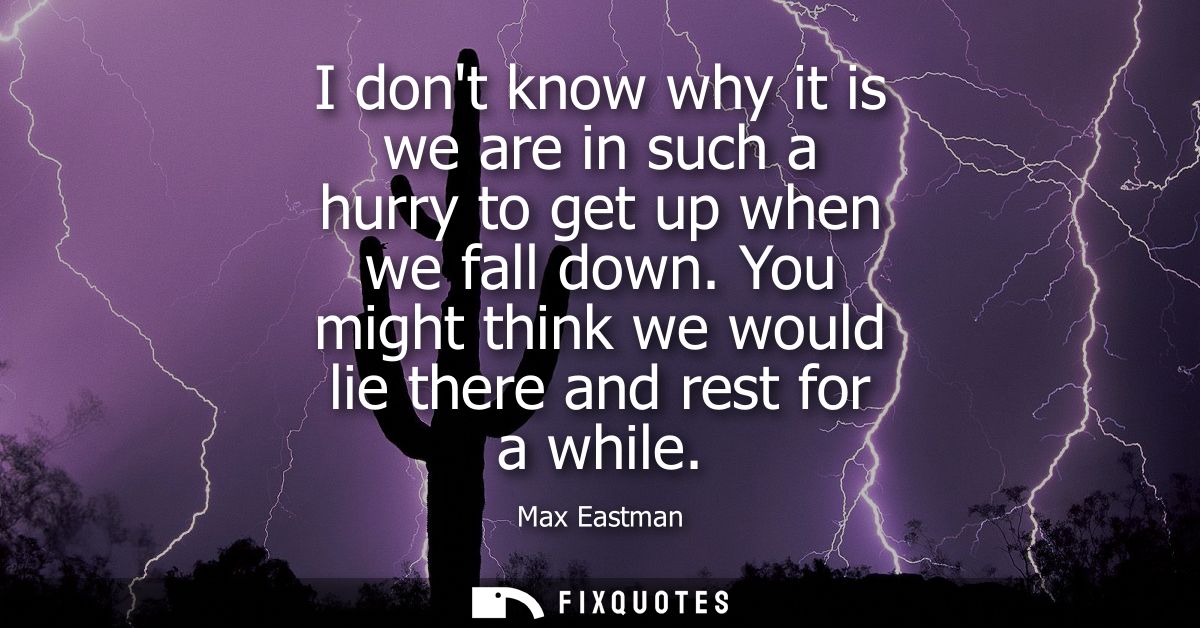
"I don't know why it is we are in such a hurry to get up when we fall down. You might think we would lie there and rest for a while"
About this Quote
The subtext is psychological and political. “Get up” is the moral command baked into capitalist modernity: productivity equals virtue, pause equals failure, visible struggle must be converted into a motivational anecdote before anyone gets uncomfortable. Eastman flips the script by offering an un-American permission: lying there. Not forever, not as defeat, but as recuperation and reflection - a refusal to turn every bruise into content. It’s a jab at the Protestant-adjacent idea that suffering must be redeemed through labor, as if rest were a suspicious luxury rather than a human need.
Context matters: Eastman moved through early 20th-century radical circles, watching industrial tempo, ideology, and self-help grit harden into a national personality. Read against that backdrop, the quote isn’t mere whimsy; it’s a critique of the way society polices weakness. “Lie there and rest” becomes quietly insurgent, suggesting that recovery is not laziness but strategy, and that dignity might include the right to be broken without immediately performing strength.
Quote Details
| Topic | Learning from Mistakes |
|---|---|
| Source | Help us find the source |
| Cite |
Citation Formats
APA Style (7th ed.)
Eastman, Max. (2026, January 16). I don't know why it is we are in such a hurry to get up when we fall down. You might think we would lie there and rest for a while. FixQuotes. https://fixquotes.com/quotes/i-dont-know-why-it-is-we-are-in-such-a-hurry-to-82554/
Chicago Style
Eastman, Max. "I don't know why it is we are in such a hurry to get up when we fall down. You might think we would lie there and rest for a while." FixQuotes. January 16, 2026. https://fixquotes.com/quotes/i-dont-know-why-it-is-we-are-in-such-a-hurry-to-82554/.
MLA Style (9th ed.)
"I don't know why it is we are in such a hurry to get up when we fall down. You might think we would lie there and rest for a while." FixQuotes, 16 Jan. 2026, https://fixquotes.com/quotes/i-dont-know-why-it-is-we-are-in-such-a-hurry-to-82554/. Accessed 2 Apr. 2026.