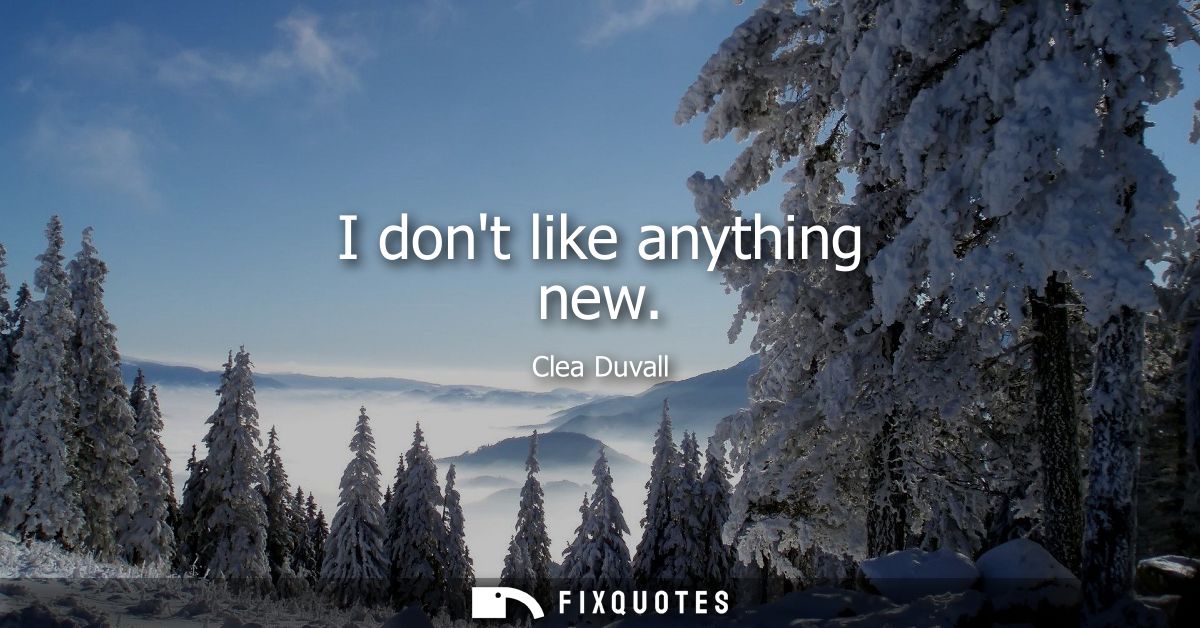
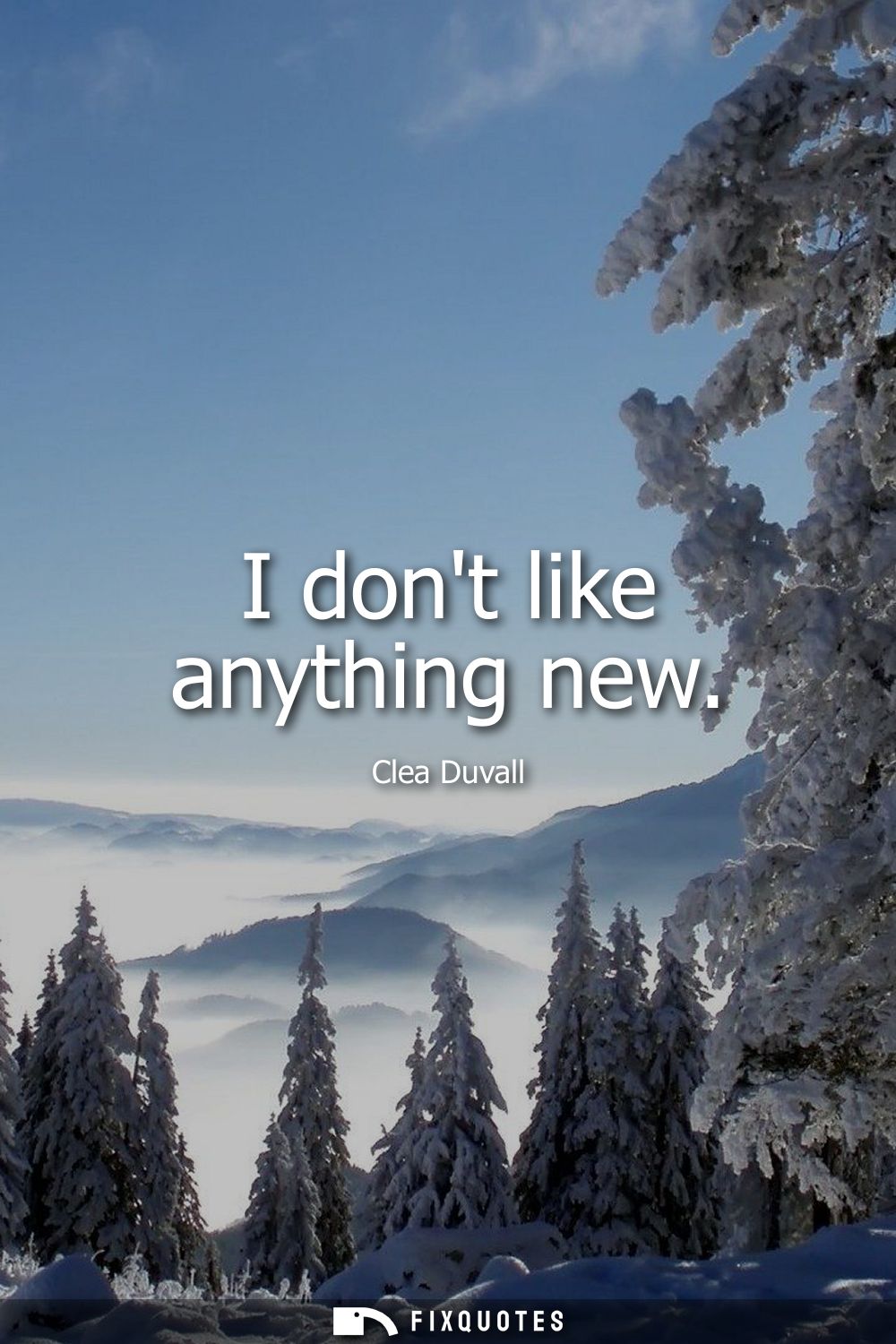
"I don't like anything new"
About this Quote
A flat little sentence like "I don't like anything new" lands as both confession and performance, the kind of deadpan honesty Clea DuVall has made a career out of. Coming from an actress associated with sharp-edged indies and sly ensemble work, it reads less like a blanket policy than a comedic defense mechanism: preemptively lowering expectations, announcing skepticism before the world can disappoint you. The bluntness is the joke. It undercuts the cultural demand to be perpetually curious, perpetually updated, perpetually impressed.
The intent feels two-pronged. On the surface, it signals taste: a preference for the familiar, for tried-and-true rhythms. Underneath, it’s a statement about control. Newness requires vulnerability. You have to risk liking something, misunderstanding it, missing out, being late. Saying you dislike anything new is a way to opt out of that anxiety with a shrug that sounds like principle.
The subtext also pokes at the branding of "new" as inherently good. In entertainment culture, novelty is marketed as virtue and personality: new show, new era, new face. DuVall’s line flips that script by treating novelty as suspicious, even exhausting. It’s an actor’s line, too: someone whose job depends on reinvention admitting a craving for stability. That tension is what gives it bite.
Context matters: if delivered in an interview or on a panel, it plays like a dry punchline about aging in public, about nostalgia, about the comfort of rewatching what already proved itself. It’s less anti-progress than anti-hype, a small rebellion against the algorithmic treadmill.
The intent feels two-pronged. On the surface, it signals taste: a preference for the familiar, for tried-and-true rhythms. Underneath, it’s a statement about control. Newness requires vulnerability. You have to risk liking something, misunderstanding it, missing out, being late. Saying you dislike anything new is a way to opt out of that anxiety with a shrug that sounds like principle.
The subtext also pokes at the branding of "new" as inherently good. In entertainment culture, novelty is marketed as virtue and personality: new show, new era, new face. DuVall’s line flips that script by treating novelty as suspicious, even exhausting. It’s an actor’s line, too: someone whose job depends on reinvention admitting a craving for stability. That tension is what gives it bite.
Context matters: if delivered in an interview or on a panel, it plays like a dry punchline about aging in public, about nostalgia, about the comfort of rewatching what already proved itself. It’s less anti-progress than anti-hype, a small rebellion against the algorithmic treadmill.
Quote Details
| Topic | Change |
|---|---|
| Source | Help us find the source |
| Cite |
Citation Formats
APA Style (7th ed.)
Duvall, Clea. (2026, January 17). I don't like anything new. FixQuotes. https://fixquotes.com/quotes/i-dont-like-anything-new-45052/
Chicago Style
Duvall, Clea. "I don't like anything new." FixQuotes. January 17, 2026. https://fixquotes.com/quotes/i-dont-like-anything-new-45052/.
MLA Style (9th ed.)
"I don't like anything new." FixQuotes, 17 Jan. 2026, https://fixquotes.com/quotes/i-dont-like-anything-new-45052/. Accessed 28 Mar. 2026.
More Quotes by Clea
Add to List