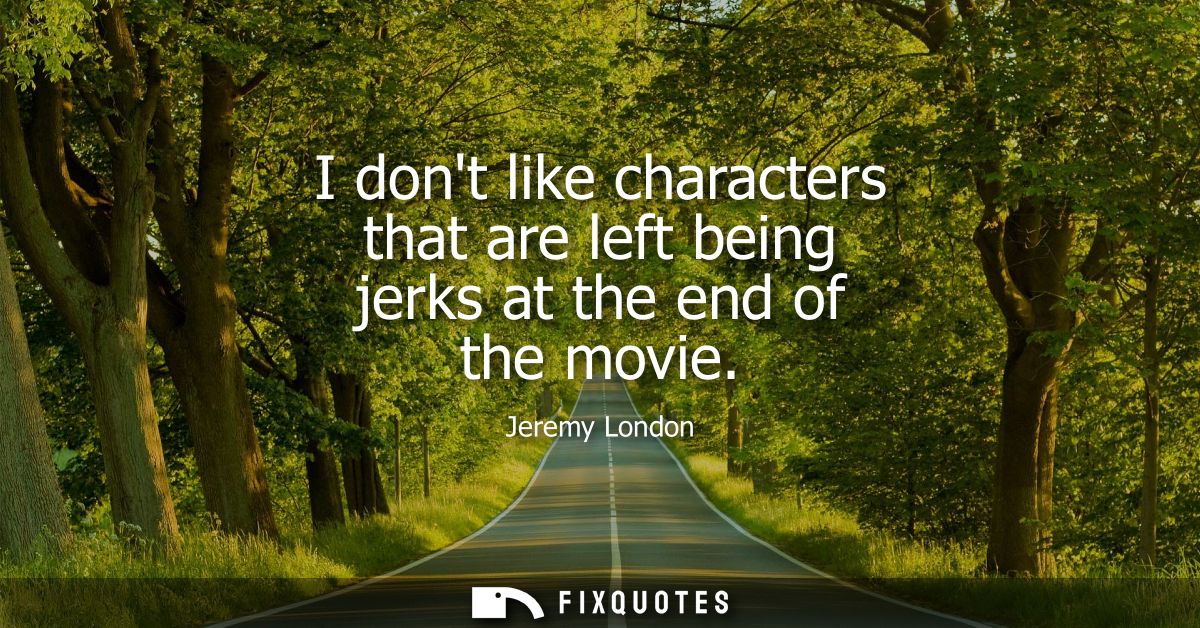
"I don't like characters that are left being jerks at the end of the movie"
About this Quote
The specific intent is practical and actorly. Performers live inside motivations; they need arcs that justify the time, the screen space, the emotional investment. A character who remains a jerk at the end can feel like a writer’s shortcut, the kind of “realism” that flatters itself while ducking consequence. London’s line subtly separates two things often conflated: ambiguity versus abdication. You can end unresolved without ending unchanged.
The subtext is also about dignity, both for the character and the audience. “Left being” implies abandonment: the film simply drops the person where it found them, asking viewers to mistake stasis for honesty. London’s preference hints at a more classical contract - transformation, accountability, or at least a clear-eyed cost.
Context matters: actors from mainstream film and TV ecosystems are trained on closure, on the emotional math of satisfaction. This isn’t a demand for tidy morality plays so much as a resistance to cynicism marketed as sophistication.
Quote Details
| Topic | Movie |
|---|---|
| Source | Help us find the source |
| Cite |
Citation Formats
APA Style (7th ed.)
London, Jeremy. (2026, January 15). I don't like characters that are left being jerks at the end of the movie. FixQuotes. https://fixquotes.com/quotes/i-dont-like-characters-that-are-left-being-jerks-142908/
Chicago Style
London, Jeremy. "I don't like characters that are left being jerks at the end of the movie." FixQuotes. January 15, 2026. https://fixquotes.com/quotes/i-dont-like-characters-that-are-left-being-jerks-142908/.
MLA Style (9th ed.)
"I don't like characters that are left being jerks at the end of the movie." FixQuotes, 15 Jan. 2026, https://fixquotes.com/quotes/i-dont-like-characters-that-are-left-being-jerks-142908/. Accessed 24 Mar. 2026.