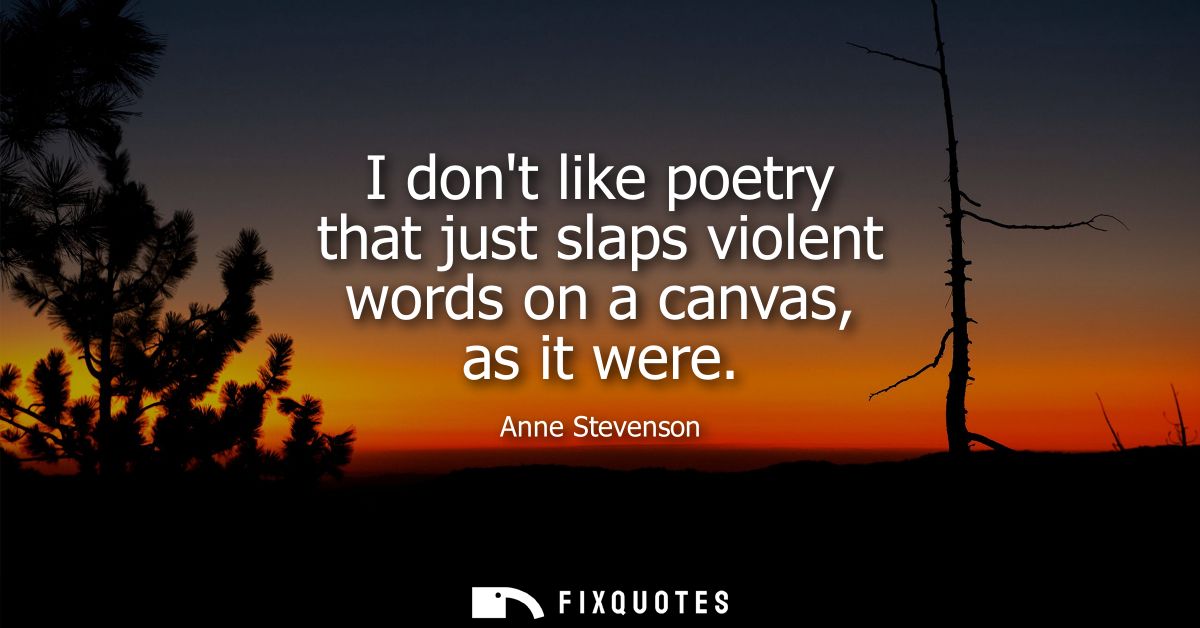
"I don't like poetry that just slaps violent words on a canvas, as it were"
About this Quote
The intent is aesthetic but also ethical. Stevenson is defending craft against the contemporary premium on shock. “Violent words” become a kind of shortcut, a ready-made voltage. Her phrasing implies that some poets reach for brutality the way an underbaked painter reaches for thick red paint: to force immediacy, to signal depth without earning it through structure, image, or thought. The subtext is a warning about spectacle. Violence, handled carelessly, flattens experience into a posture - it performs transgression rather than interrogating it.
Context matters because Stevenson worked in a postwar, post-confessional literary ecosystem where extremity could read as authenticity. Her own sensibility - lucid, formally alert, suspicious of cant - pushes back against the idea that rawness equals truth. The quote argues for poems that metabolize violence rather than merely displaying it: language that doesn’t decorate the page with brutality, but shows how brutality actually lives in minds, bodies, histories, and moral choices.
Quote Details
| Topic | Poetry |
|---|---|
| Source | Help us find the source |
| Cite |
Citation Formats
APA Style (7th ed.)
Stevenson, Anne. (2026, January 16). I don't like poetry that just slaps violent words on a canvas, as it were. FixQuotes. https://fixquotes.com/quotes/i-dont-like-poetry-that-just-slaps-violent-words-122760/
Chicago Style
Stevenson, Anne. "I don't like poetry that just slaps violent words on a canvas, as it were." FixQuotes. January 16, 2026. https://fixquotes.com/quotes/i-dont-like-poetry-that-just-slaps-violent-words-122760/.
MLA Style (9th ed.)
"I don't like poetry that just slaps violent words on a canvas, as it were." FixQuotes, 16 Jan. 2026, https://fixquotes.com/quotes/i-dont-like-poetry-that-just-slaps-violent-words-122760/. Accessed 4 Apr. 2026.