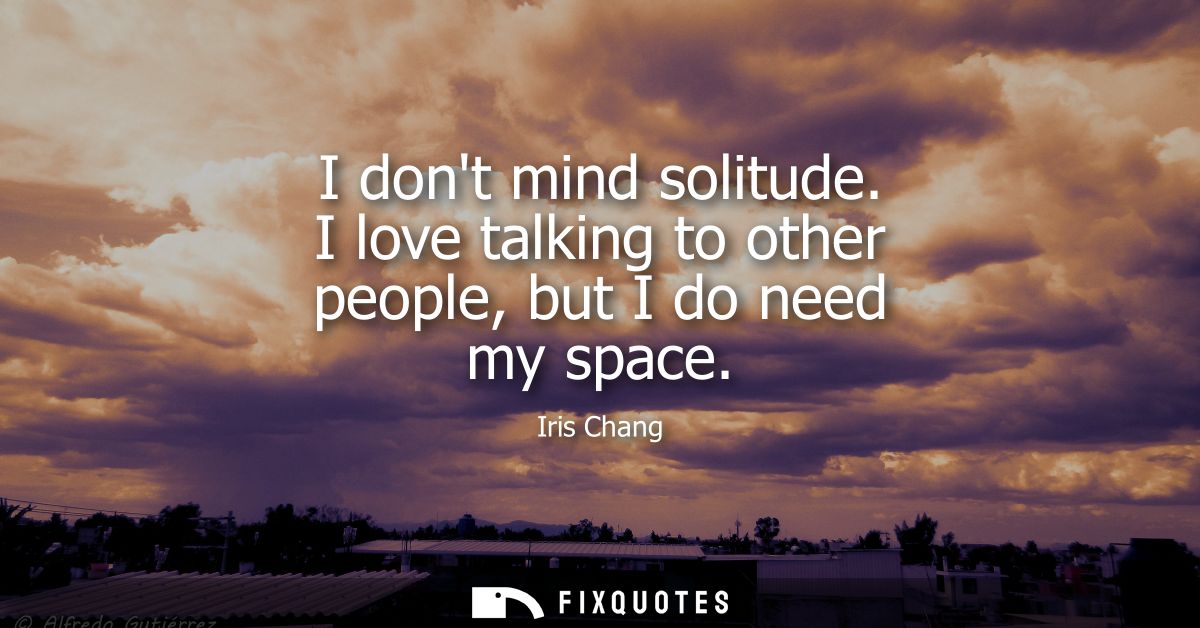
"I don't mind solitude. I love talking to other people, but I do need my space"
About this Quote
Coming from a historian, the line carries extra charge. Chang’s work demanded prolonged immersion in human catastrophe and contested memory; her most famous projects required her to sit with testimonies and archives that don’t politely let go at 5 p.m. In that context, "space" reads as psychic hygiene, a way to metabolize other people’s pain without being swallowed by it. The subtext is that empathy has a cost, and the mind needs a perimeter.
The phrasing is also culturally legible: a pushback against the expectation that public-facing women, especially women of color in intellectual life, should be perpetually available, agreeable, and "on". Chang’s clarity resists that performance. It’s a small statement with a big implied refusal: you can have my warmth and my attention, but not my entire interior life. Solitude becomes not loneliness, but authorship.
Quote Details
| Topic | Self-Care |
|---|---|
| Source | Help us find the source |
| Cite |
Citation Formats
APA Style (7th ed.)
Chang, Iris. (2026, January 17). I don't mind solitude. I love talking to other people, but I do need my space. FixQuotes. https://fixquotes.com/quotes/i-dont-mind-solitude-i-love-talking-to-other-55075/
Chicago Style
Chang, Iris. "I don't mind solitude. I love talking to other people, but I do need my space." FixQuotes. January 17, 2026. https://fixquotes.com/quotes/i-dont-mind-solitude-i-love-talking-to-other-55075/.
MLA Style (9th ed.)
"I don't mind solitude. I love talking to other people, but I do need my space." FixQuotes, 17 Jan. 2026, https://fixquotes.com/quotes/i-dont-mind-solitude-i-love-talking-to-other-55075/. Accessed 13 Feb. 2026.