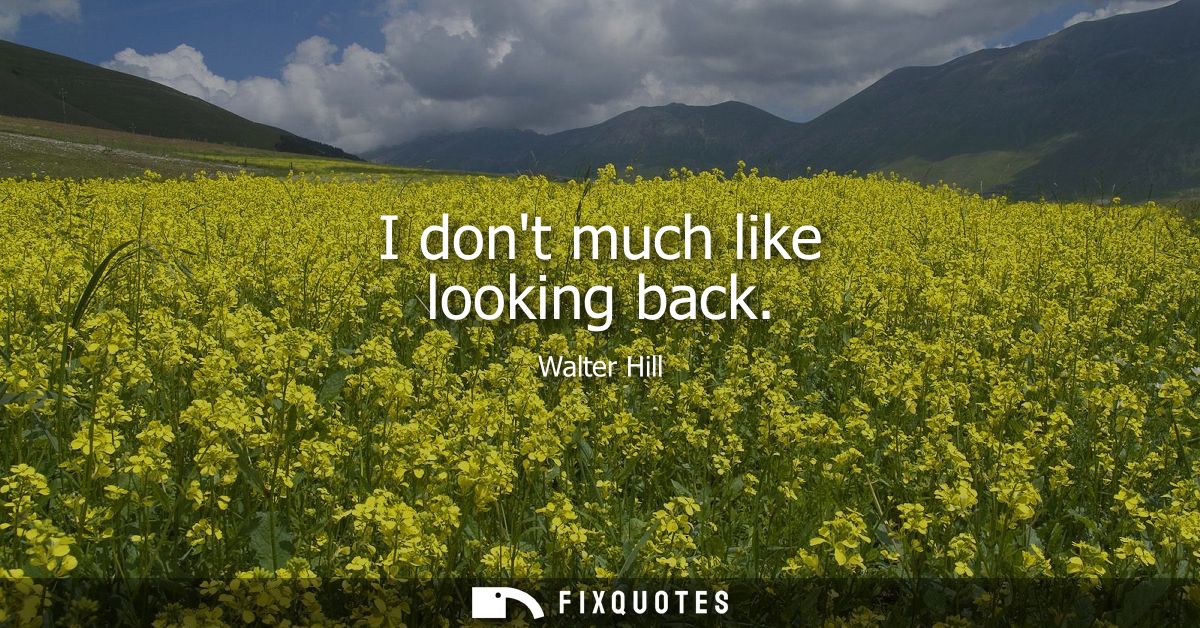
"I don't much like looking back"
About this Quote
"I don't much like looking back" is the kind of plainspoken line that sounds like personal preference until you hear the defensive steel in it. Coming from Walter Hill, a director whose films move like machines and talk like knife fights, the sentence reads as an aesthetic manifesto disguised as temperament. Hill is a forward-motion filmmaker: chase narratives, hard edits, characters who live by momentum because stopping means getting caught, getting soft, getting sentimental.
The intent is practical. Looking back invites revision, self-mythology, regret. For a working director in Hollywood, nostalgia can be a trap: it tempts you to re-litigate old battles (the cut you lost, the studio note you swallowed) or to turn your own filmography into a museum of Greatest Hits. Hill’s refusal is a way of keeping the work alive, not embalmed.
The subtext is control. "Don't much like" understates what’s really being asserted: don’t ask me to explain myself, don’t make me perform gratitude, don’t turn my past into a confession booth. It’s also a protective move for an artist associated with a certain strain of American masculinity. Looking back can read as vulnerability; Hill’s brand is competence, not self-exposure.
Context matters, too. Hill comes out of an era where directors were craftsmen as much as auteurs, where career survival meant the next job, not the retrospective. In a culture currently addicted to reboots, anniversaries, and director’s-cut archaeology, his line feels almost contrarian: a curt refusal to let the past become content.
The intent is practical. Looking back invites revision, self-mythology, regret. For a working director in Hollywood, nostalgia can be a trap: it tempts you to re-litigate old battles (the cut you lost, the studio note you swallowed) or to turn your own filmography into a museum of Greatest Hits. Hill’s refusal is a way of keeping the work alive, not embalmed.
The subtext is control. "Don't much like" understates what’s really being asserted: don’t ask me to explain myself, don’t make me perform gratitude, don’t turn my past into a confession booth. It’s also a protective move for an artist associated with a certain strain of American masculinity. Looking back can read as vulnerability; Hill’s brand is competence, not self-exposure.
Context matters, too. Hill comes out of an era where directors were craftsmen as much as auteurs, where career survival meant the next job, not the retrospective. In a culture currently addicted to reboots, anniversaries, and director’s-cut archaeology, his line feels almost contrarian: a curt refusal to let the past become content.
Quote Details
| Topic | Letting Go |
|---|---|
| Source | Help us find the source |
| Cite |
Citation Formats
APA Style (7th ed.)
Hill, Walter. (2026, January 15). I don't much like looking back. FixQuotes. https://fixquotes.com/quotes/i-dont-much-like-looking-back-152806/
Chicago Style
Hill, Walter. "I don't much like looking back." FixQuotes. January 15, 2026. https://fixquotes.com/quotes/i-dont-much-like-looking-back-152806/.
MLA Style (9th ed.)
"I don't much like looking back." FixQuotes, 15 Jan. 2026, https://fixquotes.com/quotes/i-dont-much-like-looking-back-152806/. Accessed 27 Mar. 2026.
More Quotes by Walter
Add to List