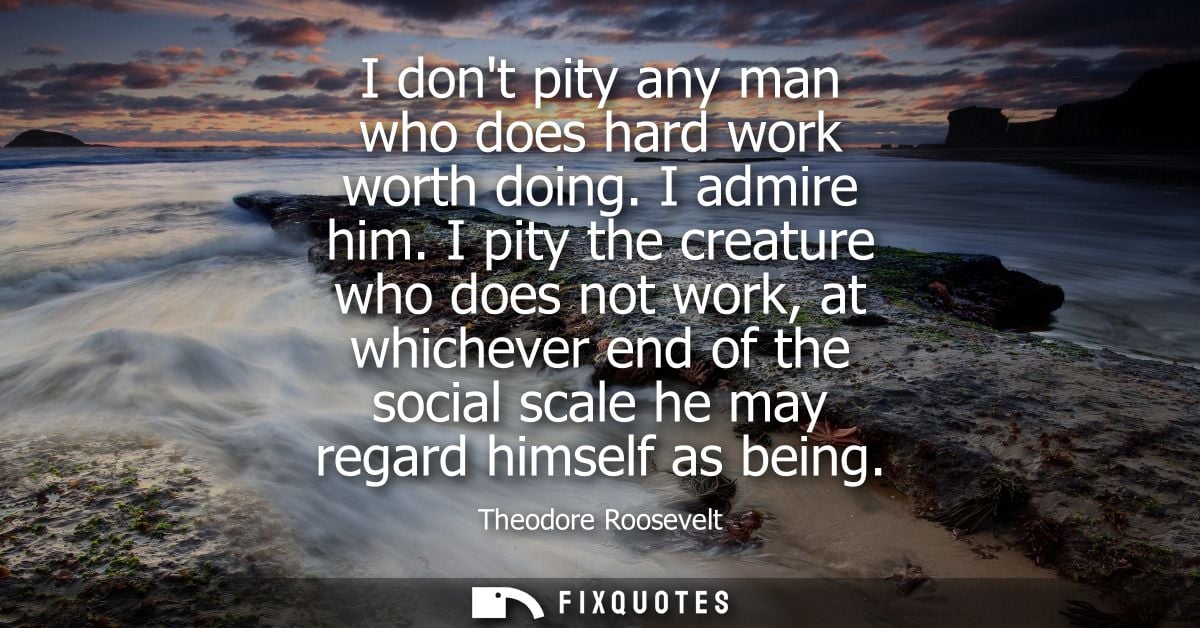
"I don't pity any man who does hard work worth doing. I admire him. I pity the creature who does not work, at whichever end of the social scale he may regard himself as being"
About this Quote
Then he snaps the frame wider. “The creature who does not work” isn’t just the idle rich stereotype; it’s anyone, “whichever end of the social scale,” who opts out of contribution while still claiming a place in the moral order. Calling that person a “creature” is deliberate dehumanization: a refusal to treat non-work as a quirky lifestyle choice. Roosevelt’s intent is disciplinary. He’s drawing a bright line between citizens and passengers.
The subtext is a Progressive Era bargain: capitalism gets to keep its engine, but it must be justified by strenuous citizenship. Roosevelt admired labor and courted working-class voters, yet he was also policing them. “Worth doing” isn’t neutral; it smuggles in a hierarchy of acceptable effort, defined by national productivity, public virtue, and often masculine toughness. The line flatters workers while also warning against dependency, leisure, and grievance.
Context matters: an industrializing America anxious about class conflict, immigration, urban poverty, and inherited wealth. Roosevelt offers a unifying moral metric - work - that scolds both the gilded loafer and the despairing unemployed, and quietly suggests that the real sin isn’t inequality. It’s uselessness.
Quote Details
| Topic | Work Ethic |
|---|---|
| Source | Help us find the source |
| Cite |
Citation Formats
APA Style (7th ed.)
Roosevelt, Theodore. (2026, January 17). I don't pity any man who does hard work worth doing. I admire him. I pity the creature who does not work, at whichever end of the social scale he may regard himself as being. FixQuotes. https://fixquotes.com/quotes/i-dont-pity-any-man-who-does-hard-work-worth-27958/
Chicago Style
Roosevelt, Theodore. "I don't pity any man who does hard work worth doing. I admire him. I pity the creature who does not work, at whichever end of the social scale he may regard himself as being." FixQuotes. January 17, 2026. https://fixquotes.com/quotes/i-dont-pity-any-man-who-does-hard-work-worth-27958/.
MLA Style (9th ed.)
"I don't pity any man who does hard work worth doing. I admire him. I pity the creature who does not work, at whichever end of the social scale he may regard himself as being." FixQuotes, 17 Jan. 2026, https://fixquotes.com/quotes/i-dont-pity-any-man-who-does-hard-work-worth-27958/. Accessed 28 Mar. 2026.