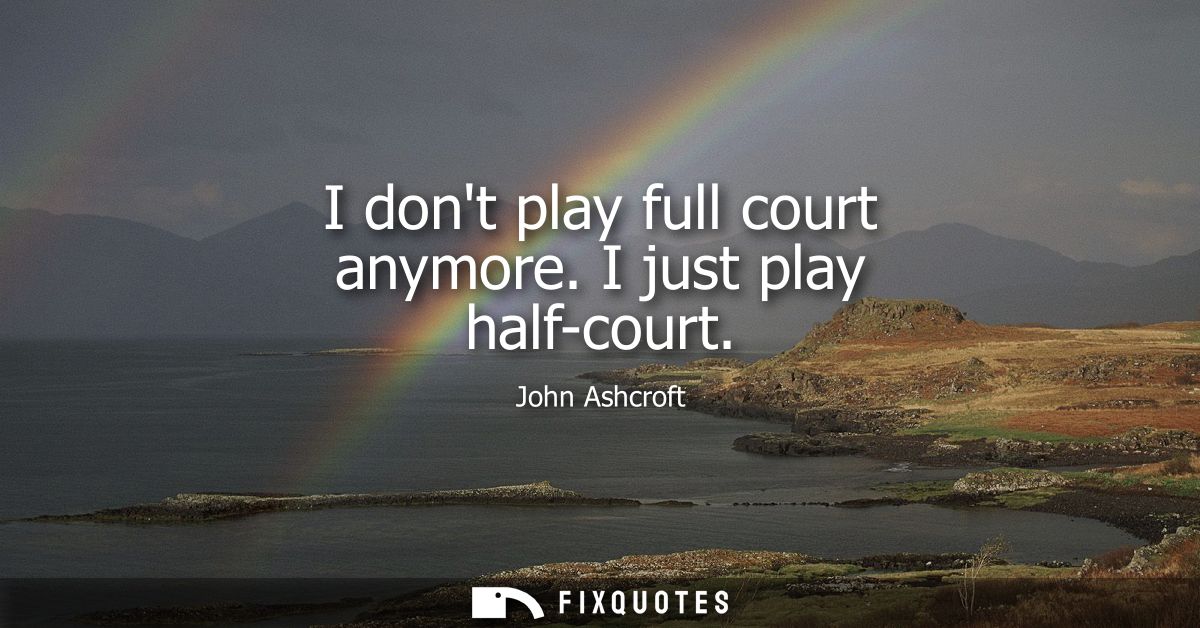
"I don't play full court anymore. I just play half-court"
About this Quote
There is something almost accidentally revealing in Ashcroft reaching for the language of pickup basketball: a game of youthful stamina repurposed as a metaphor for scaled-back ambition. “I don’t play full court anymore” isn’t just about aging or fitness. It’s an admission that the era of constant sprinting - the high-pressure, always-on version of public life - has ended, and he wants credit for knowing where his limits are.
The phrase “anymore” does a lot of work. It implies a prior identity built on endurance and total coverage: full-court means you defend everything, press everywhere, leave no space unpatrolled. Coming from a public servant best known for a post-9/11 posture of maximum vigilance, the subtext lands harder. Full-court is also a governing philosophy: expansive scope, aggressive reach, relentless energy. Half-court is containment. Fewer possessions, fewer risks, less exposure.
It’s a casual line with strategic humility. He doesn’t frame the change as decline; he frames it as wisdom, like a veteran who has learned efficiency. That matters culturally because public figures are rarely allowed to age in public without turning it into narrative. Ashcroft’s metaphor chooses a familiar, almost neighborly image - not a policy memo, not a sermon - to humanize the transition from power to afterlife: speeches, commentary, legacy management.
The intent reads as reassurance: I’m still in the game, just not chasing every play. The subtext: stepping back can be a choice, not a defeat.
The phrase “anymore” does a lot of work. It implies a prior identity built on endurance and total coverage: full-court means you defend everything, press everywhere, leave no space unpatrolled. Coming from a public servant best known for a post-9/11 posture of maximum vigilance, the subtext lands harder. Full-court is also a governing philosophy: expansive scope, aggressive reach, relentless energy. Half-court is containment. Fewer possessions, fewer risks, less exposure.
It’s a casual line with strategic humility. He doesn’t frame the change as decline; he frames it as wisdom, like a veteran who has learned efficiency. That matters culturally because public figures are rarely allowed to age in public without turning it into narrative. Ashcroft’s metaphor chooses a familiar, almost neighborly image - not a policy memo, not a sermon - to humanize the transition from power to afterlife: speeches, commentary, legacy management.
The intent reads as reassurance: I’m still in the game, just not chasing every play. The subtext: stepping back can be a choice, not a defeat.
Quote Details
| Topic | Aging |
|---|---|
| Source | Help us find the source |
| Cite |
Citation Formats
APA Style (7th ed.)
Ashcroft, John. (2026, January 16). I don't play full court anymore. I just play half-court. FixQuotes. https://fixquotes.com/quotes/i-dont-play-full-court-anymore-i-just-play-99467/
Chicago Style
Ashcroft, John. "I don't play full court anymore. I just play half-court." FixQuotes. January 16, 2026. https://fixquotes.com/quotes/i-dont-play-full-court-anymore-i-just-play-99467/.
MLA Style (9th ed.)
"I don't play full court anymore. I just play half-court." FixQuotes, 16 Jan. 2026, https://fixquotes.com/quotes/i-dont-play-full-court-anymore-i-just-play-99467/. Accessed 20 Mar. 2026.
More Quotes by John
Add to List