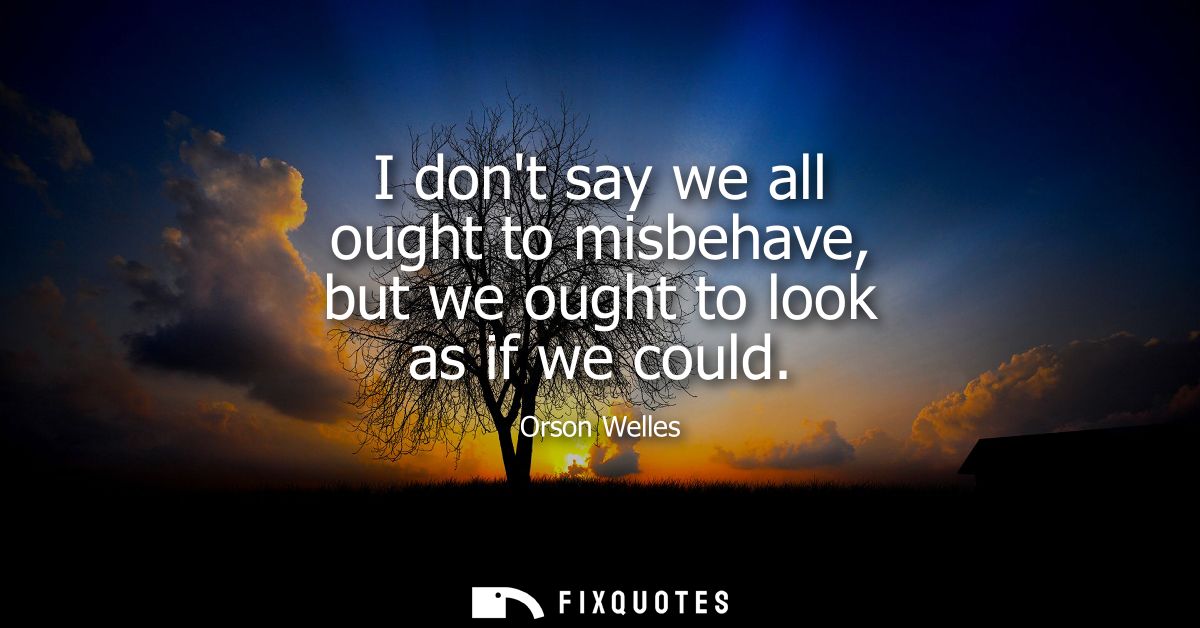
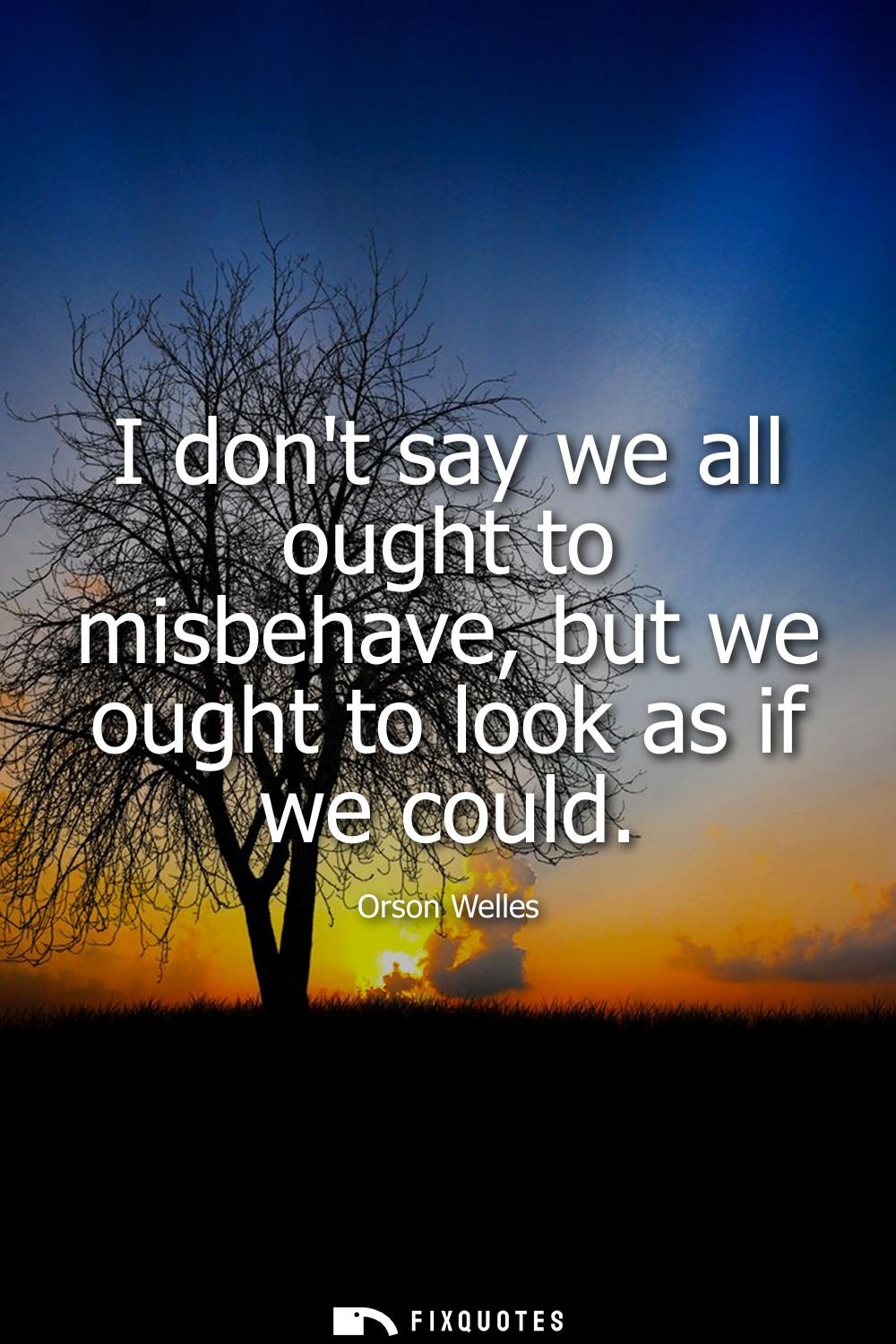
"I don't say we all ought to misbehave, but we ought to look as if we could"
About this Quote
For an actor-director who built a career on grand entrances, booming authority, and controlled chaos (from the Mercury Theatre's rule-breaking bravado to the War of the Worlds broadcast that proved how easily mass attention can be hijacked), the line reads like a credo. Respectability is a costume; keep it slightly unbuttoned. The subtext is that conformity is safest when it has a pressure valve: you can sit at the table, but you should radiate the ability to flip it.
It's also a canny social critique. "Looking capable of misbehavior" is how you resist being managed: by institutions, by polite society, by the deadening expectation that adults should be predictable. Welles isn't romanticizing delinquency; he's advocating for a visible margin of autonomy. The wink is that this is exactly what show business trades in: the carefully staged illusion of someone who might go off-script, even when every beat is rehearsed.
Quote Details
| Topic | Witty One-Liners |
|---|---|
| Source | Help us find the source |
| Cite |
Citation Formats
APA Style (7th ed.)
Welles, Orson. (2026, January 18). I don't say we all ought to misbehave, but we ought to look as if we could. FixQuotes. https://fixquotes.com/quotes/i-dont-say-we-all-ought-to-misbehave-but-we-ought-1155/
Chicago Style
Welles, Orson. "I don't say we all ought to misbehave, but we ought to look as if we could." FixQuotes. January 18, 2026. https://fixquotes.com/quotes/i-dont-say-we-all-ought-to-misbehave-but-we-ought-1155/.
MLA Style (9th ed.)
"I don't say we all ought to misbehave, but we ought to look as if we could." FixQuotes, 18 Jan. 2026, https://fixquotes.com/quotes/i-dont-say-we-all-ought-to-misbehave-but-we-ought-1155/. Accessed 22 Mar. 2026.