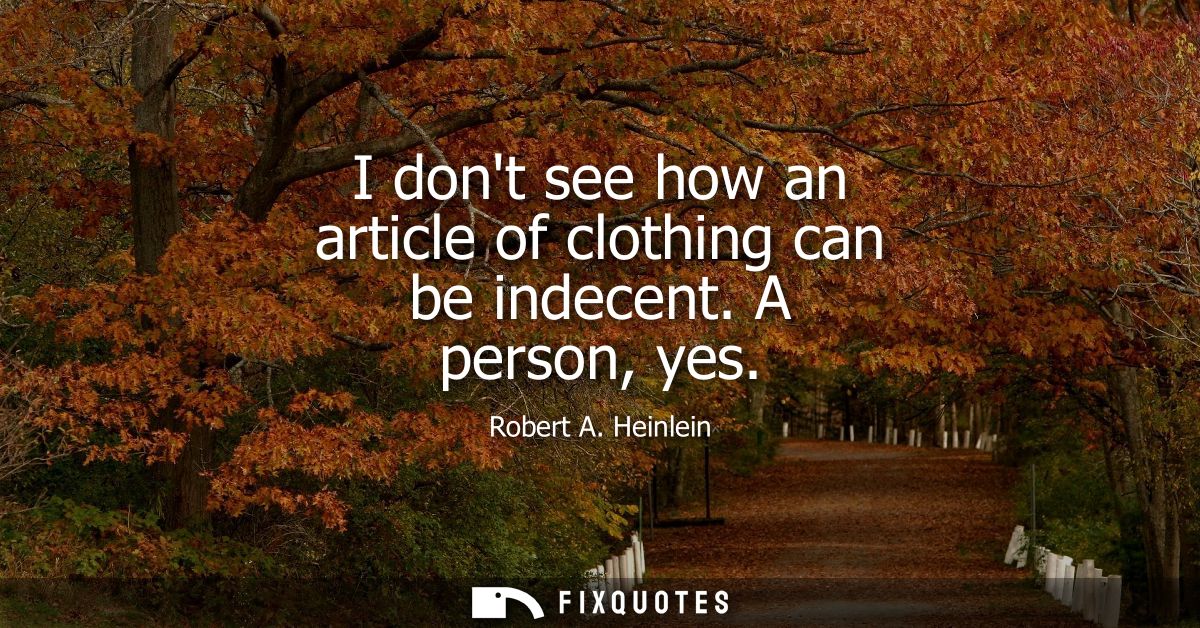
"I don't see how an article of clothing can be indecent. A person, yes"
About this Quote
Heinlein’s line slices through moral panic with a clean bit of sci-fi pragmatism: indecency isn’t stitched into fabric, it’s performed by people. The construction is a bait-and-switch. He starts with the obvious target of public scolding - “an article of clothing” - then snaps the blame back onto the human body and mind: “A person, yes.” That abrupt pivot is the punchline and the thesis. It’s also a dare. If you’re offended, he implies, interrogate the offender, not the hemline.
The specific intent is less about defending nudity than exposing how societies outsource responsibility to symbols. Clothes become a convenient scapegoat because they’re legible and controllable: you can ban a skirt length, police a neckline, write a dress code. You can’t as easily legislate intent, consent, or predatory behavior - the actual sources of “indecency.” Heinlein collapses that distinction on purpose, pushing readers to admit that what gets called “immodest” often functions as cultural shorthand for anxiety about sex, gender, and power.
Context matters: Heinlein wrote from a mid-century American landscape where obscenity law, censorship, and conformist respectability politics were active forces, and his own fiction repeatedly tested the borders of sexual norms and personal liberty. The subtext is libertarian and slightly contemptuous of busybody moralism: stop fetishizing objects, start holding humans accountable. It’s a tidy reversal that turns “protecting public decency” into what it often is - controlling bodies while pretending to regulate cloth.
The specific intent is less about defending nudity than exposing how societies outsource responsibility to symbols. Clothes become a convenient scapegoat because they’re legible and controllable: you can ban a skirt length, police a neckline, write a dress code. You can’t as easily legislate intent, consent, or predatory behavior - the actual sources of “indecency.” Heinlein collapses that distinction on purpose, pushing readers to admit that what gets called “immodest” often functions as cultural shorthand for anxiety about sex, gender, and power.
Context matters: Heinlein wrote from a mid-century American landscape where obscenity law, censorship, and conformist respectability politics were active forces, and his own fiction repeatedly tested the borders of sexual norms and personal liberty. The subtext is libertarian and slightly contemptuous of busybody moralism: stop fetishizing objects, start holding humans accountable. It’s a tidy reversal that turns “protecting public decency” into what it often is - controlling bodies while pretending to regulate cloth.
Quote Details
| Topic | Witty One-Liners |
|---|---|
| Source | Help us find the source |
| Cite |
Citation Formats
APA Style (7th ed.)
Heinlein, Robert A. (2026, January 18). I don't see how an article of clothing can be indecent. A person, yes. FixQuotes. https://fixquotes.com/quotes/i-dont-see-how-an-article-of-clothing-can-be-1463/
Chicago Style
Heinlein, Robert A. "I don't see how an article of clothing can be indecent. A person, yes." FixQuotes. January 18, 2026. https://fixquotes.com/quotes/i-dont-see-how-an-article-of-clothing-can-be-1463/.
MLA Style (9th ed.)
"I don't see how an article of clothing can be indecent. A person, yes." FixQuotes, 18 Jan. 2026, https://fixquotes.com/quotes/i-dont-see-how-an-article-of-clothing-can-be-1463/. Accessed 12 Feb. 2026.
More Quotes by Robert
Add to List