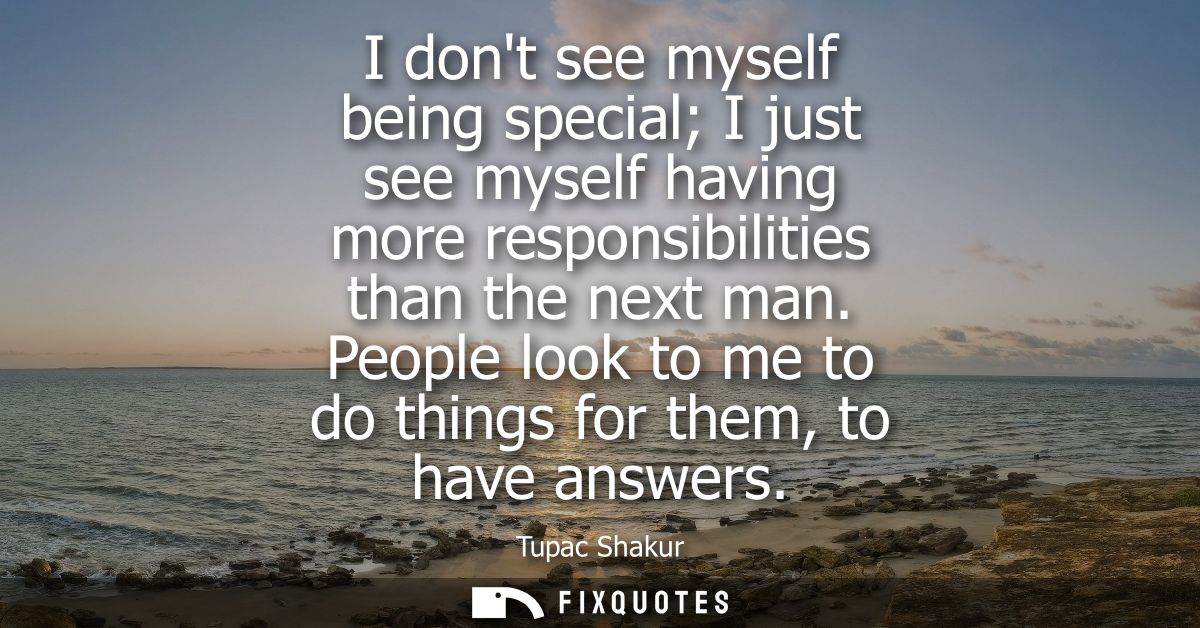
"I don't see myself being special; I just see myself having more responsibilities than the next man. People look to me to do things for them, to have answers"
About this Quote
The subtext is equal parts pride and warning. “People look to me” is recognition of influence, but it also reads like a weight on the chest: you become the person strangers want fixed answers from, even when your own life is chaotic, surveilled, and compressed by the demands of performance, press, and conflict. Tupac’s line quietly rejects the fantasy that icons are born knowing what to do. He’s describing a pipeline from trauma to charisma to public obligation, where authenticity becomes a public utility.
Context sharpens the edge. Mid-90s hip-hop was being treated as both cultural engine and social threat, with Tupac at the center of moral panics, label politics, and street mythology. In that climate, “having answers” isn’t about being right; it’s about being legible to everyone projecting onto you at once. He’s not crowning himself. He’s naming the trap: when you’re made into a symbol, your humanity becomes everyone else’s assignment.
Quote Details
| Topic | Leadership |
|---|---|
| Source | Help us find the source |
| Cite |
Citation Formats
APA Style (7th ed.)
Shakur, Tupac. (2026, January 15). I don't see myself being special; I just see myself having more responsibilities than the next man. People look to me to do things for them, to have answers. FixQuotes. https://fixquotes.com/quotes/i-dont-see-myself-being-special-i-just-see-myself-2158/
Chicago Style
Shakur, Tupac. "I don't see myself being special; I just see myself having more responsibilities than the next man. People look to me to do things for them, to have answers." FixQuotes. January 15, 2026. https://fixquotes.com/quotes/i-dont-see-myself-being-special-i-just-see-myself-2158/.
MLA Style (9th ed.)
"I don't see myself being special; I just see myself having more responsibilities than the next man. People look to me to do things for them, to have answers." FixQuotes, 15 Jan. 2026, https://fixquotes.com/quotes/i-dont-see-myself-being-special-i-just-see-myself-2158/. Accessed 6 Apr. 2026.