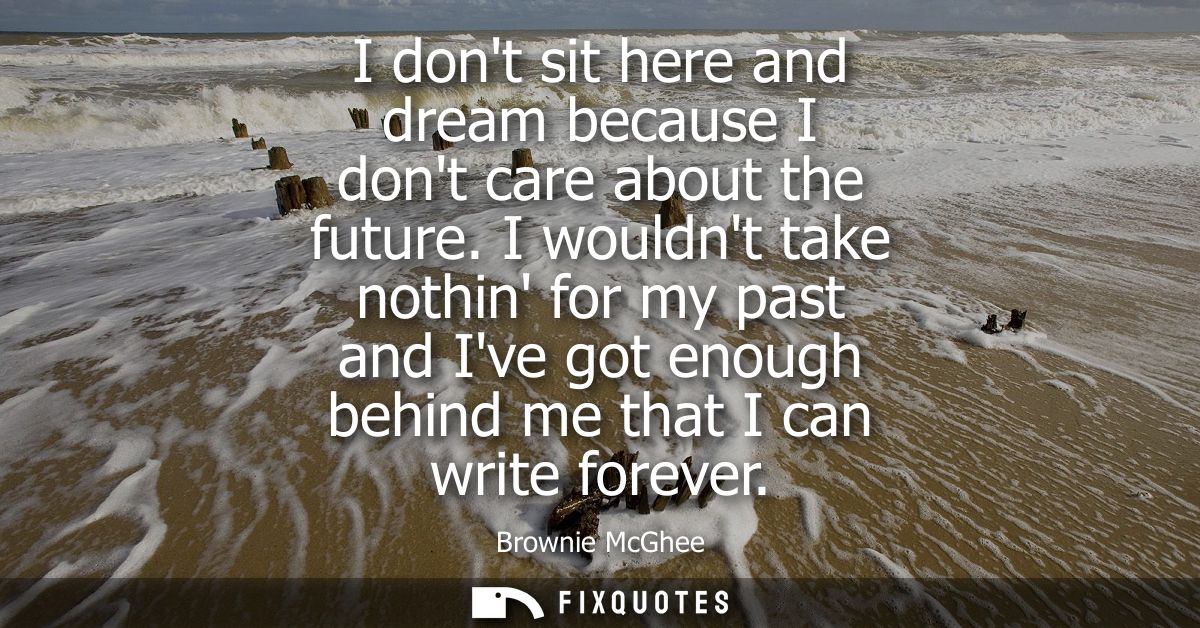
"I don't sit here and dream because I don't care about the future. I wouldn't take nothin' for my past and I've got enough behind me that I can write forever"
About this Quote
The second sentence does the real work. “I wouldn’t take nothin’ for my past” flips hardship into capital. He’s not romanticizing pain; he’s claiming authorship over it. The past becomes a catalog of scenes, scars, and characters - the raw material that blues turns into art. When he adds, “I’ve got enough behind me that I can write forever,” he’s telling you how the genre functions: not as escapism, but as transcription. The song doesn’t come from fantasy; it comes from memory, witness, and the discipline of having paid attention.
There’s also a quiet jab at the culture industry that pressures musicians to reinvent endlessly. McGhee insists his “behind” is sufficient - a bottomless archive that makes him independent of trends. It’s old-school confidence, but earned: the kind that says my life is my catalog, and I’m still cashing it in.
Quote Details
| Topic | Legacy & Remembrance |
|---|---|
| Source | Help us find the source |
| Cite |
Citation Formats
APA Style (7th ed.)
McGhee, Brownie. (2026, January 15). I don't sit here and dream because I don't care about the future. I wouldn't take nothin' for my past and I've got enough behind me that I can write forever. FixQuotes. https://fixquotes.com/quotes/i-dont-sit-here-and-dream-because-i-dont-care-150250/
Chicago Style
McGhee, Brownie. "I don't sit here and dream because I don't care about the future. I wouldn't take nothin' for my past and I've got enough behind me that I can write forever." FixQuotes. January 15, 2026. https://fixquotes.com/quotes/i-dont-sit-here-and-dream-because-i-dont-care-150250/.
MLA Style (9th ed.)
"I don't sit here and dream because I don't care about the future. I wouldn't take nothin' for my past and I've got enough behind me that I can write forever." FixQuotes, 15 Jan. 2026, https://fixquotes.com/quotes/i-dont-sit-here-and-dream-because-i-dont-care-150250/. Accessed 31 Mar. 2026.