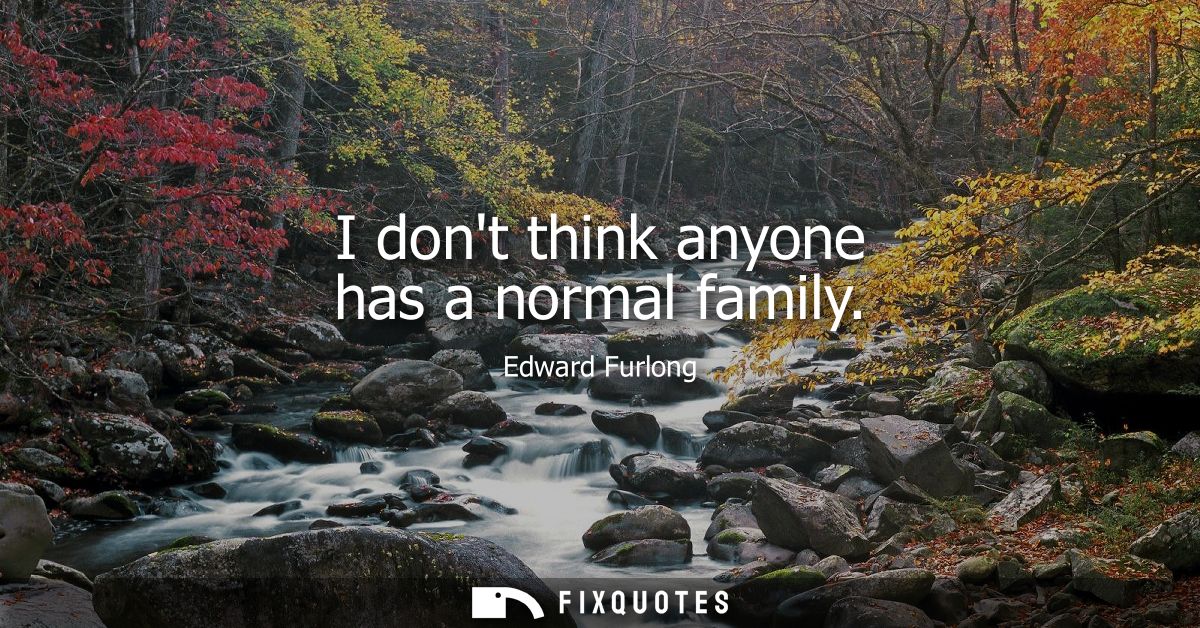
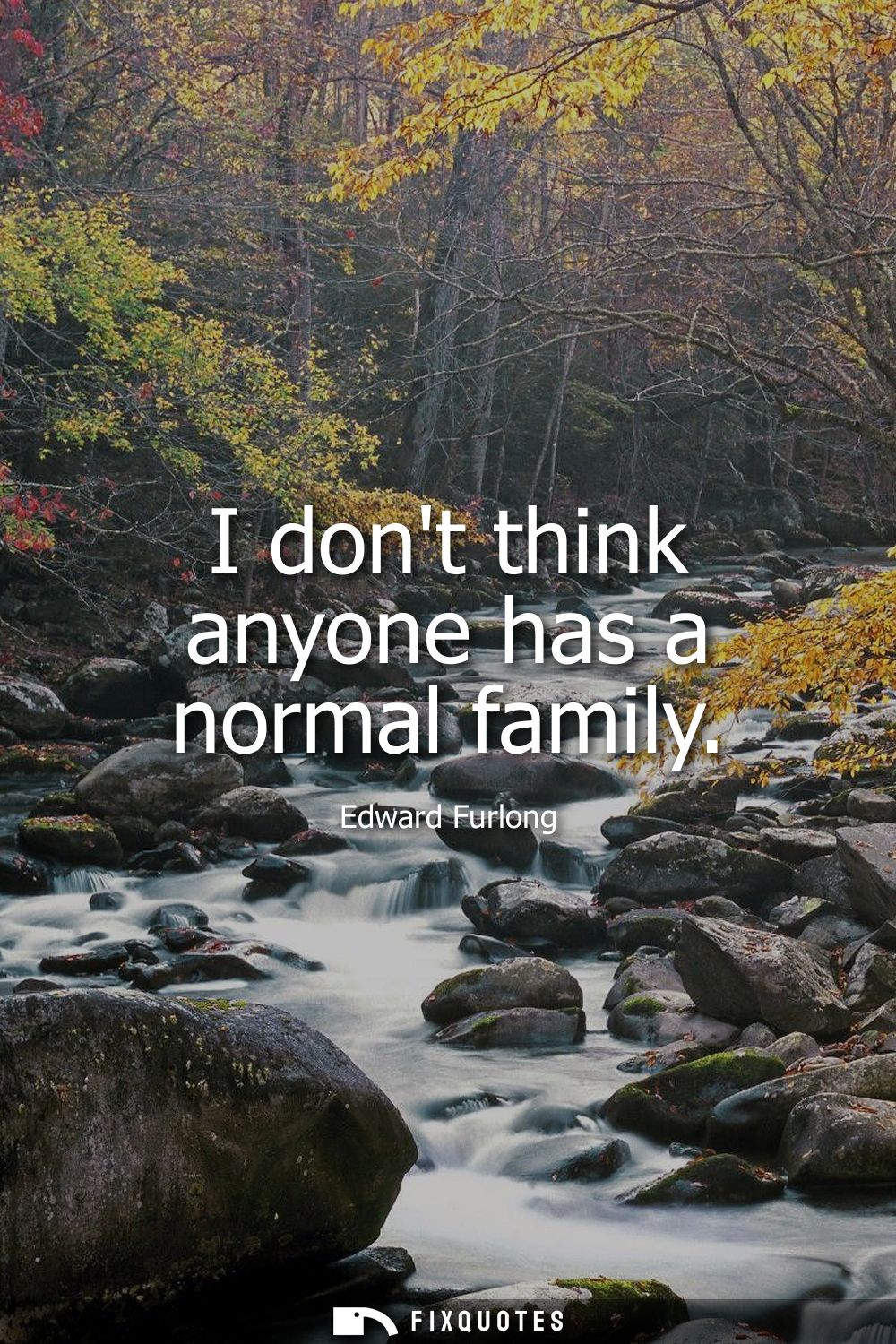
"I don't think anyone has a normal family"
About this Quote
Normal is the myth we buy so we can stop talking about what happens behind closed doors. Edward Furlong’s line lands because it refuses the comforting idea that there’s a stable baseline called “a normal family” and everyone else is deviating from it. Coming from an actor who grew up in the public eye, it reads less like a hot take and more like a survival logic: if nobody’s normal, then your mess isn’t uniquely disqualifying.
The intent feels defensive but also oddly generous. Instead of confessing dysfunction, he universalizes it, widening the frame so the shame has nowhere to stick. That’s the subtext: family is where people learn their first scripts - loyalty, silence, performance - and those scripts are rarely tidy. “Normal” becomes a branding term, not a lived reality, something maintained through omission and good lighting.
Culturally, the quote sits in that late-20th/early-21st-century shift where celebrity interviews doubled as public therapy. Audiences were being trained to hear trauma not as scandal but as backstory, and stars were expected to translate private chaos into relatable content. Furlong’s phrasing is blunt, almost shrugging, which helps it travel: it’s easy to repeat at a dinner table or in a comment thread because it doesn’t demand specifics. It offers absolution without details.
What makes it work is its quiet attack on the nuclear-family fantasy. It punctures the idea that “healthy” looks one way, insisting that every family is improvised, patched together, and haunted by something unphotographable.
The intent feels defensive but also oddly generous. Instead of confessing dysfunction, he universalizes it, widening the frame so the shame has nowhere to stick. That’s the subtext: family is where people learn their first scripts - loyalty, silence, performance - and those scripts are rarely tidy. “Normal” becomes a branding term, not a lived reality, something maintained through omission and good lighting.
Culturally, the quote sits in that late-20th/early-21st-century shift where celebrity interviews doubled as public therapy. Audiences were being trained to hear trauma not as scandal but as backstory, and stars were expected to translate private chaos into relatable content. Furlong’s phrasing is blunt, almost shrugging, which helps it travel: it’s easy to repeat at a dinner table or in a comment thread because it doesn’t demand specifics. It offers absolution without details.
What makes it work is its quiet attack on the nuclear-family fantasy. It punctures the idea that “healthy” looks one way, insisting that every family is improvised, patched together, and haunted by something unphotographable.
Quote Details
| Topic | Family |
|---|---|
| Source | Help us find the source |
| Cite |
Citation Formats
APA Style (7th ed.)
Furlong, Edward. (2026, January 15). I don't think anyone has a normal family. FixQuotes. https://fixquotes.com/quotes/i-dont-think-anyone-has-a-normal-family-158170/
Chicago Style
Furlong, Edward. "I don't think anyone has a normal family." FixQuotes. January 15, 2026. https://fixquotes.com/quotes/i-dont-think-anyone-has-a-normal-family-158170/.
MLA Style (9th ed.)
"I don't think anyone has a normal family." FixQuotes, 15 Jan. 2026, https://fixquotes.com/quotes/i-dont-think-anyone-has-a-normal-family-158170/. Accessed 3 Apr. 2026.
More Quotes by Edward
Add to List