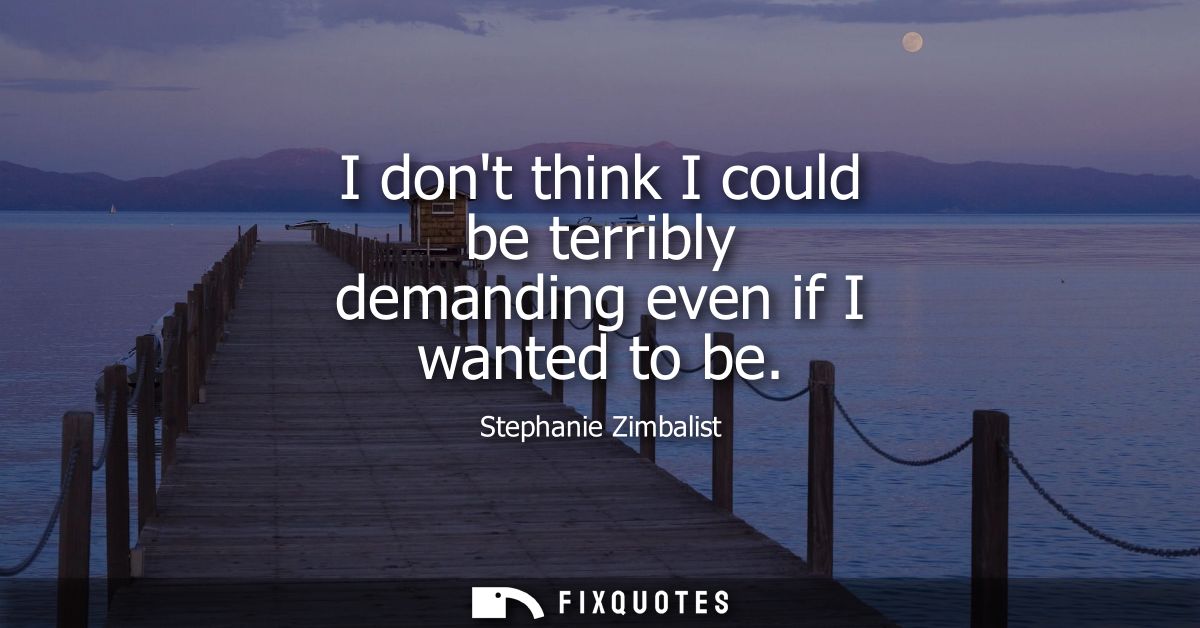
"I don't think I could be terribly demanding even if I wanted to be"
About this Quote
The interesting hinge is “even if I wanted to be.” That clause admits desire without claiming it. She’s not saying she lacks standards; she’s saying her temperament (or her social training) keeps her from exercising them loudly. It’s a confession shaped to be socially acceptable: ambition and needs get translated into likability. “Terribly” also softens the whole thing, framing demandingness as a moral excess rather than a professional boundary. That’s a culturally legible move in entertainment, where asking for basic respect can be recoded as attitude.
Context matters: Zimbalist came up in a television era that sold approachable competence, and her most famous role, Laura Holt on Remington Steele, played a woman constantly negotiating credit and authority. The quote echoes that dynamic off-screen: a professional signaling she can cooperate, while hinting at the quiet cost of having to. It works because it’s a small sentence with a big survival strategy tucked inside.
Quote Details
| Topic | Humility |
|---|---|
| Source | Help us find the source |
| Cite |
Citation Formats
APA Style (7th ed.)
Zimbalist, Stephanie. (2026, January 16). I don't think I could be terribly demanding even if I wanted to be. FixQuotes. https://fixquotes.com/quotes/i-dont-think-i-could-be-terribly-demanding-even-135895/
Chicago Style
Zimbalist, Stephanie. "I don't think I could be terribly demanding even if I wanted to be." FixQuotes. January 16, 2026. https://fixquotes.com/quotes/i-dont-think-i-could-be-terribly-demanding-even-135895/.
MLA Style (9th ed.)
"I don't think I could be terribly demanding even if I wanted to be." FixQuotes, 16 Jan. 2026, https://fixquotes.com/quotes/i-dont-think-i-could-be-terribly-demanding-even-135895/. Accessed 8 Apr. 2026.