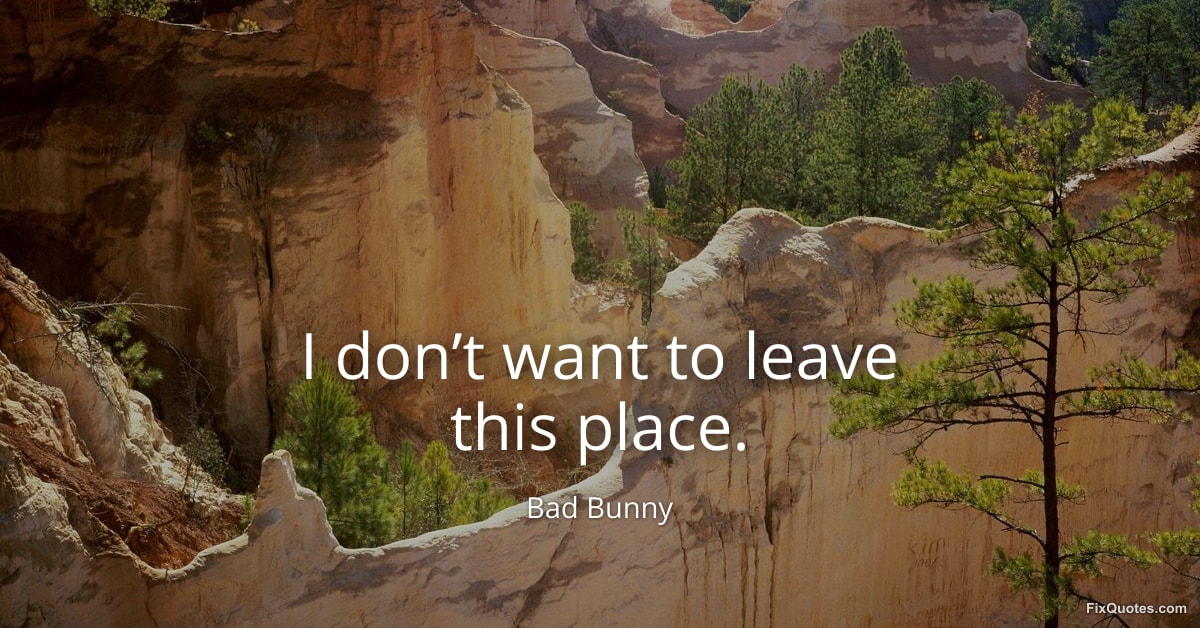
"I don’t want to leave this place"
About this Quote
There’s a deceptively ordinary ache in “I don’t want to leave this place,” the kind of line Bad Bunny can drop in the middle of a glossy pop record and make feel like a private confession. On its face, it’s simple reluctance. Underneath, it’s about what “place” means when you’re an artist whose life is split between the island and the industry, between intimacy and spectacle, between the bedroom and the world tour.
Bad Bunny’s best writing often treats location as identity, not scenery. “This place” can be literal (a room, a night, a city that finally feels safe) and also symbolic: the fleeting pocket of normal life fame keeps trying to evacuate. The line works because it refuses to specify. That vagueness is strategic; listeners can plug in their own version of the place they’re trying not to lose. He’s speaking in the first person, but aiming for a collective mood.
In Puerto Rican pop’s current era, nostalgia isn’t just sentimentality; it’s politics and economics. Leaving can mean diaspora, gentrification, or the soft pressure to translate yourself into something export-ready. From an artist who’s turned global visibility into a platform while still guarding his private self, “I don’t want to leave” lands like a small act of resistance: against time, against career velocity, against the idea that success requires departure.
It’s not melodrama. It’s the quiet panic of someone who knows the moment is already ending.
Bad Bunny’s best writing often treats location as identity, not scenery. “This place” can be literal (a room, a night, a city that finally feels safe) and also symbolic: the fleeting pocket of normal life fame keeps trying to evacuate. The line works because it refuses to specify. That vagueness is strategic; listeners can plug in their own version of the place they’re trying not to lose. He’s speaking in the first person, but aiming for a collective mood.
In Puerto Rican pop’s current era, nostalgia isn’t just sentimentality; it’s politics and economics. Leaving can mean diaspora, gentrification, or the soft pressure to translate yourself into something export-ready. From an artist who’s turned global visibility into a platform while still guarding his private self, “I don’t want to leave” lands like a small act of resistance: against time, against career velocity, against the idea that success requires departure.
It’s not melodrama. It’s the quiet panic of someone who knows the moment is already ending.
Quote Details
| Topic | Letting Go |
|---|---|
| Source | "Yo no me quiero ir de aquí" from song: Yo No Me Quiero Ir de Aquí, Un Verano Sin Ti (2022) |
| Cite |
Citation Formats
APA Style (7th ed.)
Bunny, Bad. (2026, January 30). I don’t want to leave this place. FixQuotes. https://fixquotes.com/quotes/i-dont-want-to-leave-this-place-184788/
Chicago Style
Bunny, Bad. "I don’t want to leave this place." FixQuotes. January 30, 2026. https://fixquotes.com/quotes/i-dont-want-to-leave-this-place-184788/.
MLA Style (9th ed.)
"I don’t want to leave this place." FixQuotes, 30 Jan. 2026, https://fixquotes.com/quotes/i-dont-want-to-leave-this-place-184788/. Accessed 12 Feb. 2026.
More Quotes by Bad
Add to List