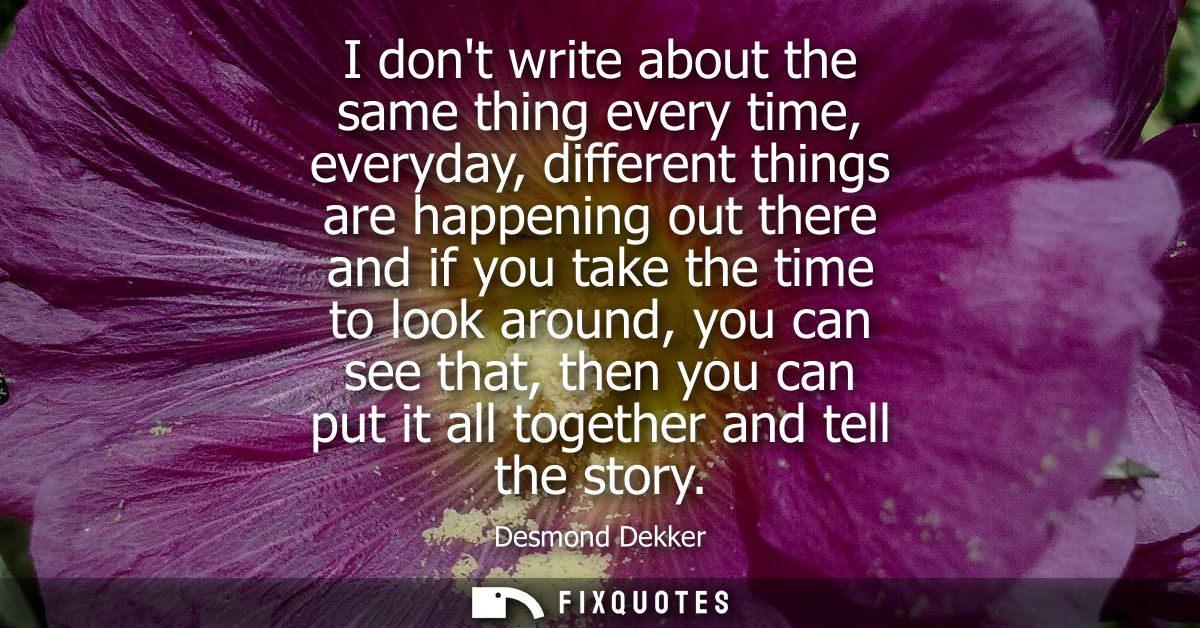
"I don't write about the same thing every time, everyday, different things are happening out there and if you take the time to look around, you can see that, then you can put it all together and tell the story"
About this Quote
The subtext lands harder when you remember what Dekker’s best-known songs actually did. “Israelites” wasn’t a diary entry; it was a street-level report on work, debt, and dignity, the kind of pop record that smuggles social reality onto the radio. He’s describing a method rooted in movement through public life: listening, watching, catching fragments of other people’s pressure and joy, then “putting it all together.” That phrase matters. It frames songwriting as montage - taking scattered episodes, slang, headlines, gossip, labor, love, and making them cohere into narrative.
There’s also a quiet argument here about authorship. Dekker positions himself less as a solitary genius and more as a translator for a community’s daily churn, especially in post-independence Jamaica and its diaspora circuits where ska and rocksteady were both dance music and newsfeed. The intent isn’t to sound deep; it’s to insist that good songs are built from attention, and that attention is political. If you “look around,” you can’t pretend nothing is happening.
Quote Details
| Topic | Writing |
|---|---|
| Source | Help us find the source |
| Cite |
Citation Formats
APA Style (7th ed.)
Dekker, Desmond. (2026, January 17). I don't write about the same thing every time, everyday, different things are happening out there and if you take the time to look around, you can see that, then you can put it all together and tell the story. FixQuotes. https://fixquotes.com/quotes/i-dont-write-about-the-same-thing-every-time-49871/
Chicago Style
Dekker, Desmond. "I don't write about the same thing every time, everyday, different things are happening out there and if you take the time to look around, you can see that, then you can put it all together and tell the story." FixQuotes. January 17, 2026. https://fixquotes.com/quotes/i-dont-write-about-the-same-thing-every-time-49871/.
MLA Style (9th ed.)
"I don't write about the same thing every time, everyday, different things are happening out there and if you take the time to look around, you can see that, then you can put it all together and tell the story." FixQuotes, 17 Jan. 2026, https://fixquotes.com/quotes/i-dont-write-about-the-same-thing-every-time-49871/. Accessed 5 Mar. 2026.