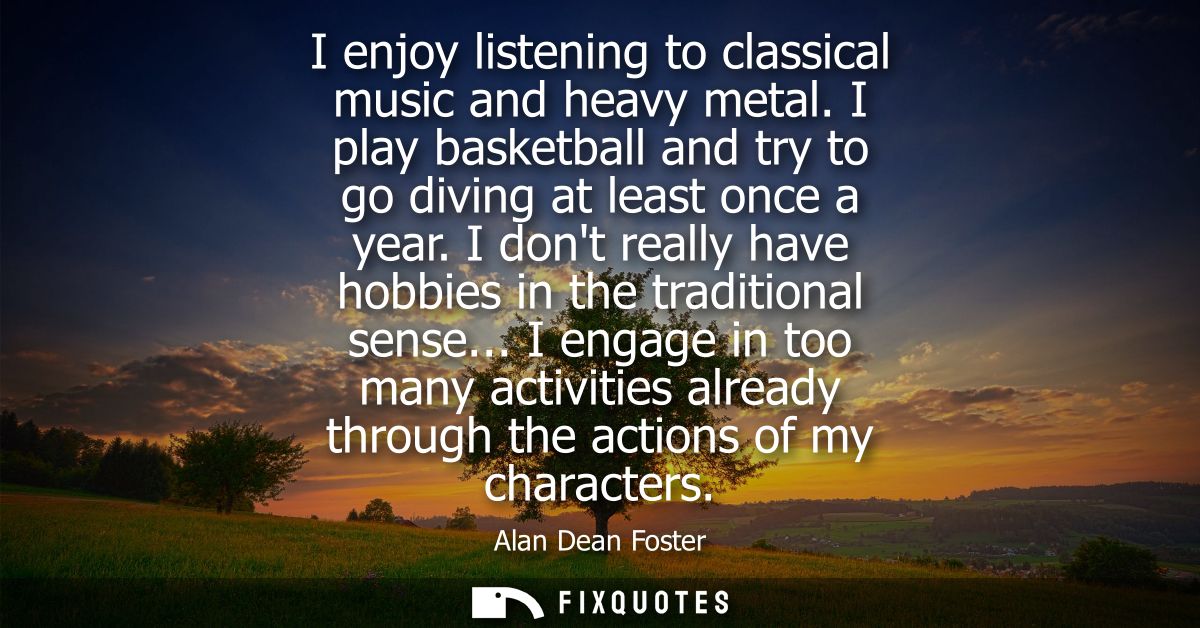
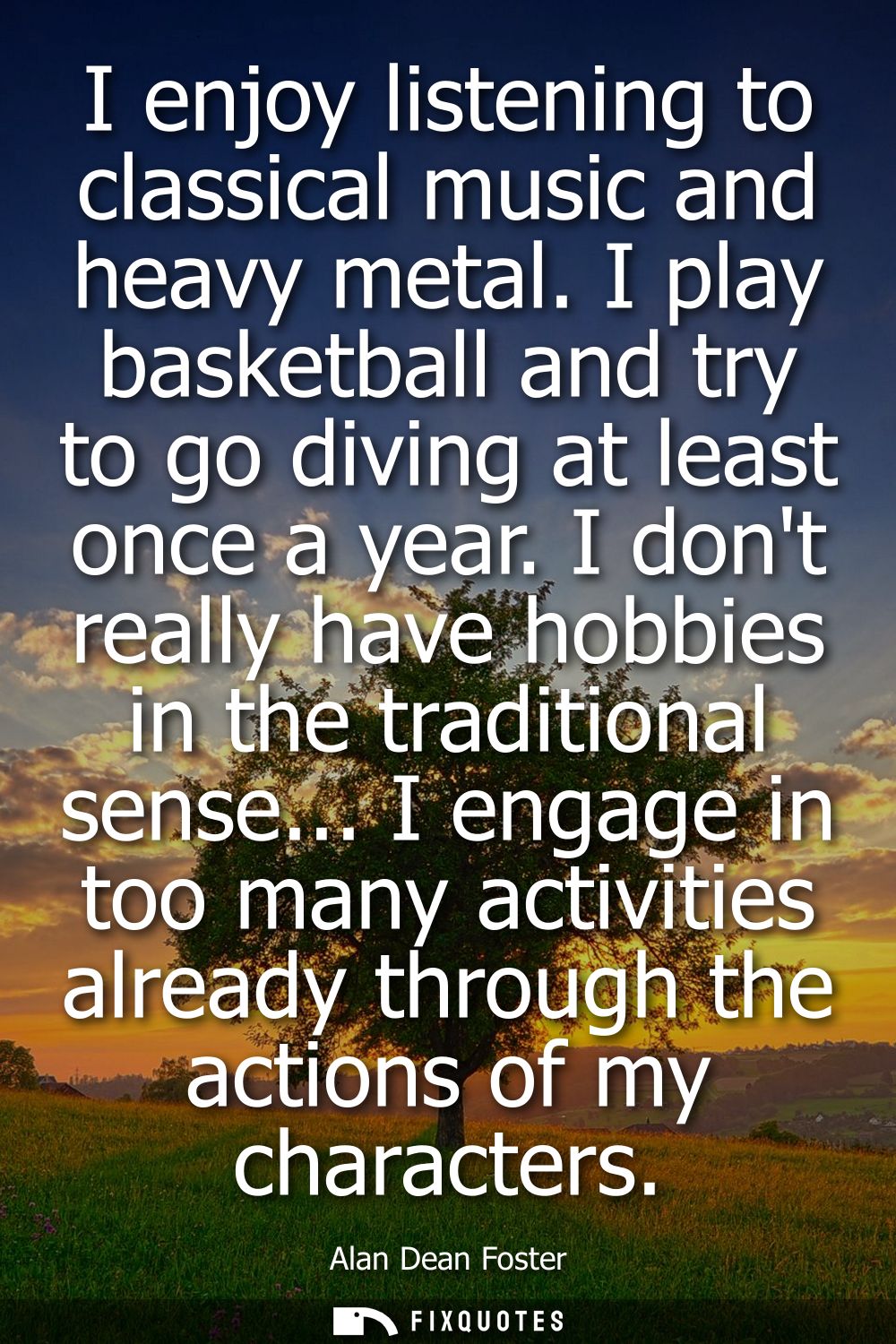
"I enjoy listening to classical music and heavy metal. I play basketball and try to go diving at least once a year. I don't really have hobbies in the traditional sense... I engage in too many activities already through the actions of my characters"
About this Quote
A small flex disguised as a shrug: Alan Dean Foster frames his life as deliberately eclectic, then undercuts the whole premise of a stable, label-friendly identity. Classical and heavy metal aren’t just two playlists; they’re a clean shorthand for range, discipline and chaos, control and catharsis. Basketball and annual diving do the same work in physical form: grounded team rhythm on one end, solitary plunge into alien pressure on the other. He’s sketching a personality built for genre fiction without saying “I contain multitudes.”
The key move is the feint about hobbies. By rejecting “hobbies in the traditional sense,” Foster pushes back against the cozy myth that writers need a tidy off-switch: the stamp collecting that proves you’re normal, the gardening that balances the imagination. His real claim is more pointed: writing isn’t a job he leaves at the desk, it’s an activity that metabolizes everything else. “Through the actions of my characters” is craft talk, but it’s also a boundary statement. He’s too busy living via proxies.
There’s subtexted pride in that displacement. Characters become his scuba tank, his arena, his mosh pit and his concert hall. It’s an argument for fiction as experiential theft: the author gets to try on extremes without needing to perform them publicly. Coming from a prolific, workmanlike novelist long associated with tie-ins and big, transportive adventure, it reads like a quiet manifesto: don’t mistake the author’s apparent ordinariness for creative smallness. The life is on the page; the hobbies are the plot.
The key move is the feint about hobbies. By rejecting “hobbies in the traditional sense,” Foster pushes back against the cozy myth that writers need a tidy off-switch: the stamp collecting that proves you’re normal, the gardening that balances the imagination. His real claim is more pointed: writing isn’t a job he leaves at the desk, it’s an activity that metabolizes everything else. “Through the actions of my characters” is craft talk, but it’s also a boundary statement. He’s too busy living via proxies.
There’s subtexted pride in that displacement. Characters become his scuba tank, his arena, his mosh pit and his concert hall. It’s an argument for fiction as experiential theft: the author gets to try on extremes without needing to perform them publicly. Coming from a prolific, workmanlike novelist long associated with tie-ins and big, transportive adventure, it reads like a quiet manifesto: don’t mistake the author’s apparent ordinariness for creative smallness. The life is on the page; the hobbies are the plot.
Quote Details
| Topic | Writing |
|---|---|
| Source | Help us find the source |
More Quotes by Alan
Add to List