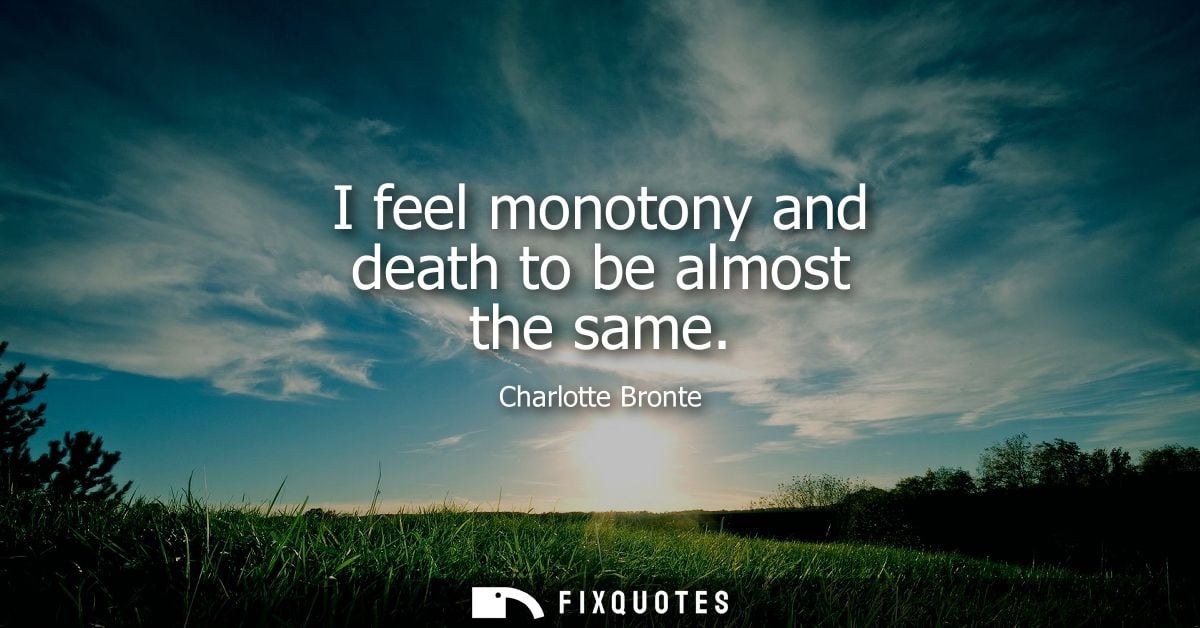
"I feel monotony and death to be almost the same"
About this Quote
Monotony isn’t just boredom here; it’s a kind of slow erasure. Bronte’s line works because it collapses a mild, socially acceptable complaint into something terminal, exposing how easily “nothing happening” becomes “nothing left of me.” The provocation is in the word “almost”: she stops short of melodrama while still letting the reader feel the chill. That restraint is the Victorian version of a raised eyebrow.
Bronte wrote out of a life where sameness was not an abstract mood but a structure. As a woman with few sanctioned routes to autonomy, she knew repetition as confinement: the same rooms, the same duties, the same polite performances. In that context, monotony becomes a moral and psychic threat, the danger of being made compliant by routine until desire, ambition, and even personality dull into quietness. It’s not only that monotony resembles death; it rehearses it, training the spirit to accept stasis.
The subtext is also about creative hunger. Bronte’s novels burn with the need for interior intensity - not mere excitement, but recognition, movement, consequence. To equate monotony with death is to argue that a life without meaningful change, risk, or self-determination is a life lived under protest. It’s a private rebellion phrased as a simple feeling, which is exactly how Bronte smuggles radicalism past the era’s expectations: she makes the personal sound inevitable, then lets that inevitability indict the world that produced it.
Bronte wrote out of a life where sameness was not an abstract mood but a structure. As a woman with few sanctioned routes to autonomy, she knew repetition as confinement: the same rooms, the same duties, the same polite performances. In that context, monotony becomes a moral and psychic threat, the danger of being made compliant by routine until desire, ambition, and even personality dull into quietness. It’s not only that monotony resembles death; it rehearses it, training the spirit to accept stasis.
The subtext is also about creative hunger. Bronte’s novels burn with the need for interior intensity - not mere excitement, but recognition, movement, consequence. To equate monotony with death is to argue that a life without meaningful change, risk, or self-determination is a life lived under protest. It’s a private rebellion phrased as a simple feeling, which is exactly how Bronte smuggles radicalism past the era’s expectations: she makes the personal sound inevitable, then lets that inevitability indict the world that produced it.
Quote Details
| Topic | Mortality |
|---|---|
| Source | Help us find the source |
| Cite |
Citation Formats
APA Style (7th ed.)
Bronte, Charlotte. (2026, January 15). I feel monotony and death to be almost the same. FixQuotes. https://fixquotes.com/quotes/i-feel-monotony-and-death-to-be-almost-the-same-150289/
Chicago Style
Bronte, Charlotte. "I feel monotony and death to be almost the same." FixQuotes. January 15, 2026. https://fixquotes.com/quotes/i-feel-monotony-and-death-to-be-almost-the-same-150289/.
MLA Style (9th ed.)
"I feel monotony and death to be almost the same." FixQuotes, 15 Jan. 2026, https://fixquotes.com/quotes/i-feel-monotony-and-death-to-be-almost-the-same-150289/. Accessed 22 Mar. 2026.
More Quotes by Charlotte
Add to List