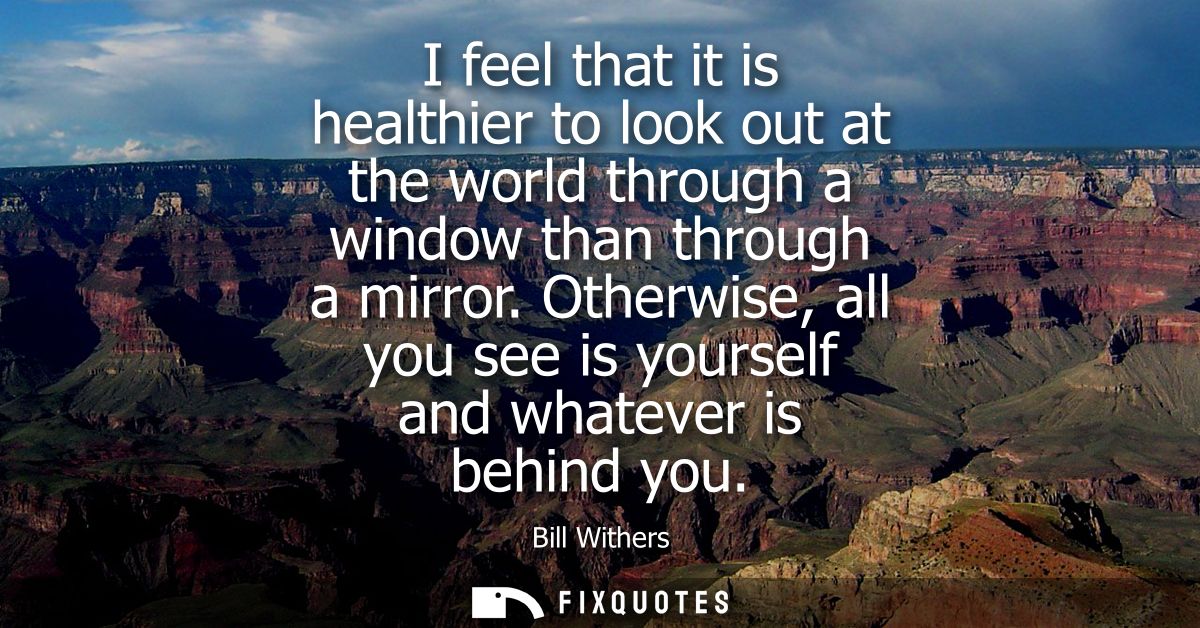
"I feel that it is healthier to look out at the world through a window than through a mirror. Otherwise, all you see is yourself and whatever is behind you"
About this Quote
The second sentence sharpens the critique. A mirror doesn’t even give you “truth,” just yourself and “whatever is behind you” - your past, your baggage, the small room you’re trapped in. It’s an elegant way of saying that self-fixation collapses time and space: you keep rehashing what happened to you, what you look like, how you’re coming off. The world becomes a backdrop to your internal weather.
Withers’ context makes the advice sting in a good way. He was famously wary of the machinery of celebrity and the industry’s demand that artists turn inward and perform themselves for approval. Coming from a songwriter whose best work translates private feeling into something broadly usable (“Lean on Me,” “Ain’t No Sunshine”), the line reads less like a self-help poster and more like a working musician’s survival tactic: keep your gaze outward, toward people, toward life as it is. That’s where songs - and sanity - come from.
Quote Details
| Topic | Wisdom |
|---|---|
| Source | Help us find the source |
| Cite |
Citation Formats
APA Style (7th ed.)
Withers, Bill. (2026, January 17). I feel that it is healthier to look out at the world through a window than through a mirror. Otherwise, all you see is yourself and whatever is behind you. FixQuotes. https://fixquotes.com/quotes/i-feel-that-it-is-healthier-to-look-out-at-the-61168/
Chicago Style
Withers, Bill. "I feel that it is healthier to look out at the world through a window than through a mirror. Otherwise, all you see is yourself and whatever is behind you." FixQuotes. January 17, 2026. https://fixquotes.com/quotes/i-feel-that-it-is-healthier-to-look-out-at-the-61168/.
MLA Style (9th ed.)
"I feel that it is healthier to look out at the world through a window than through a mirror. Otherwise, all you see is yourself and whatever is behind you." FixQuotes, 17 Jan. 2026, https://fixquotes.com/quotes/i-feel-that-it-is-healthier-to-look-out-at-the-61168/. Accessed 3 Apr. 2026.