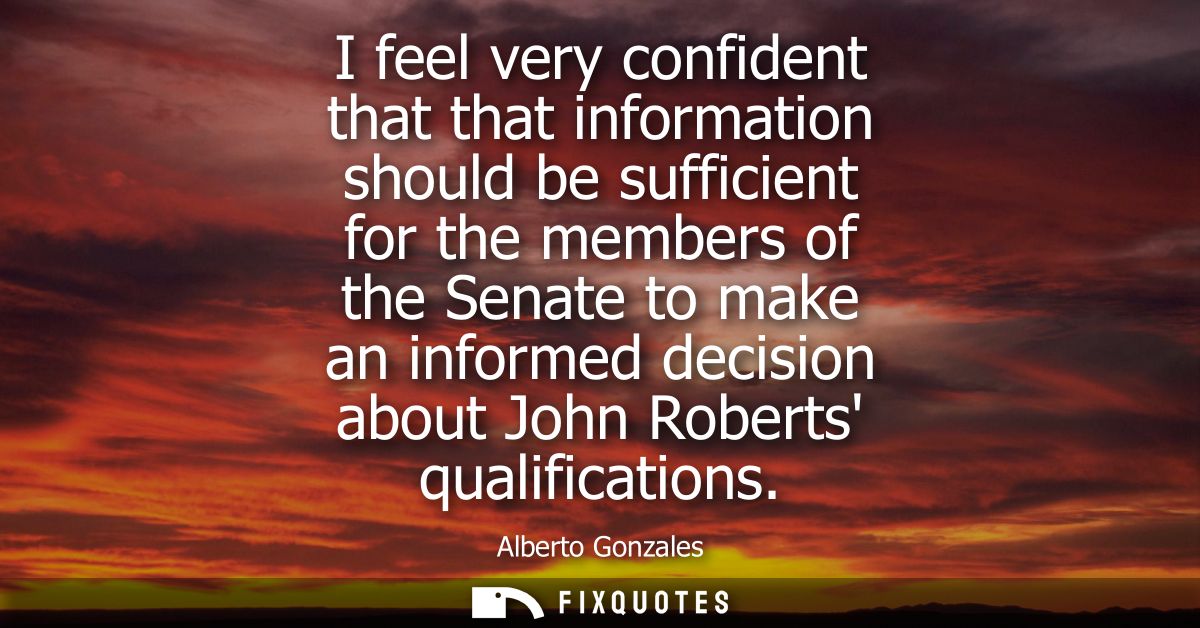
"I feel very confident that that information should be sufficient for the members of the Senate to make an informed decision about John Roberts' qualifications"
About this Quote
The intent is procedural closure. Gonzales frames the Senate’s role as decision-making based on provided materials, not as an aggressive search for what hasn’t been provided. “Information” stays conspicuously generic, avoiding the messy question of what’s missing, contested, or classified. He’s also laundering responsibility: the Senate will make an “informed decision,” so any controversy becomes a matter of their judgment, not the administration’s disclosure.
The context is a confirmation fight in a post-9/11 Washington where executive power, legal memos, and judicial philosophy were under unusual scrutiny. John Roberts was poised to become a consequential vote on the Court, and Gonzales, as a high-level administration legal voice, had incentive to keep the spotlight on credentials rather than on internal deliberations. The subtext is an invitation to accept a curated record as complete enough. It’s not about transparency; it’s about sufficiency, the politics of giving just enough to move history along.
Quote Details
| Topic | Decision-Making |
|---|---|
| Source | Help us find the source |
| Cite |
Citation Formats
APA Style (7th ed.)
Gonzales, Alberto. (2026, January 17). I feel very confident that that information should be sufficient for the members of the Senate to make an informed decision about John Roberts' qualifications. FixQuotes. https://fixquotes.com/quotes/i-feel-very-confident-that-that-information-36630/
Chicago Style
Gonzales, Alberto. "I feel very confident that that information should be sufficient for the members of the Senate to make an informed decision about John Roberts' qualifications." FixQuotes. January 17, 2026. https://fixquotes.com/quotes/i-feel-very-confident-that-that-information-36630/.
MLA Style (9th ed.)
"I feel very confident that that information should be sufficient for the members of the Senate to make an informed decision about John Roberts' qualifications." FixQuotes, 17 Jan. 2026, https://fixquotes.com/quotes/i-feel-very-confident-that-that-information-36630/. Accessed 31 Mar. 2026.