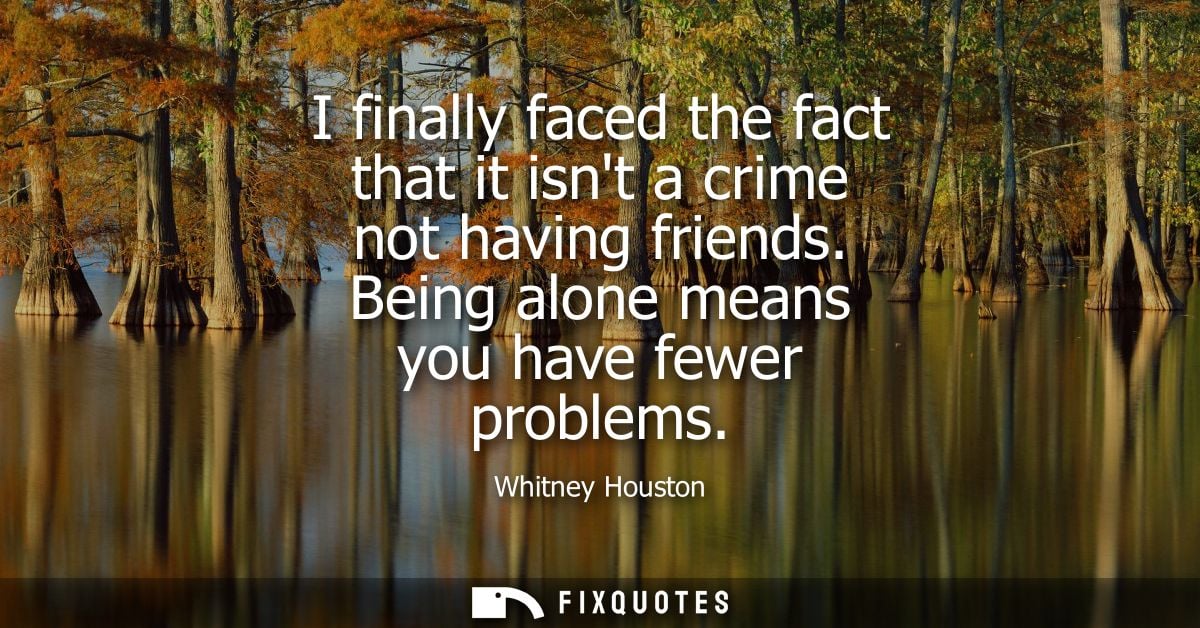
"I finally faced the fact that it isn't a crime not having friends. Being alone means you have fewer problems"
About this Quote
There is a bracing, almost taboo honesty in admitting that friendlessness is not a moral failure. Houston’s line reads like self-defense turned self-definition: she’s not romanticizing loneliness, she’s decriminalizing it. The first clause is the tell - “I finally faced the fact” suggests a long internal trial, a verdict reached after shame, gossip, or the kind of social pressure that treats popularity as proof of health. For a public figure, “friends” aren’t just companions; they’re an ecosystem of handlers, hangers-on, and opportunists. In that light, “crime” isn’t metaphorical fluff. It’s the language of accusation, of being judged by an audience that wants access to your life and then punishes you for guarding it.
“Being alone means you have fewer problems” lands with the hard practicality of someone who’s been burned by proximity. It’s not the Instagram version of solitude; it’s risk management. Houston is sketching a boundary in one sentence: fewer confidences to betray, fewer demands to perform intimacy on command, fewer people turning your success into their entitlement. The subtext is weary and savvy: connection can be nourishing, but it can also be expensive, especially when fame makes every relationship potentially transactional.
In the context of a career lived under intense scrutiny, the quote doubles as a quiet critique of a culture that treats constant sociability as virtue. Houston isn’t preaching isolation. She’s claiming the right to quiet without being pathologized - and hinting that sometimes “alone” is the only place you can hear your own voice.
“Being alone means you have fewer problems” lands with the hard practicality of someone who’s been burned by proximity. It’s not the Instagram version of solitude; it’s risk management. Houston is sketching a boundary in one sentence: fewer confidences to betray, fewer demands to perform intimacy on command, fewer people turning your success into their entitlement. The subtext is weary and savvy: connection can be nourishing, but it can also be expensive, especially when fame makes every relationship potentially transactional.
In the context of a career lived under intense scrutiny, the quote doubles as a quiet critique of a culture that treats constant sociability as virtue. Houston isn’t preaching isolation. She’s claiming the right to quiet without being pathologized - and hinting that sometimes “alone” is the only place you can hear your own voice.
Quote Details
| Topic | Loneliness |
|---|---|
| Source | Help us find the source |
More Quotes by Whitney
Add to List