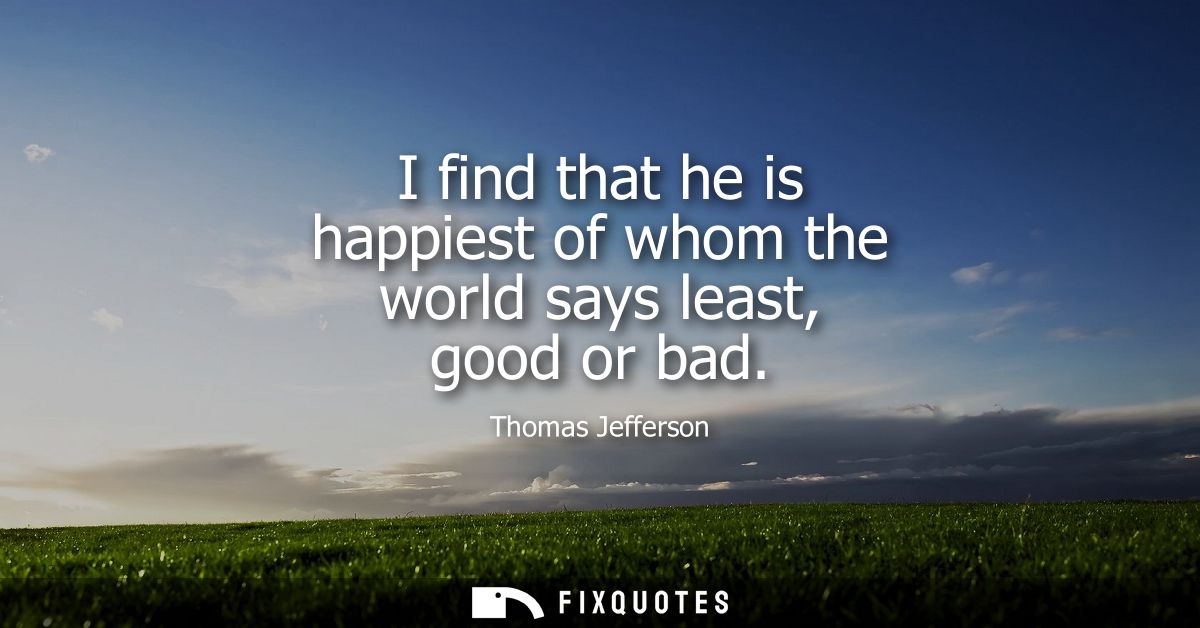
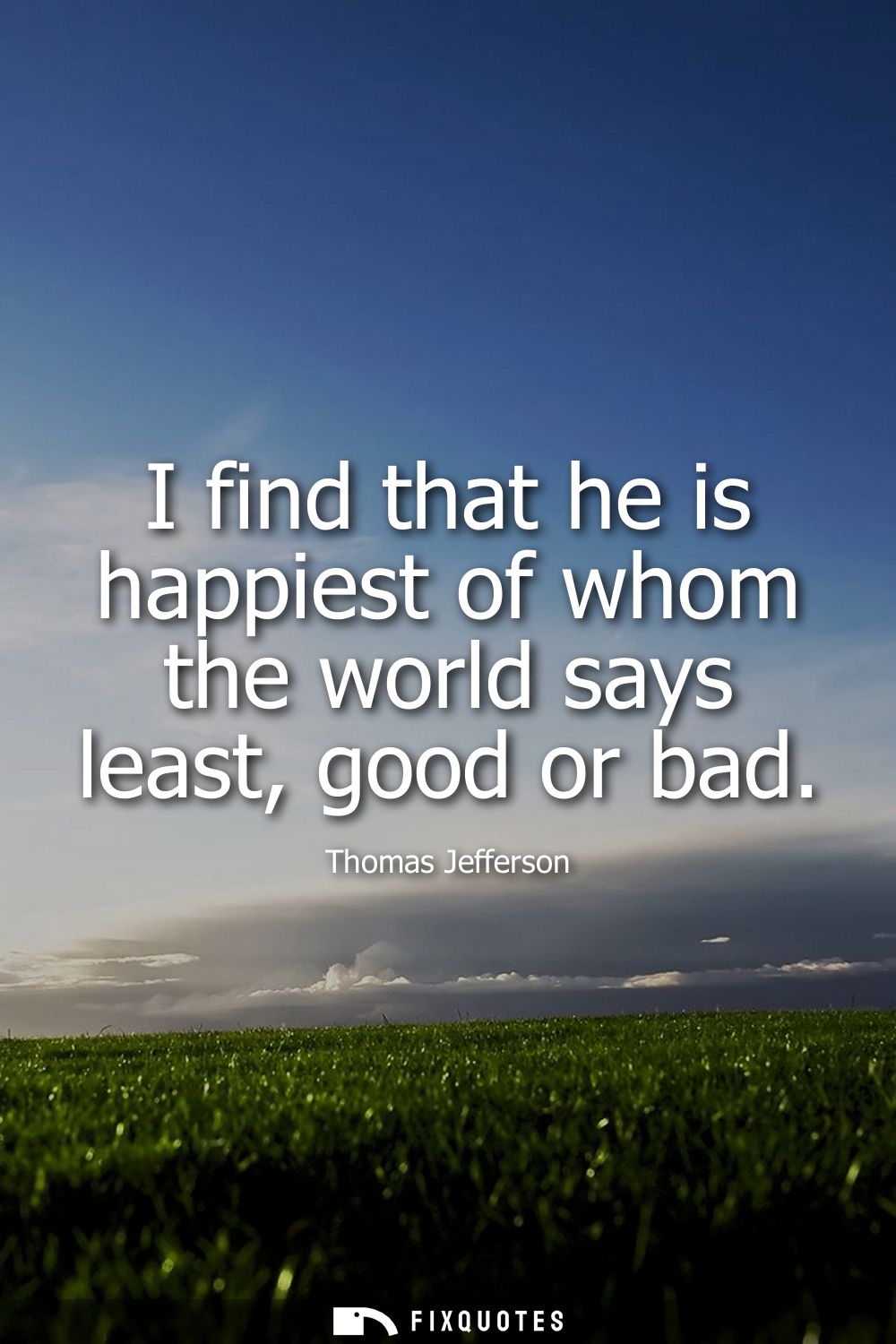
"I find that he is happiest of whom the world says least, good or bad"
About this Quote
That’s a loaded posture for a president - and even more loaded for Jefferson, a man who cultivated public reason while privately craving control over his own narrative. In the early American republic, “public opinion” was becoming a real political force: partisan newspapers, rival factions, reputational warfare. Jefferson understood that visibility is not just attention; it’s exposure to moral accounting. Silence from “the world” reads as a kind of immunity.
The subtext also hints at the plantation ideal of self-sufficient virtue: the gentleman-farmer unbothered, locally rooted, apparently above the scramble of applause and scandal. It’s a serene image that doubles as a defense mechanism. If happiness lives where people say “least,” then criticism can be dismissed as noise, and praise can be treated as suspect.
Rhetorically, the sentence is calm, almost bloodless, which is the point: it models the detachment it recommends. It’s self-help for statesmen, and a quiet indictment of a culture where reputation becomes a second government.
Quote Details
| Topic | Happiness |
|---|---|
| Source | Help us find the source |
| Cite |
Citation Formats
APA Style (7th ed.)
Jefferson, Thomas. (2026, January 17). I find that he is happiest of whom the world says least, good or bad. FixQuotes. https://fixquotes.com/quotes/i-find-that-he-is-happiest-of-whom-the-world-says-27358/
Chicago Style
Jefferson, Thomas. "I find that he is happiest of whom the world says least, good or bad." FixQuotes. January 17, 2026. https://fixquotes.com/quotes/i-find-that-he-is-happiest-of-whom-the-world-says-27358/.
MLA Style (9th ed.)
"I find that he is happiest of whom the world says least, good or bad." FixQuotes, 17 Jan. 2026, https://fixquotes.com/quotes/i-find-that-he-is-happiest-of-whom-the-world-says-27358/. Accessed 7 Apr. 2026.