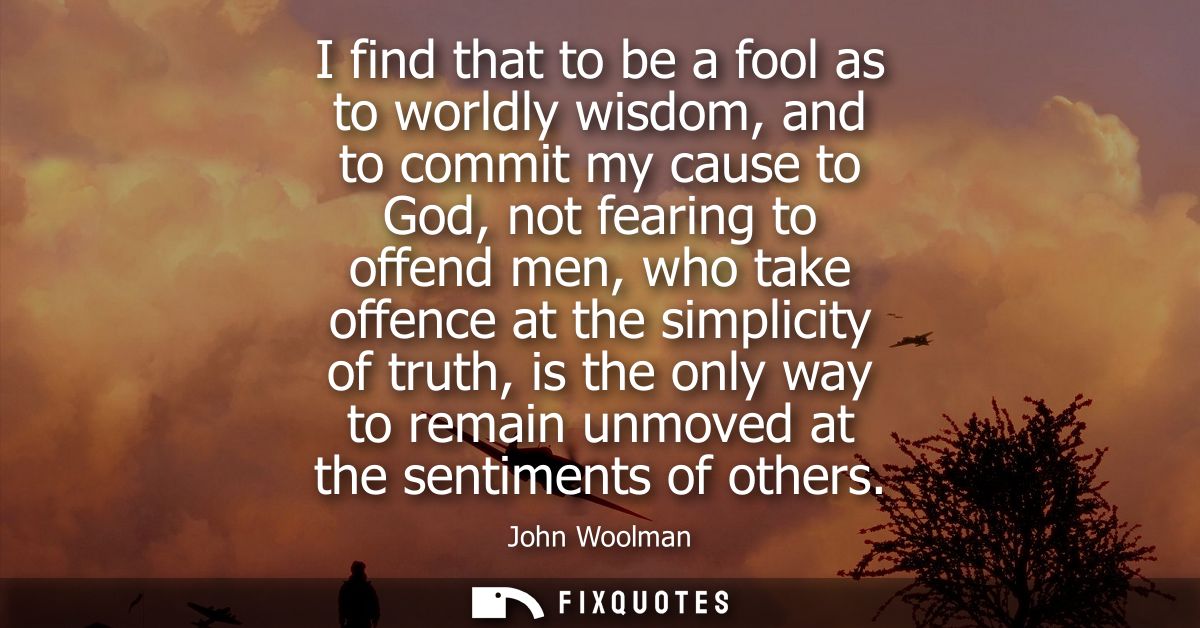
"I find that to be a fool, as to worldly wisdom, and to commit my cause to God, not fearing to offend men, who take offence at the simplicity of truth, is the only way to remain unmoved at the sentiments of others"
About this Quote
Woolman was a Quaker minister writing in an 18th-century Anglo-American world where reputation functioned like currency and conformity like safety. Quaker “plainness” wasn’t merely aesthetic; it was a disciplined refusal of status games. So when he says he won’t fear to offend men “who take offence at the simplicity of truth,” he’s diagnosing a psychological trick: people don’t just disagree with truth; they resent how little it flatters them. “Simplicity” here is a provocation. It strips away the elaborate justifications that allow injustice to feel polite.
The subtext is especially sharp given Woolman’s abolitionist witness. Calling slavery wrong was not an abstract theological position; it threatened livelihoods, church unity, and the social order. He’s describing how to survive that backlash: accept the “fool” label, refuse the performance of sophistication, and treat public opinion as weather, not law. “Remain unmoved” doesn’t mean numb; it means anchored. In a culture that rewards tact over conscience, Woolman chooses the steadier violence of plain truth.
Quote Details
| Topic | God |
|---|---|
| Source | Help us find the source |
| Cite |
Citation Formats
APA Style (7th ed.)
Woolman, John. (2026, February 18). I find that to be a fool, as to worldly wisdom, and to commit my cause to God, not fearing to offend men, who take offence at the simplicity of truth, is the only way to remain unmoved at the sentiments of others. FixQuotes. https://fixquotes.com/quotes/i-find-that-to-be-a-fool-as-to-worldly-wisdom-and-91793/
Chicago Style
Woolman, John. "I find that to be a fool, as to worldly wisdom, and to commit my cause to God, not fearing to offend men, who take offence at the simplicity of truth, is the only way to remain unmoved at the sentiments of others." FixQuotes. February 18, 2026. https://fixquotes.com/quotes/i-find-that-to-be-a-fool-as-to-worldly-wisdom-and-91793/.
MLA Style (9th ed.)
"I find that to be a fool, as to worldly wisdom, and to commit my cause to God, not fearing to offend men, who take offence at the simplicity of truth, is the only way to remain unmoved at the sentiments of others." FixQuotes, 18 Feb. 2026, https://fixquotes.com/quotes/i-find-that-to-be-a-fool-as-to-worldly-wisdom-and-91793/. Accessed 31 Mar. 2026.