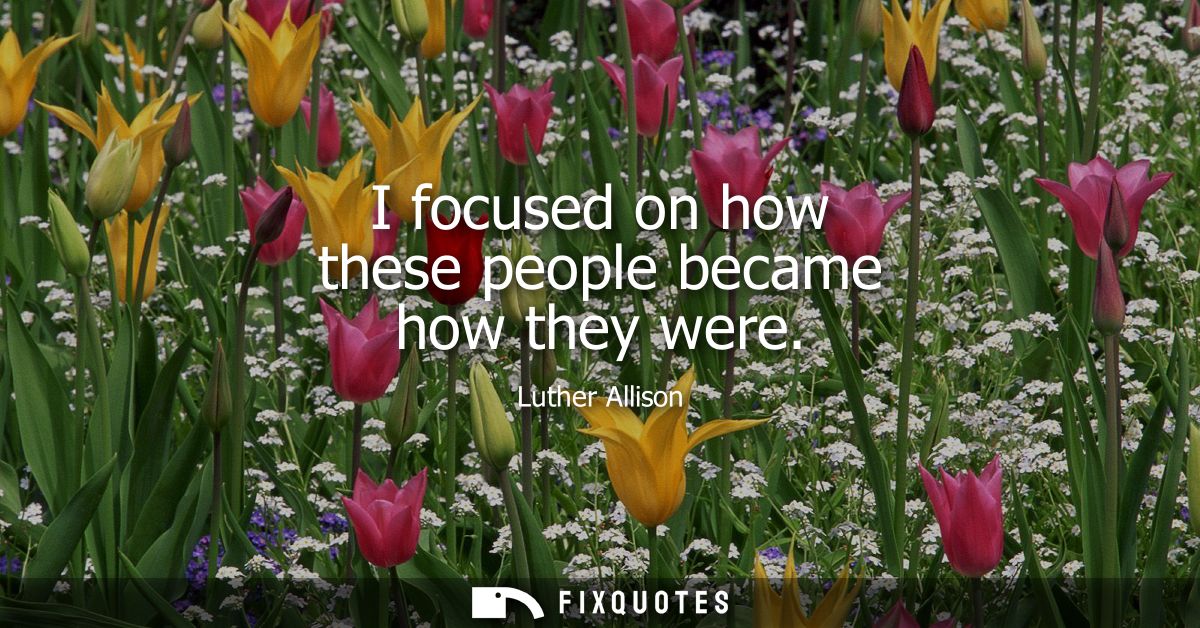
"I focused on how these people became how they were"
About this Quote
A blues musician talking like a novelist: that is the quiet flex in Luther Allison's line. "I focused on how these people became how they were" isn't just a backstage note on songwriting; it's a mission statement for a genre that gets flattened into mood. Allison is pointing away from easy archetypes - the hard-luck man, the cheating lover, the hustler, the saint - and toward origin stories. Not what they did, but what happened to them, what shaped their angle on the world.
The phrasing matters. "Focused" suggests discipline, almost a refusal: he won't settle for stock characters or crowd-pleasing pity. "These people" keeps the lens outward, documentary-style. He's not romanticizing his own pain; he's studying a community, a set of social forces, a chain of cause and effect. That shift is culturally loaded for a Black American musician who came up through the postwar circuit, where the industry often rewarded performers for embodying a type rather than articulating a life. Allison's subtext is dignity through specificity: if you understand the making of a person, you can't dismiss them as a punchline or a stereotype.
It also reads like a rebuttal to the myth that blues is just raw feeling pouring out unfiltered. The best blues is crafted empathy. Allison is admitting the work behind the catharsis: observation, memory, maybe even restraint. He's telling you that the ache has architecture, and the story behind the voice is the real instrument.
The phrasing matters. "Focused" suggests discipline, almost a refusal: he won't settle for stock characters or crowd-pleasing pity. "These people" keeps the lens outward, documentary-style. He's not romanticizing his own pain; he's studying a community, a set of social forces, a chain of cause and effect. That shift is culturally loaded for a Black American musician who came up through the postwar circuit, where the industry often rewarded performers for embodying a type rather than articulating a life. Allison's subtext is dignity through specificity: if you understand the making of a person, you can't dismiss them as a punchline or a stereotype.
It also reads like a rebuttal to the myth that blues is just raw feeling pouring out unfiltered. The best blues is crafted empathy. Allison is admitting the work behind the catharsis: observation, memory, maybe even restraint. He's telling you that the ache has architecture, and the story behind the voice is the real instrument.
Quote Details
| Topic | Deep |
|---|---|
| Source | Help us find the source |
| Cite |
Citation Formats
APA Style (7th ed.)
Allison, Luther. (2026, January 16). I focused on how these people became how they were. FixQuotes. https://fixquotes.com/quotes/i-focused-on-how-these-people-became-how-they-were-87790/
Chicago Style
Allison, Luther. "I focused on how these people became how they were." FixQuotes. January 16, 2026. https://fixquotes.com/quotes/i-focused-on-how-these-people-became-how-they-were-87790/.
MLA Style (9th ed.)
"I focused on how these people became how they were." FixQuotes, 16 Jan. 2026, https://fixquotes.com/quotes/i-focused-on-how-these-people-became-how-they-were-87790/. Accessed 11 Mar. 2026.
More Quotes by Luther
Add to List