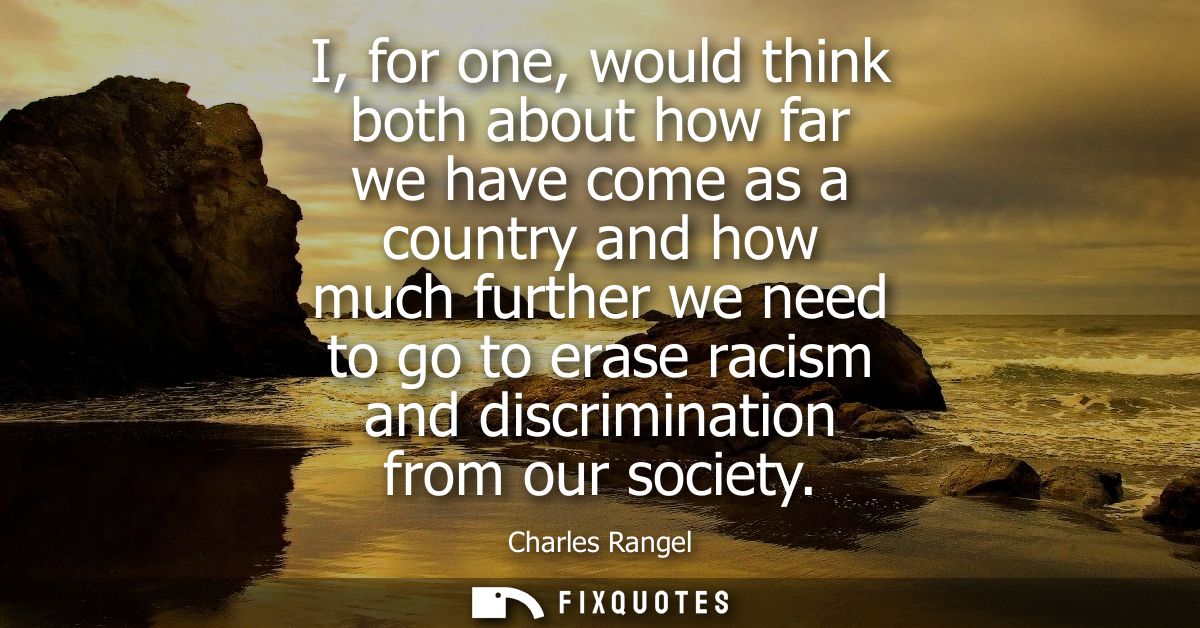
"I, for one, would think both about how far we have come as a country and how much further we need to go to erase racism and discrimination from our society"
About this Quote
The phrase “as a country” matters. Rangel isn’t locating racism in individual bad actors; he’s placing it in the national fabric, something inherited, maintained, and therefore changeable only through collective will. Then comes the pivot: “how much further we need to go.” It’s a familiar cadence in American reform rhetoric, echoing civil rights sermons and stump speeches where progress is acknowledged to keep the persuadable onboard, but the moral debt is kept outstanding.
His most revealing word is “erase.” Politicians often promise to “reduce” or “address” racism; “erase” implies something more ambitious: not managing a problem, but removing it from the system. That aspiration is both uplifting and quietly accusatory, because it suggests racism isn’t an aberration but a residue that persists precisely because society tolerates it.
Rangel’s context as a Harlem congressman and longtime civil rights advocate sharpens the subtext: progress is real, but it’s also an alibi people reach for when they want to stop listening. The line is a reminder that American advancement is not self-executing; it has to be demanded, repeatedly.
Quote Details
| Topic | Equality |
|---|---|
| Source | Help us find the source |
| Cite |
Citation Formats
APA Style (7th ed.)
Rangel, Charles. (2026, January 17). I, for one, would think both about how far we have come as a country and how much further we need to go to erase racism and discrimination from our society. FixQuotes. https://fixquotes.com/quotes/i-for-one-would-think-both-about-how-far-we-have-66043/
Chicago Style
Rangel, Charles. "I, for one, would think both about how far we have come as a country and how much further we need to go to erase racism and discrimination from our society." FixQuotes. January 17, 2026. https://fixquotes.com/quotes/i-for-one-would-think-both-about-how-far-we-have-66043/.
MLA Style (9th ed.)
"I, for one, would think both about how far we have come as a country and how much further we need to go to erase racism and discrimination from our society." FixQuotes, 17 Jan. 2026, https://fixquotes.com/quotes/i-for-one-would-think-both-about-how-far-we-have-66043/. Accessed 21 Mar. 2026.