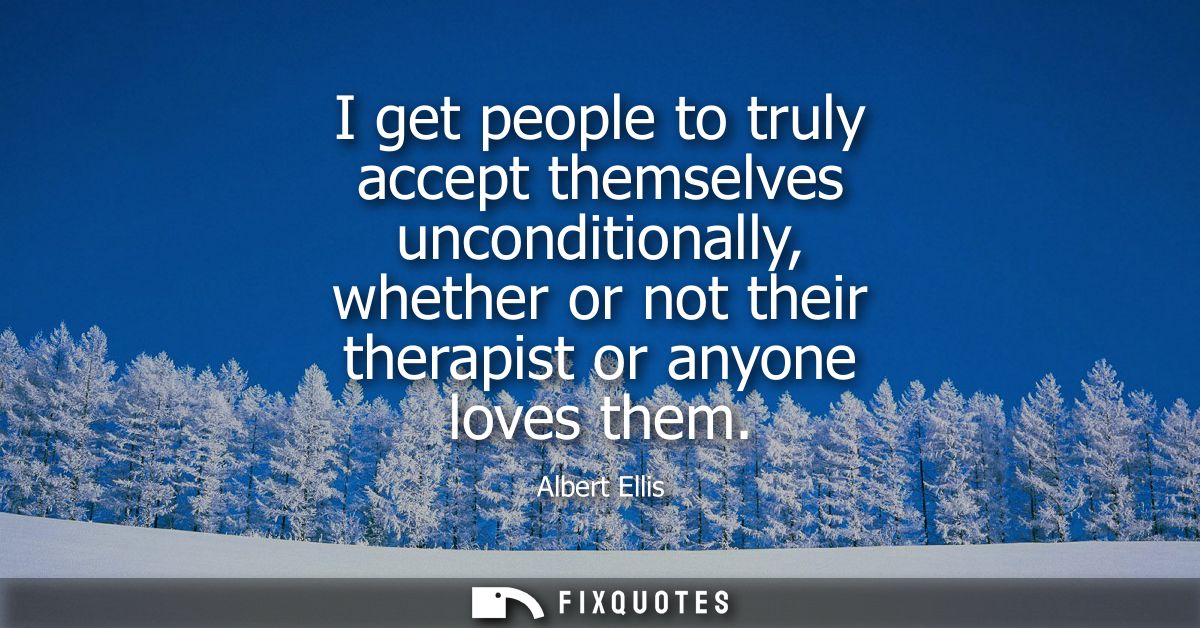
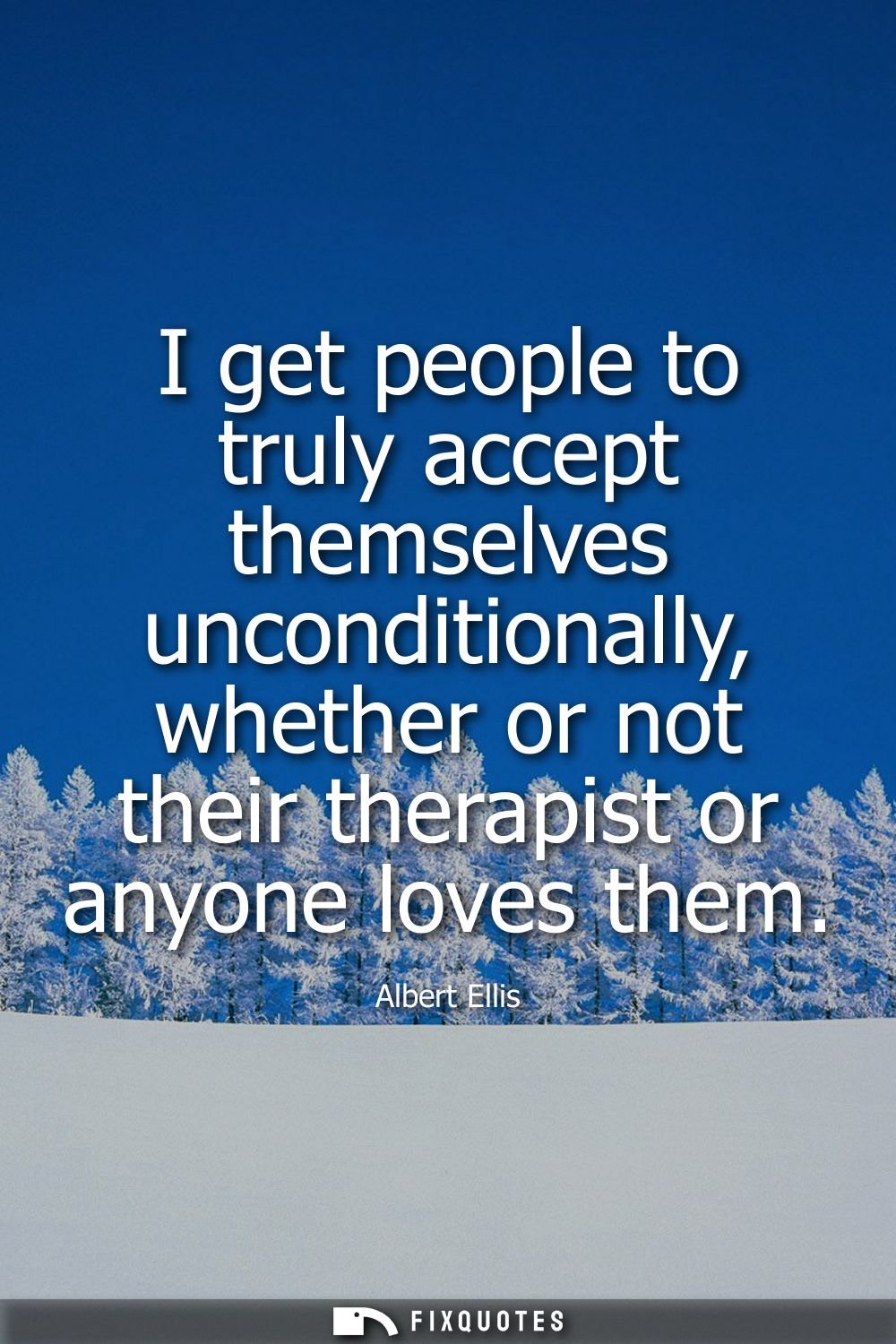
"I get people to truly accept themselves unconditionally, whether or not their therapist or anyone loves them"
About this Quote
The intent is clinical but also quietly insurgent. "Whether or not their therapist... loves them" pokes at a taboo inside helping professions: the therapist as moral authority, as the dispenser of legitimacy. Ellis is warning that even therapy can become another stage for earning approval, another arena where the client performs wellness. By yanking love out of the equation, he reframes mental health as a practice of disentangling identity from evaluation.
The subtext is almost abrasive: you don't need to be special to be acceptable. In an era that increasingly medicalized distress while also selling self-improvement as a lifestyle, Ellis insists on an unglamorous baseline: you are a flawed human, and that is not a verdict. It's not self-love as a warm bath; it's self-acceptance as an anti-hostage policy. He isn't promising happiness. He's promising fewer psychological ransom notes.
Quote Details
| Topic | Self-Love |
|---|---|
| Source | Help us find the source |
| Cite |
Citation Formats
APA Style (7th ed.)
Ellis, Albert. (2026, January 15). I get people to truly accept themselves unconditionally, whether or not their therapist or anyone loves them. FixQuotes. https://fixquotes.com/quotes/i-get-people-to-truly-accept-themselves-29612/
Chicago Style
Ellis, Albert. "I get people to truly accept themselves unconditionally, whether or not their therapist or anyone loves them." FixQuotes. January 15, 2026. https://fixquotes.com/quotes/i-get-people-to-truly-accept-themselves-29612/.
MLA Style (9th ed.)
"I get people to truly accept themselves unconditionally, whether or not their therapist or anyone loves them." FixQuotes, 15 Jan. 2026, https://fixquotes.com/quotes/i-get-people-to-truly-accept-themselves-29612/. Accessed 14 Mar. 2026.