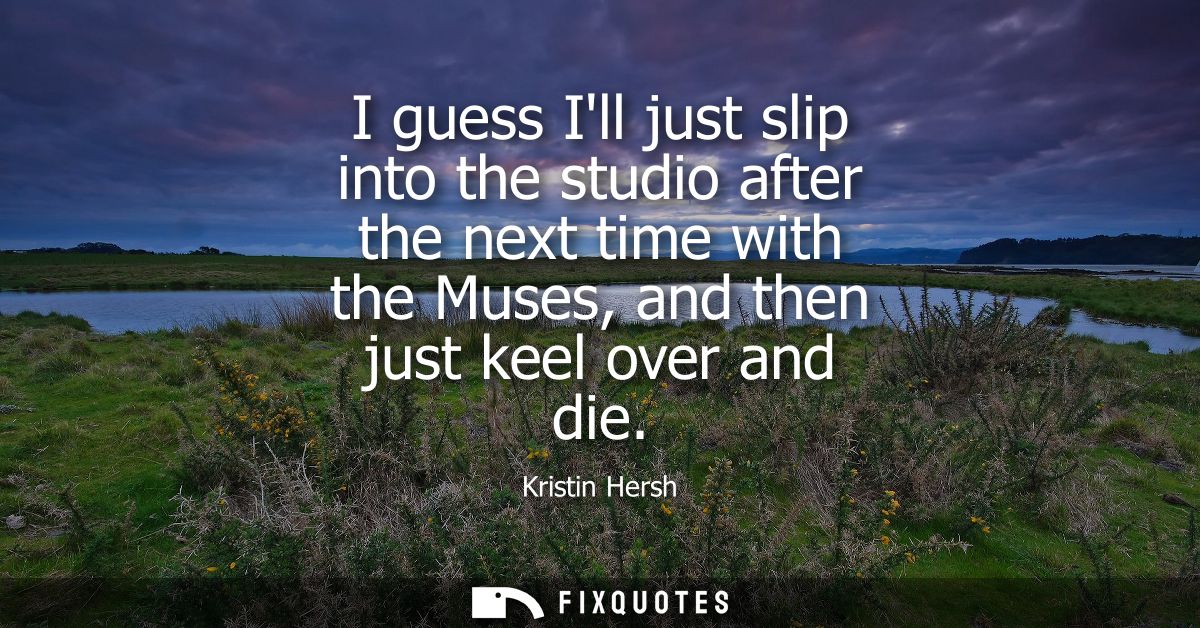
"I guess I'll just slip into the studio after the next time with the Muses, and then just keel over and die"
About this Quote
“Slip” is doing stealth work here. It suggests the studio isn’t a glamorous temple but a place you sneak into like an obligation, or like you’re trying not to wake the rest of your life. Then the Muses show up as a punchline. Artists are supposed to court them, chase them, beg for them. Hersh frames them as a recurring event she has to survive, not a gift she gets to enjoy. The joke is sharp, but it’s also a defense mechanism: if you can make inspiration sound ridiculous, maybe it can’t hurt you as much.
The subtext is that the act of turning raw feeling into a record is its own kind of self-erasure. You give the thing everything, and afterward there’s a crash: emotional, physical, chemical. This is a working musician’s realism cutting through the prestige language around “genius.” It nods to the grind of making art under deadlines, in cycles, while still being a person with a nervous system that can only take so much.
It also reads like a dare to the audience’s appetite. If you want the songs, understand the transaction: you’re asking for the part that costs her.
Quote Details
| Topic | Music |
|---|---|
| Source | Help us find the source |
| Cite |
Citation Formats
APA Style (7th ed.)
Hersh, Kristin. (2026, January 17). I guess I'll just slip into the studio after the next time with the Muses, and then just keel over and die. FixQuotes. https://fixquotes.com/quotes/i-guess-ill-just-slip-into-the-studio-after-the-80972/
Chicago Style
Hersh, Kristin. "I guess I'll just slip into the studio after the next time with the Muses, and then just keel over and die." FixQuotes. January 17, 2026. https://fixquotes.com/quotes/i-guess-ill-just-slip-into-the-studio-after-the-80972/.
MLA Style (9th ed.)
"I guess I'll just slip into the studio after the next time with the Muses, and then just keel over and die." FixQuotes, 17 Jan. 2026, https://fixquotes.com/quotes/i-guess-ill-just-slip-into-the-studio-after-the-80972/. Accessed 6 Mar. 2026.