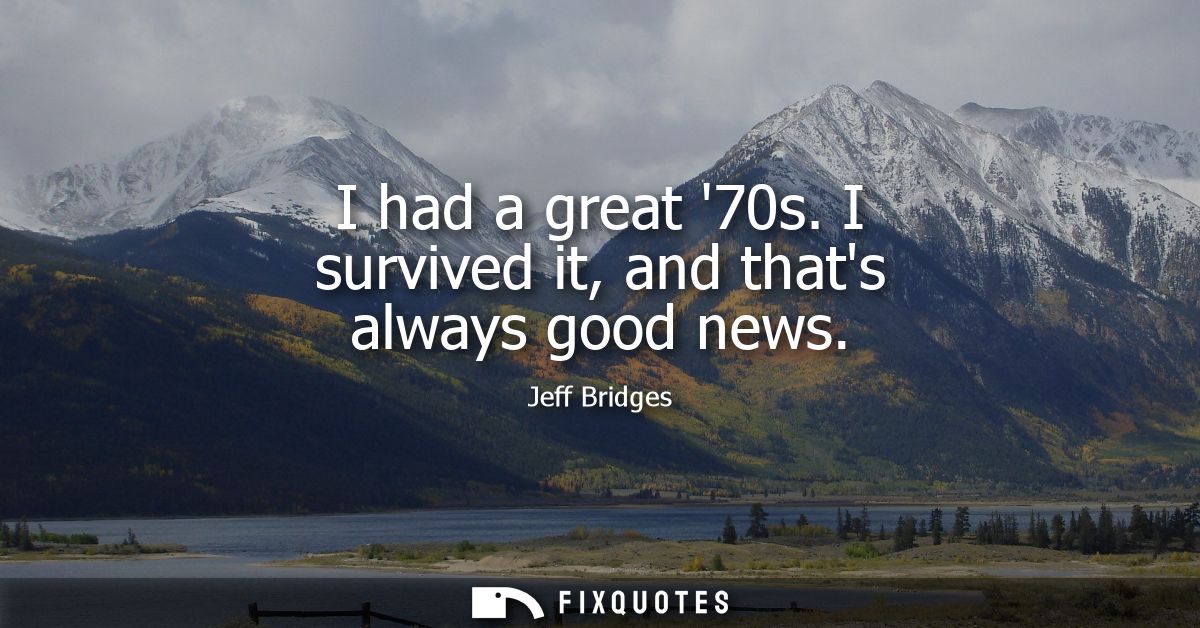
"I had a great '70s. I survived it, and that's always good news"
About this Quote
Bridges’ line lands like a wink that doubles as a tiny survival memoir. “I had a great ’70s” is the official story: the decade as sunlit freedom, Hollywood swagger, the era when the counterculture still felt like it had a future. Then he snaps the frame shut with “I survived it,” puncturing the nostalgia with a dark, almost throwaway realism. The joke works because it acknowledges what polite retrospectives often airbrush out: the ’70s weren’t just denim and good records, they were also coke, chaos, burnout, bad decisions, and a culture that glamorized self-destruction as authenticity.
The intent is modestly self-protective. Bridges isn’t confessing specifics or performing repentance; he’s controlling the narrative with humor. “Survived” implies proximity to danger without itemizing it, letting the audience fill in the blanks with the decade’s mythology. That’s savvy celebrity talk: intimate enough to feel candid, vague enough to stay tasteful.
Subtextually, it’s also a generational marker. Many public figures from that era are either gone, diminished, or trapped in endless recovery-story branding. Bridges positions himself as neither saint nor cautionary tale, just a guy who got out with his life and, crucially, with his charm intact.
The closing tag - “and that’s always good news” - is the softest possible moral. Not a lecture, not a flex. Just a reminder that in a culture that still romanticizes excess, simply making it through can be its own punchline and its own achievement.
The intent is modestly self-protective. Bridges isn’t confessing specifics or performing repentance; he’s controlling the narrative with humor. “Survived” implies proximity to danger without itemizing it, letting the audience fill in the blanks with the decade’s mythology. That’s savvy celebrity talk: intimate enough to feel candid, vague enough to stay tasteful.
Subtextually, it’s also a generational marker. Many public figures from that era are either gone, diminished, or trapped in endless recovery-story branding. Bridges positions himself as neither saint nor cautionary tale, just a guy who got out with his life and, crucially, with his charm intact.
The closing tag - “and that’s always good news” - is the softest possible moral. Not a lecture, not a flex. Just a reminder that in a culture that still romanticizes excess, simply making it through can be its own punchline and its own achievement.
Quote Details
| Topic | Witty One-Liners |
|---|---|
| Source | Help us find the source |
| Cite |
Citation Formats
APA Style (7th ed.)
Bridges, Jeff. (2026, January 17). I had a great '70s. I survived it, and that's always good news. FixQuotes. https://fixquotes.com/quotes/i-had-a-great-70s-i-survived-it-and-thats-always-67772/
Chicago Style
Bridges, Jeff. "I had a great '70s. I survived it, and that's always good news." FixQuotes. January 17, 2026. https://fixquotes.com/quotes/i-had-a-great-70s-i-survived-it-and-thats-always-67772/.
MLA Style (9th ed.)
"I had a great '70s. I survived it, and that's always good news." FixQuotes, 17 Jan. 2026, https://fixquotes.com/quotes/i-had-a-great-70s-i-survived-it-and-thats-always-67772/. Accessed 21 Mar. 2026.
More Quotes by Jeff
Add to List