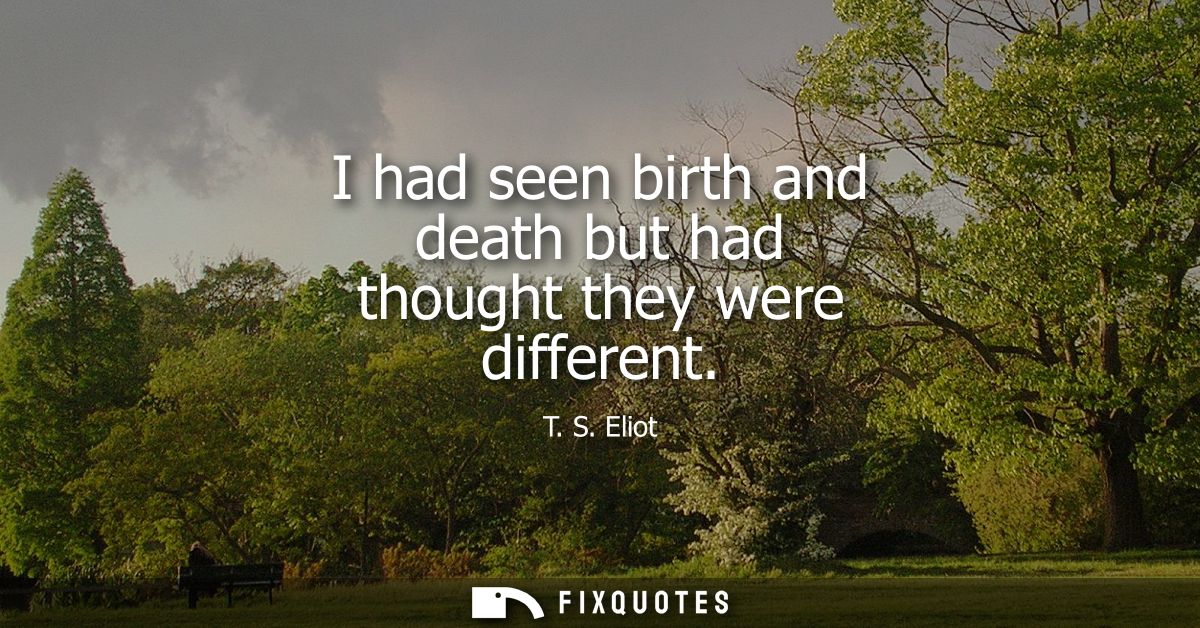
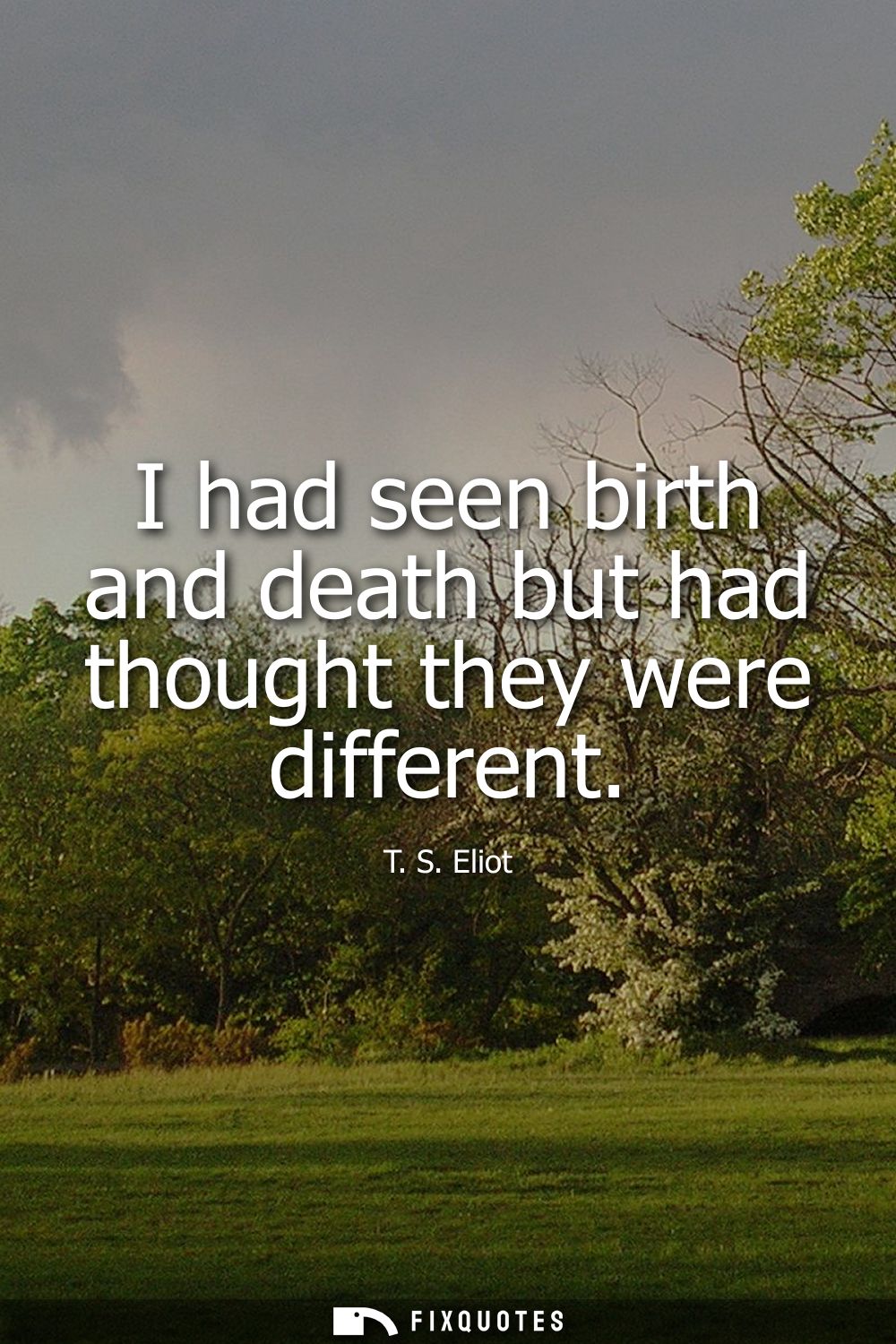
"I had seen birth and death but had thought they were different"
About this Quote
Eliot lands this line like a cold coin on a table: flat, final, impossible to ignore. The shock isn’t in the imagery (birth, death) but in the pivot of belief. “Had thought they were different” is doing the real work. It’s a confession of a worldview collapsing mid-sentence, the moment when the tidy categories that organize a life - beginnings over here, endings over there - stop holding.
The intent is less to be mystical than diagnostic. Eliot is registering modern consciousness under strain: after war, after spiritual depletion, after the daily evidence that the body’s “start” and “stop” are entangled with suffering, fear, and repetition. Birth isn’t automatically a clean dawn; death isn’t a single dramatic curtain. Each can feel like the other: an expulsion, a rupture, a crossing into dependency, a loss of self. The line suggests that what we call “new life” already contains a kind of dying (of the mother’s autonomy, of innocence, of the old self), and what we call “death” can resemble a grim delivery into whatever comes next - or into nothing.
Subtext: Eliot’s signature dread of hollow ritual and broken meaning. The speaker has “seen” the raw events, but the experience hasn’t granted clarity; it has erased distinctions. That’s quintessential Eliot: perception doesn’t redeem, it corrodes. The grammar is plain, almost reportorial, which makes the metaphysical punch sharper. He refuses consolation, and the refusal feels like the point.
The intent is less to be mystical than diagnostic. Eliot is registering modern consciousness under strain: after war, after spiritual depletion, after the daily evidence that the body’s “start” and “stop” are entangled with suffering, fear, and repetition. Birth isn’t automatically a clean dawn; death isn’t a single dramatic curtain. Each can feel like the other: an expulsion, a rupture, a crossing into dependency, a loss of self. The line suggests that what we call “new life” already contains a kind of dying (of the mother’s autonomy, of innocence, of the old self), and what we call “death” can resemble a grim delivery into whatever comes next - or into nothing.
Subtext: Eliot’s signature dread of hollow ritual and broken meaning. The speaker has “seen” the raw events, but the experience hasn’t granted clarity; it has erased distinctions. That’s quintessential Eliot: perception doesn’t redeem, it corrodes. The grammar is plain, almost reportorial, which makes the metaphysical punch sharper. He refuses consolation, and the refusal feels like the point.
Quote Details
| Topic | Mortality |
|---|---|
| Source | Later attribution: T. S. Eliot's Dialectical Imagination (Jewel Spears Brooker, 2018) modern compilationISBN: 9781421426525 · ID: m1h0DwAAQBAJ
Evidence:
... I had seen birth and death , But had thought they were different ; this Birth was Hard and bitter agony for us ... T. S. Eliot's Dialectical Imagination. |
| Cite |
Citation Formats
APA Style (7th ed.)
Eliot, T. S. (2026, March 24). I had seen birth and death but had thought they were different. FixQuotes. https://fixquotes.com/quotes/i-had-seen-birth-and-death-but-had-thought-they-22309/
Chicago Style
Eliot, T. S. "I had seen birth and death but had thought they were different." FixQuotes. March 24, 2026. https://fixquotes.com/quotes/i-had-seen-birth-and-death-but-had-thought-they-22309/.
MLA Style (9th ed.)
"I had seen birth and death but had thought they were different." FixQuotes, 24 Mar. 2026, https://fixquotes.com/quotes/i-had-seen-birth-and-death-but-had-thought-they-22309/. Accessed 7 Apr. 2026.
More Quotes by S. Eliot
Add to List