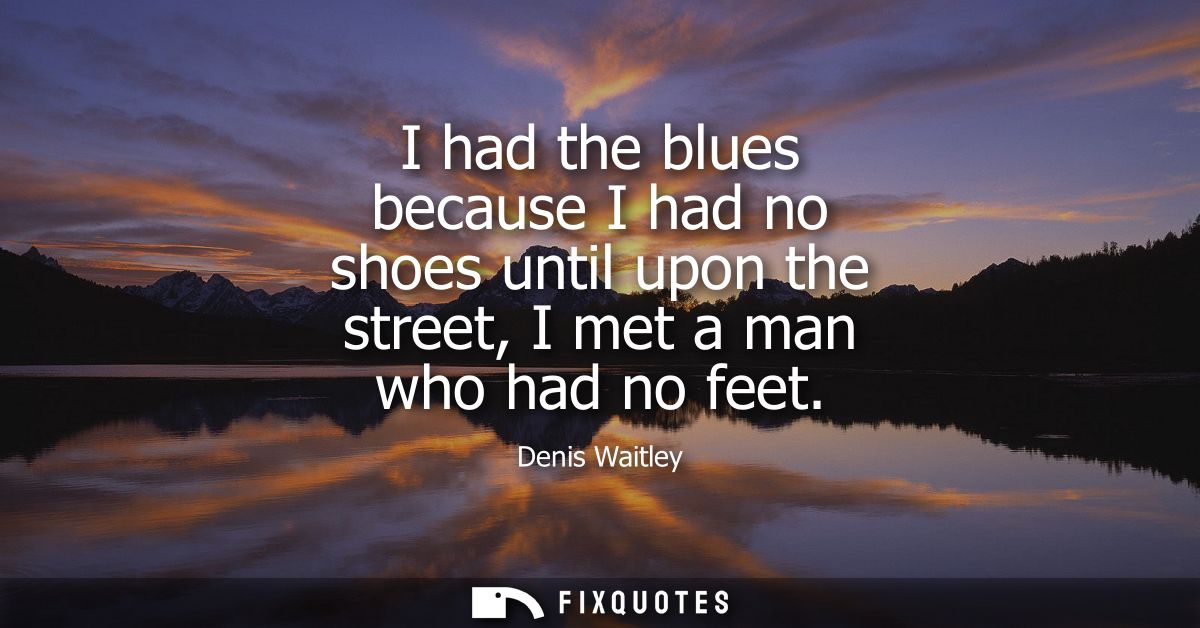
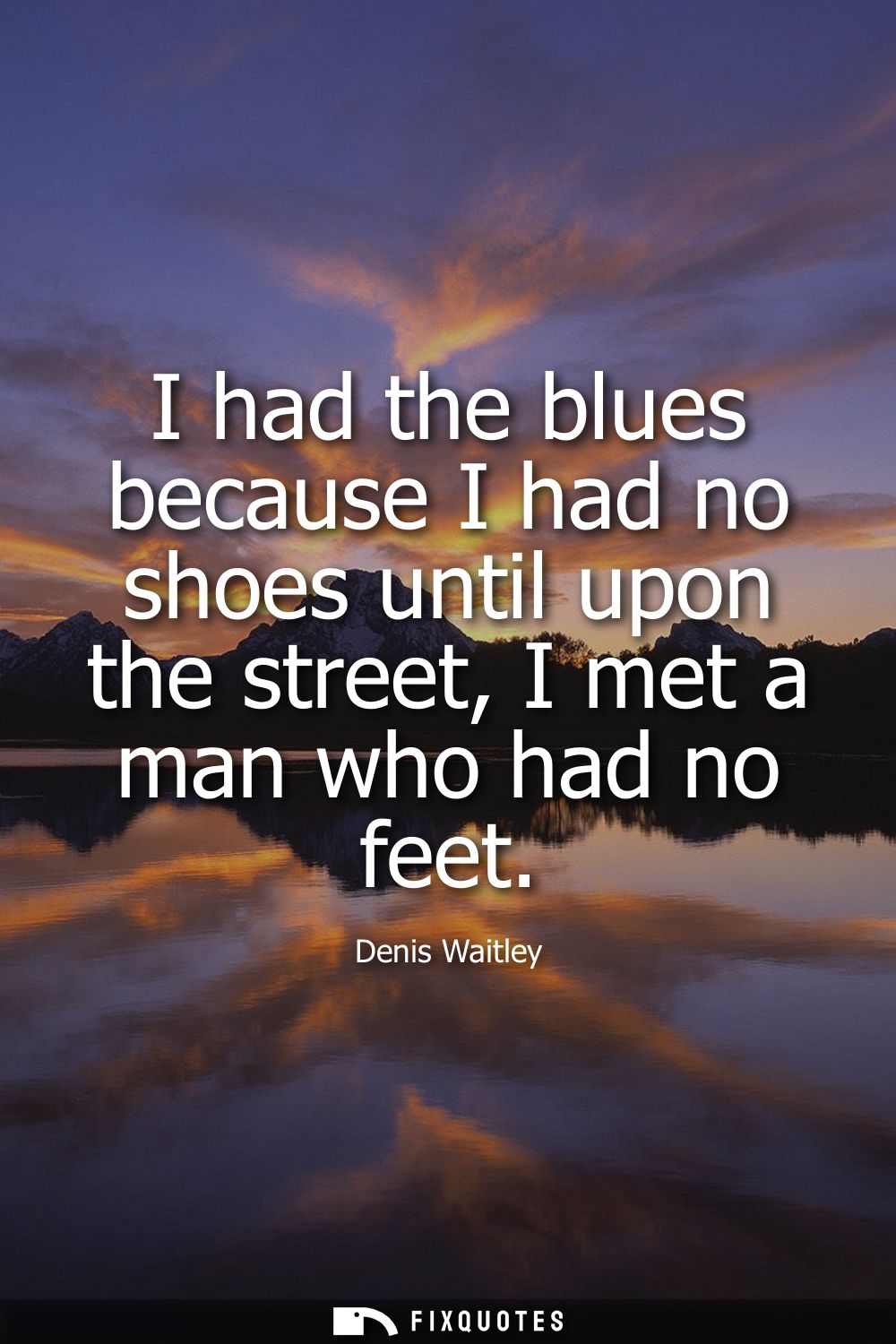
"I had the blues because I had no shoes, until upon the street, I met a man who had no feet"
About this Quote
The specific intent is motivational, but not the soft kind. Waitley doesn’t argue you out of complaining; he ambushes you with perspective. Shoes are an everyday symbol of what we treat as baseline dignity. By making the complaint about shoes, he chooses a need that feels urgent in the moment but is also instantly recognizable as solvable. Then he introduces a figure whose lack cannot be fixed with a purchase. The sentence turns on “until,” the hinge where the private story gets interrupted by the public world.
The subtext is a gentle indictment: your misery may be real, but your frame is too small. It’s also a warning about comparison culture, long before the internet made it a lifestyle. The encounter isn’t about ranking pain for sport; it’s about recalibrating gratitude by forcing proximity, the oldest empathy technology we have.
Context matters: Waitley is a self-help writer from the late-20th-century American optimism industry, where moral lessons need to be portable, repeatable, and clean enough to fit on a poster. The line works because it’s cinematic and ruthless: one walk down the street, one reversal, and your narrative loses the luxury of being the only one in town.
Quote Details
| Topic | Gratitude |
|---|---|
| Source | Help us find the source |
| Cite |
Citation Formats
APA Style (7th ed.)
Waitley, Denis. (2026, February 19). I had the blues because I had no shoes, until upon the street, I met a man who had no feet. FixQuotes. https://fixquotes.com/quotes/i-had-the-blues-because-i-had-no-shoes-until-upon-30770/
Chicago Style
Waitley, Denis. "I had the blues because I had no shoes, until upon the street, I met a man who had no feet." FixQuotes. February 19, 2026. https://fixquotes.com/quotes/i-had-the-blues-because-i-had-no-shoes-until-upon-30770/.
MLA Style (9th ed.)
"I had the blues because I had no shoes, until upon the street, I met a man who had no feet." FixQuotes, 19 Feb. 2026, https://fixquotes.com/quotes/i-had-the-blues-because-i-had-no-shoes-until-upon-30770/. Accessed 31 Mar. 2026.