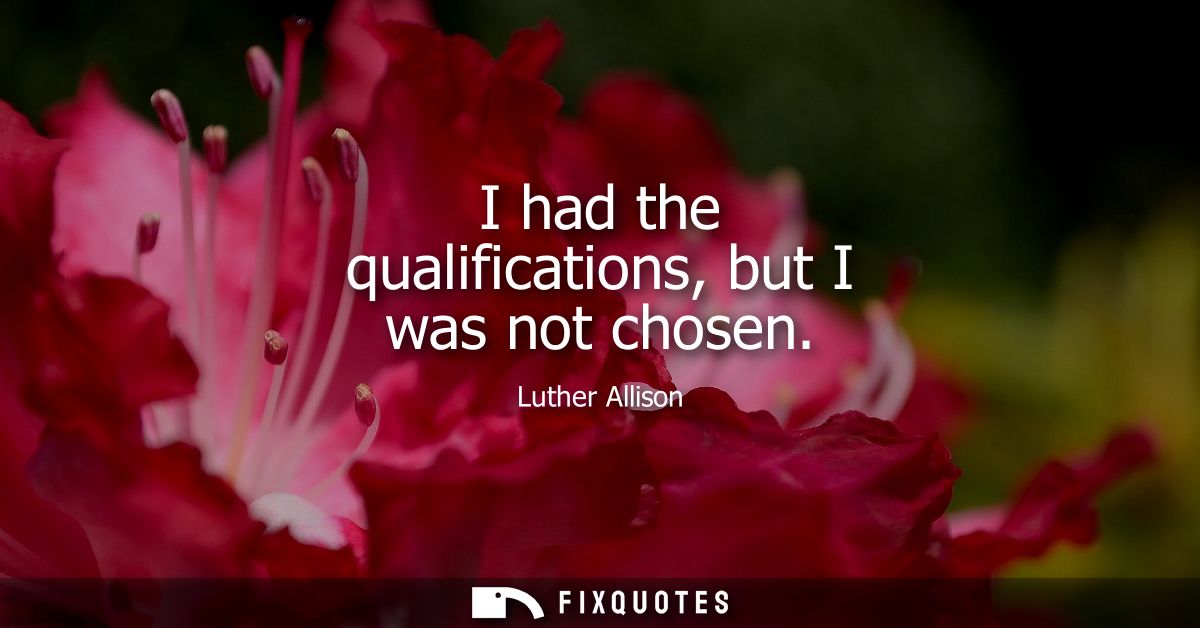
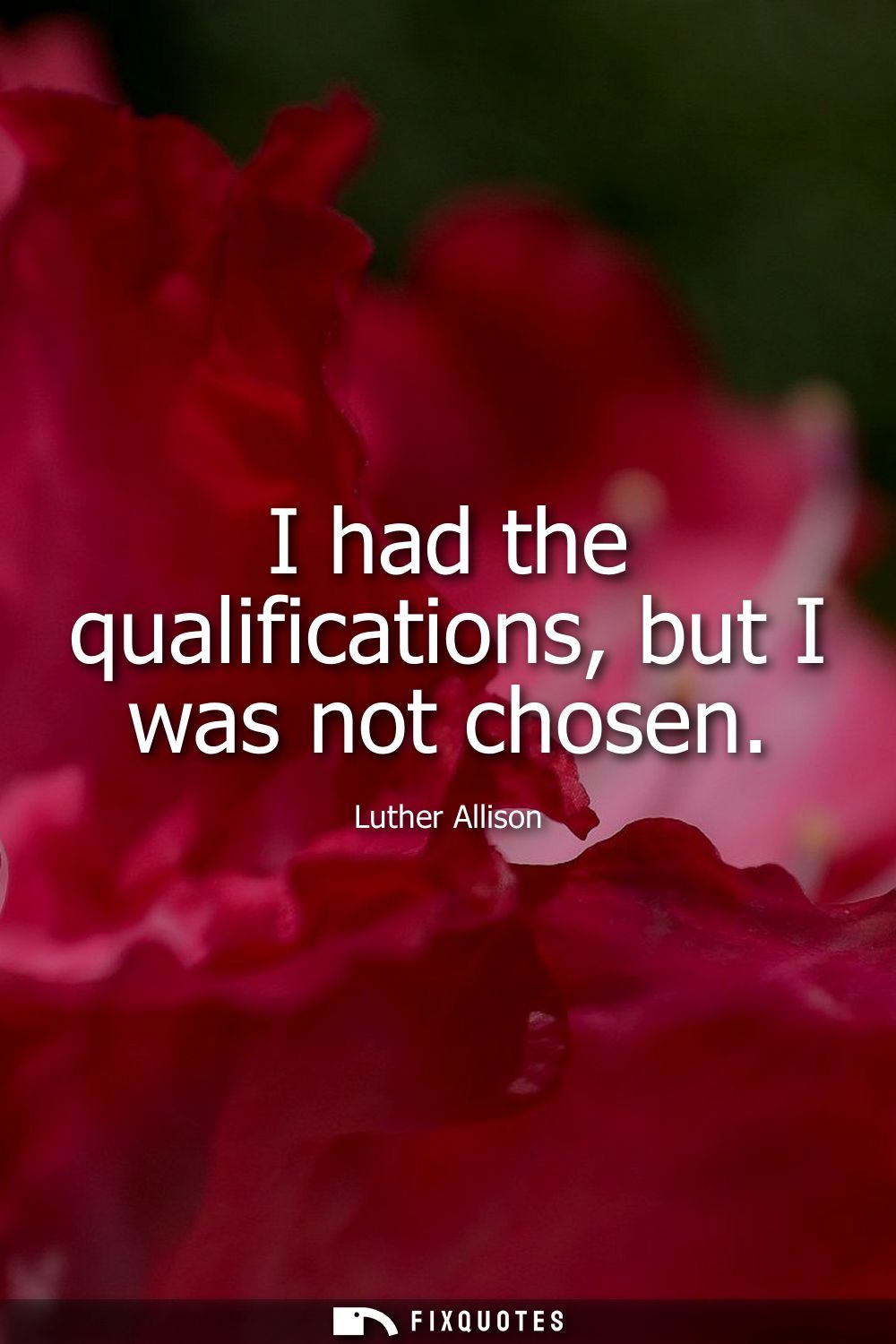
"I had the qualifications, but I was not chosen"
About this Quote
A bluesman’s complaint dressed up as a clean, almost bureaucratic sentence, “I had the qualifications, but I was not chosen” lands because it refuses the melodrama you expect from pain. Luther Allison frames rejection like a job interview gone sideways: credentials on one side, the locked door on the other. That mismatch is the engine of the line. It’s not just that someone said no; it’s that the no feels irrational, even rigged, like the rules were written to be unwinnable.
Coming from a working musician, “qualifications” reads double. It’s the obvious stuff: chops, years on the road, a catalog that proves you can do the work. It’s also the quieter resume blues artists carry: resilience, improvisation, the ability to keep playing when the market would rather you disappear. Allison spent decades better appreciated in Europe than in the American mainstream, and the sentence echoes that long history of Black innovators getting validated everywhere except the gate they built.
The subtext is pride with teeth. He’s not begging for sympathy; he’s building a moral case. If merit isn’t enough, then selection isn’t about merit. It’s about taste-makers, politics, branding, and the soft prejudices that hide behind “fit.” The line’s power is how modern it feels: a one-sentence autopsy of how industries talk about opportunity while practicing exclusion, and how a person can be undeniably ready and still left unpicked.
Coming from a working musician, “qualifications” reads double. It’s the obvious stuff: chops, years on the road, a catalog that proves you can do the work. It’s also the quieter resume blues artists carry: resilience, improvisation, the ability to keep playing when the market would rather you disappear. Allison spent decades better appreciated in Europe than in the American mainstream, and the sentence echoes that long history of Black innovators getting validated everywhere except the gate they built.
The subtext is pride with teeth. He’s not begging for sympathy; he’s building a moral case. If merit isn’t enough, then selection isn’t about merit. It’s about taste-makers, politics, branding, and the soft prejudices that hide behind “fit.” The line’s power is how modern it feels: a one-sentence autopsy of how industries talk about opportunity while practicing exclusion, and how a person can be undeniably ready and still left unpicked.
Quote Details
| Topic | Failure |
|---|---|
| Source | Help us find the source |
| Cite |
Citation Formats
APA Style (7th ed.)
Allison, Luther. (2026, January 15). I had the qualifications, but I was not chosen. FixQuotes. https://fixquotes.com/quotes/i-had-the-qualifications-but-i-was-not-chosen-88503/
Chicago Style
Allison, Luther. "I had the qualifications, but I was not chosen." FixQuotes. January 15, 2026. https://fixquotes.com/quotes/i-had-the-qualifications-but-i-was-not-chosen-88503/.
MLA Style (9th ed.)
"I had the qualifications, but I was not chosen." FixQuotes, 15 Jan. 2026, https://fixquotes.com/quotes/i-had-the-qualifications-but-i-was-not-chosen-88503/. Accessed 31 Mar. 2026.
More Quotes by Luther
Add to List