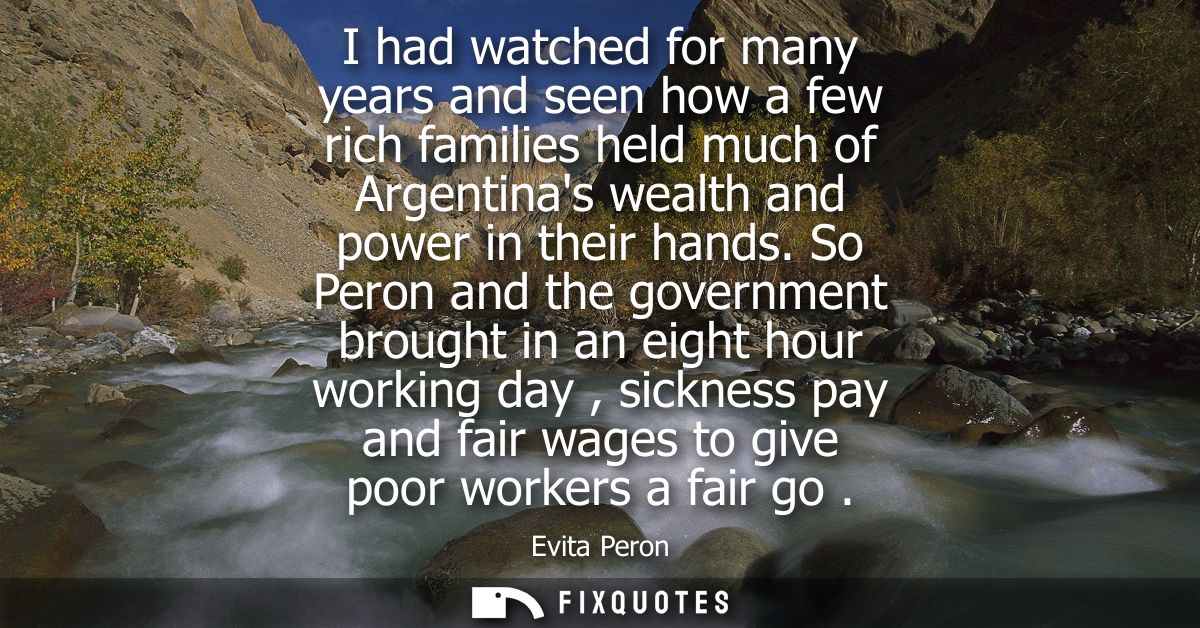
"I had watched for many years and seen how a few rich families held much of Argentina's wealth and power in their hands. So Peron and the government brought in an eight hour working day , sickness pay and fair wages to give poor workers a fair go "
About this Quote
The pivot is equally strategic. "So Peron and the government brought in..". frames Peronism as corrective force, not just ideology. Listing the reforms - eight-hour day, sickness pay, fair wages - is rhetorical concreteness: politics translated into lunch pails, bodies, and pay envelopes. It also reads like a receipt, a ledger of benefits meant to prove legitimacy. In a mid-century Argentina riven by class conflict and the long shadow of oligarchic landholding, this kind of itemization functions as moral evidence: we didn't merely speak for workers; we altered the conditions of their lives.
Subtext is doing double duty. Evita speaks in the singular ("I had watched"), building a personal bond with "poor workers", but she immediately channels that intimacy into state power. "A fair go" is populism softened into common sense, a phrase that turns redistribution into decency. The intent isn't only to defend policy; it's to define who counts as the nation, and to cast Peronism as the long-overdue hand opening the fist.
Quote Details
| Topic | Equality |
|---|---|
| Source | Help us find the source |
| Cite |
Citation Formats
APA Style (7th ed.)
Peron, Evita. (2026, January 15). I had watched for many years and seen how a few rich families held much of Argentina's wealth and power in their hands. So Peron and the government brought in an eight hour working day , sickness pay and fair wages to give poor workers a fair go . FixQuotes. https://fixquotes.com/quotes/i-had-watched-for-many-years-and-seen-how-a-few-70523/
Chicago Style
Peron, Evita. "I had watched for many years and seen how a few rich families held much of Argentina's wealth and power in their hands. So Peron and the government brought in an eight hour working day , sickness pay and fair wages to give poor workers a fair go ." FixQuotes. January 15, 2026. https://fixquotes.com/quotes/i-had-watched-for-many-years-and-seen-how-a-few-70523/.
MLA Style (9th ed.)
"I had watched for many years and seen how a few rich families held much of Argentina's wealth and power in their hands. So Peron and the government brought in an eight hour working day , sickness pay and fair wages to give poor workers a fair go ." FixQuotes, 15 Jan. 2026, https://fixquotes.com/quotes/i-had-watched-for-many-years-and-seen-how-a-few-70523/. Accessed 4 Apr. 2026.