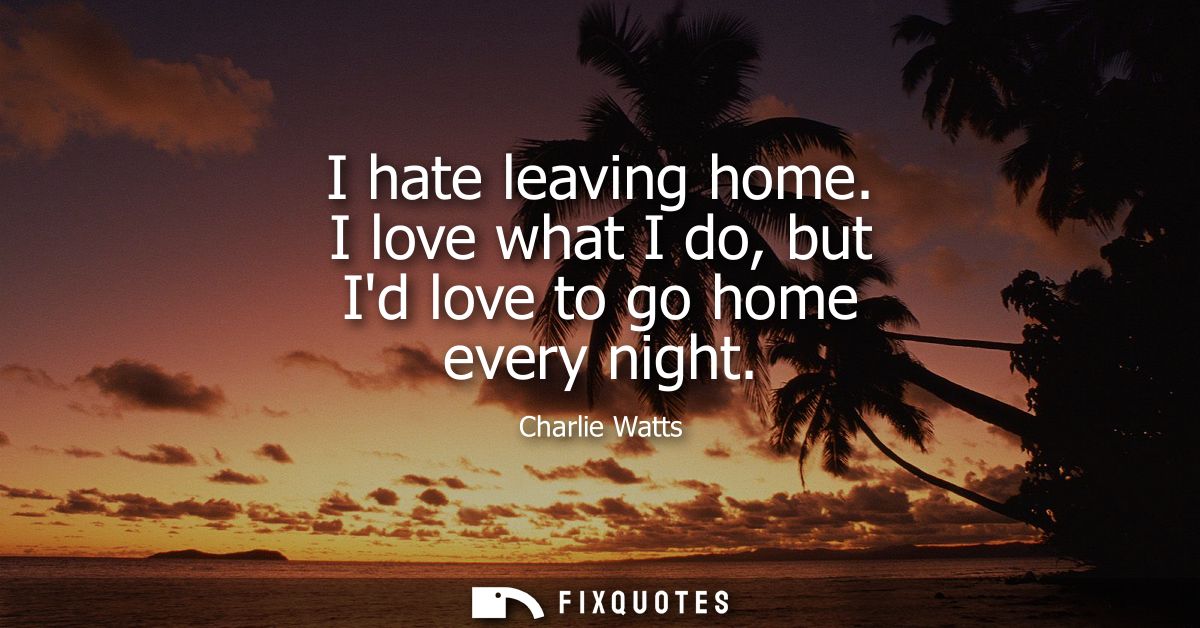
"I hate leaving home. I love what I do, but I'd love to go home every night"
About this Quote
The intent feels disarmingly personal, but it also functions as a kind of cultural correction. Watts was the engine of the Rolling Stones, a band built on motion: tours, cities, eras, scandals. Drummers are supposed to be the pulse of the party; Watts’ subtext says the pulse can come from steadiness, not chaos. The repetition of “love” does the real work here, balancing devotion to the band with devotion to domestic life, as if he’s insisting those loves don’t have to compete - even if the industry forces them to.
Context matters: for decades, rock sold itself as escape from ordinary commitments. Watts’ persona punctured that fantasy. He’s making a case for adulthood inside a youth-obsessed machine, hinting that discipline and rootedness aren’t the opposite of rebellion - they’re how you survive it.
Quote Details
| Topic | Work-Life Balance |
|---|---|
| Source | Help us find the source |
| Cite |
Citation Formats
APA Style (7th ed.)
Watts, Charlie. (2026, January 17). I hate leaving home. I love what I do, but I'd love to go home every night. FixQuotes. https://fixquotes.com/quotes/i-hate-leaving-home-i-love-what-i-do-but-id-love-44611/
Chicago Style
Watts, Charlie. "I hate leaving home. I love what I do, but I'd love to go home every night." FixQuotes. January 17, 2026. https://fixquotes.com/quotes/i-hate-leaving-home-i-love-what-i-do-but-id-love-44611/.
MLA Style (9th ed.)
"I hate leaving home. I love what I do, but I'd love to go home every night." FixQuotes, 17 Jan. 2026, https://fixquotes.com/quotes/i-hate-leaving-home-i-love-what-i-do-but-id-love-44611/. Accessed 31 Mar. 2026.