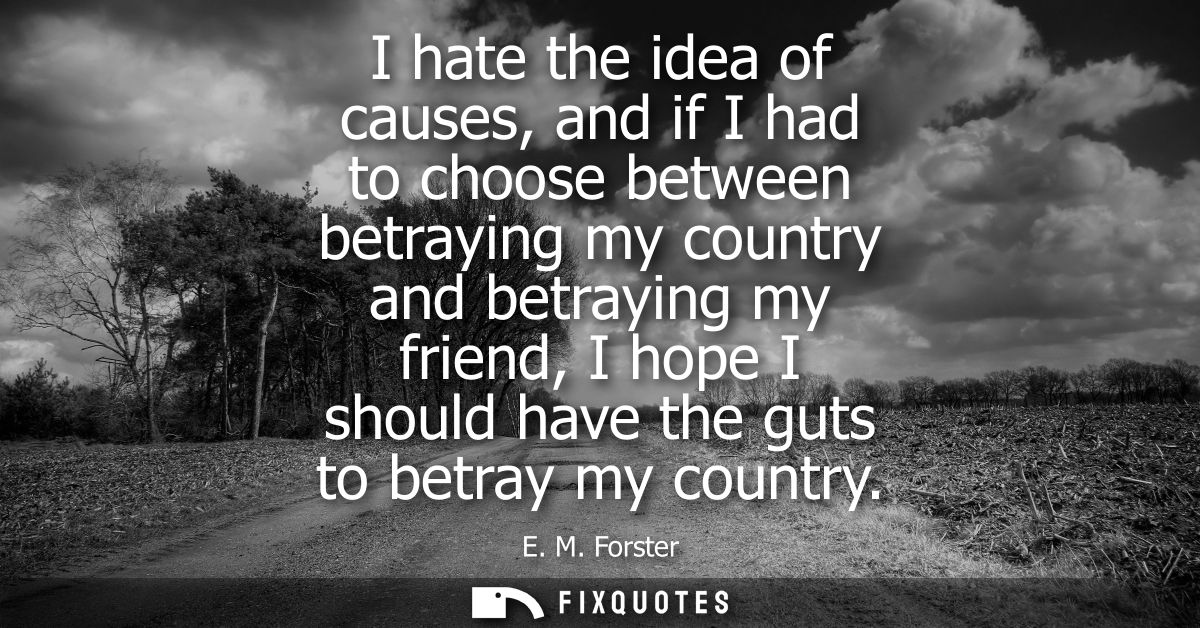
"I hate the idea of causes, and if I had to choose between betraying my country and betraying my friend, I hope I should have the guts to betray my country"
About this Quote
The subtext is anti-idolatry. Forster had watched early 20th-century Europe turn ideals into machinery: war propaganda, imperial certainty, and later the totalizing demands of fascism and communism. In that climate, the individual gets crushed between flags and slogans. His preference for “betraying my country” isn’t a policy proposal; it’s a defense of private ethics against public hysteria, insisting that real decency happens at human scale.
The phrase “I hope I should have the guts” matters as much as the heresy. It admits fear and social cost: the hardest betrayal is often of your tribe, the people who tell you you’re righteous. Forster’s wit is that he frames loyalty to a friend as the braver choice, flipping the usual moral hierarchy. The line doubles as a warning to liberals, too: if your politics requires you to harden your heart toward someone concrete, your “cause” may be doing exactly what it claims to fight.
Quote Details
| Topic | Betrayal |
|---|---|
| Source | Help us find the source |
| Cite |
Citation Formats
APA Style (7th ed.)
Forster, E. M. (2026, January 15). I hate the idea of causes, and if I had to choose between betraying my country and betraying my friend, I hope I should have the guts to betray my country. FixQuotes. https://fixquotes.com/quotes/i-hate-the-idea-of-causes-and-if-i-had-to-choose-11400/
Chicago Style
Forster, E. M. "I hate the idea of causes, and if I had to choose between betraying my country and betraying my friend, I hope I should have the guts to betray my country." FixQuotes. January 15, 2026. https://fixquotes.com/quotes/i-hate-the-idea-of-causes-and-if-i-had-to-choose-11400/.
MLA Style (9th ed.)
"I hate the idea of causes, and if I had to choose between betraying my country and betraying my friend, I hope I should have the guts to betray my country." FixQuotes, 15 Jan. 2026, https://fixquotes.com/quotes/i-hate-the-idea-of-causes-and-if-i-had-to-choose-11400/. Accessed 3 Apr. 2026.