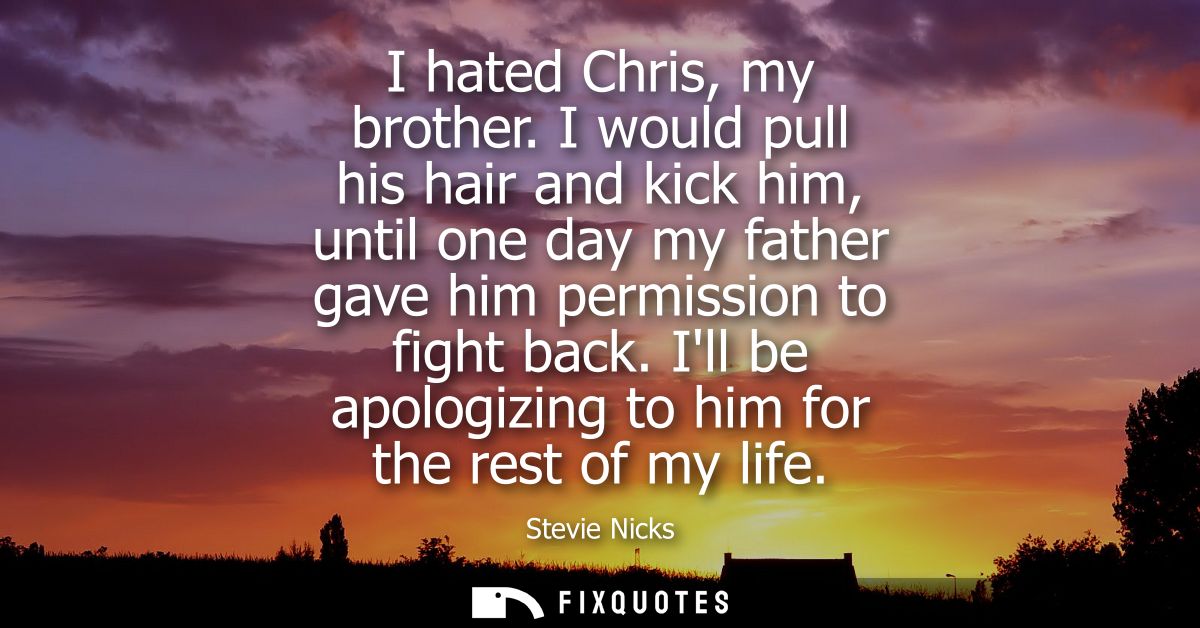
"I hated Chris, my brother. I would pull his hair and kick him until one day my father gave him permission to fight back. I'll be apologizing to him for the rest of my life"
About this Quote
The pivot is the father’s permission: not a lecture, not a punishment, but sanction. That single parental decision becomes the moral hinge of the story, revealing how families quietly engineer power dynamics. “Permission to fight back” isn’t just about self-defense; it’s the moment the household stops treating harm as one-sided entitlement. The subtext is that boundaries sometimes arrive late, and when they do, they redraw your self-image. Nicks frames it as a before-and-after: the child who could act without consequence meets the reality of consequence.
Then comes the line that does the real work: “I’ll be apologizing to him for the rest of my life.” It’s disproportionate on purpose. She’s describing how early violence doesn’t stay in childhood; it calcifies into a lifelong ledger. From a musician who built a career turning messy feelings into melody, the statement reads like a private lyric stripped of metaphor: remorse as a repeating chorus, family as the first band you can’t quit, and guilt as the one tour that never ends.
Quote Details
| Topic | Brother |
|---|---|
| Source | Help us find the source |
| Cite |
Citation Formats
APA Style (7th ed.)
Nicks, Stevie. (2026, February 16). I hated Chris, my brother. I would pull his hair and kick him until one day my father gave him permission to fight back. I'll be apologizing to him for the rest of my life. FixQuotes. https://fixquotes.com/quotes/i-hated-chris-my-brother-i-would-pull-his-hair-116870/
Chicago Style
Nicks, Stevie. "I hated Chris, my brother. I would pull his hair and kick him until one day my father gave him permission to fight back. I'll be apologizing to him for the rest of my life." FixQuotes. February 16, 2026. https://fixquotes.com/quotes/i-hated-chris-my-brother-i-would-pull-his-hair-116870/.
MLA Style (9th ed.)
"I hated Chris, my brother. I would pull his hair and kick him until one day my father gave him permission to fight back. I'll be apologizing to him for the rest of my life." FixQuotes, 16 Feb. 2026, https://fixquotes.com/quotes/i-hated-chris-my-brother-i-would-pull-his-hair-116870/. Accessed 14 Mar. 2026.