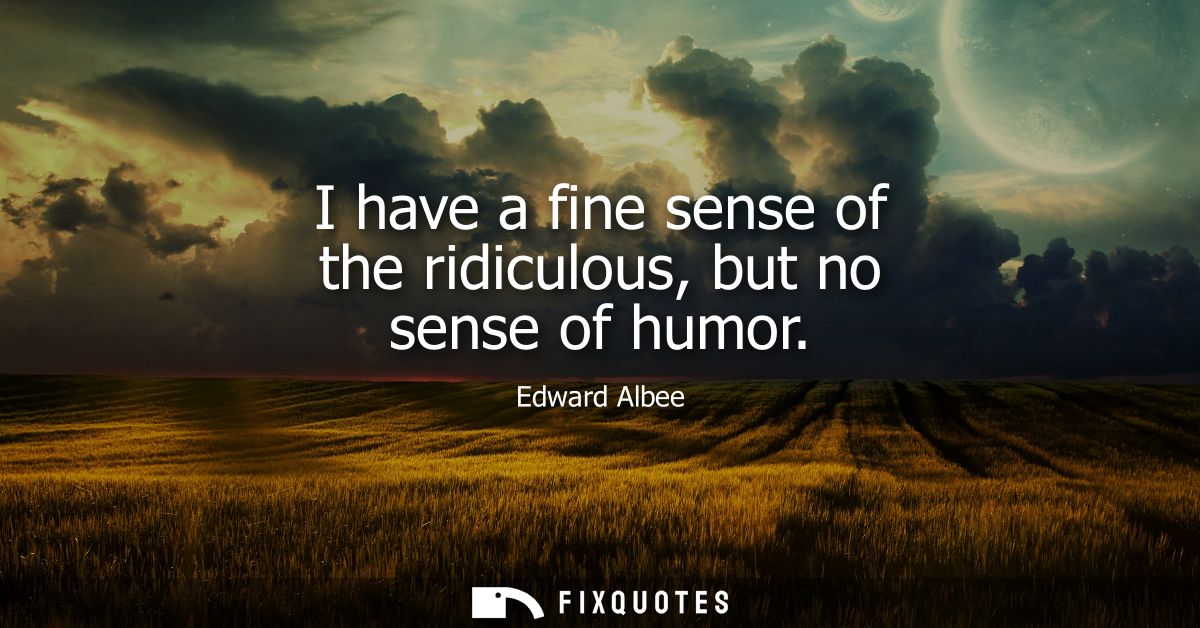
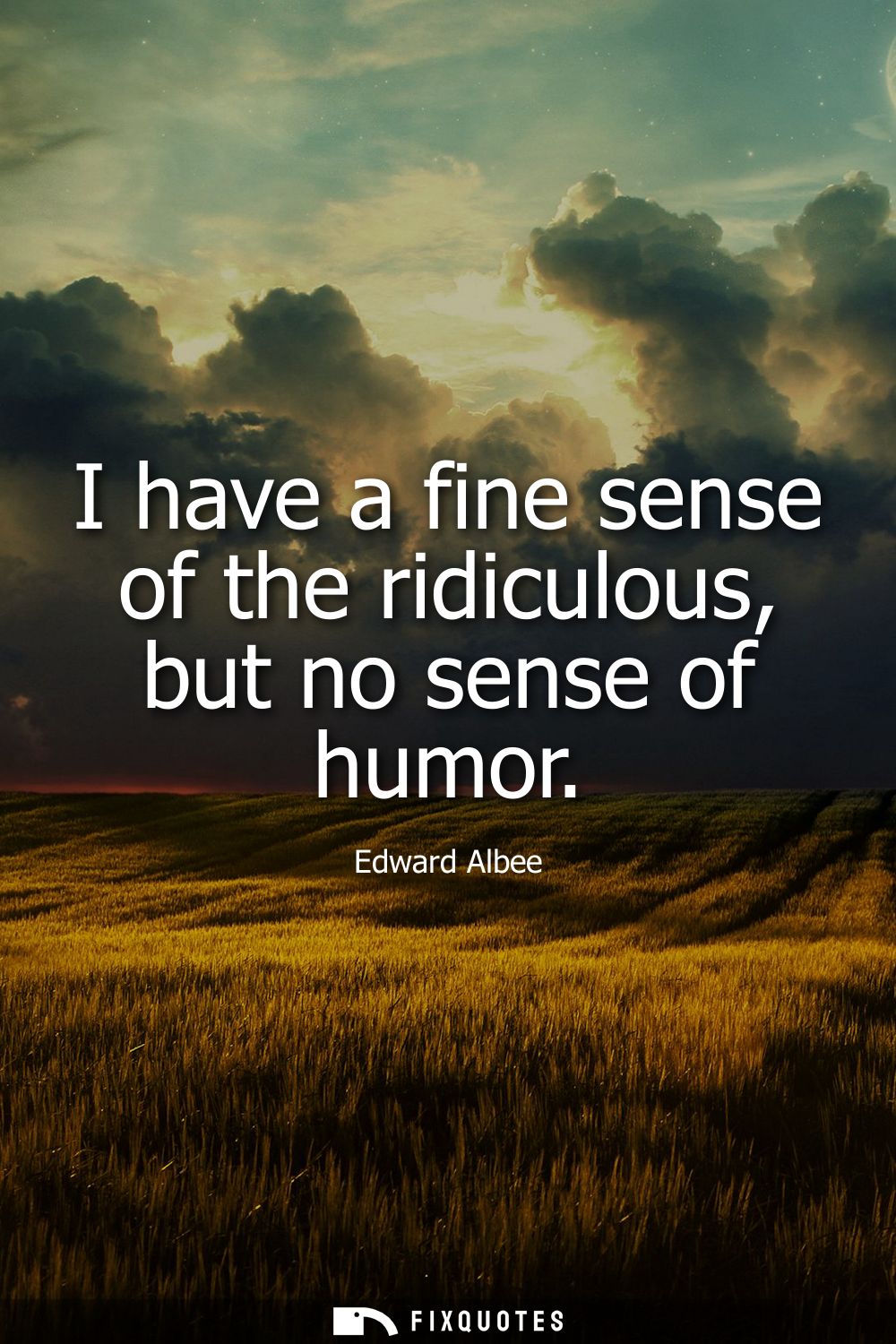
"I have a fine sense of the ridiculous, but no sense of humor"
About this Quote
Albee’s line is a scalpel masquerading as a shrug. “A fine sense of the ridiculous” sounds like a party trick, the cultivated ability to spot nonsense in people and institutions. Then he snaps the hinge: “but no sense of humor.” He’s refusing the social contract that says recognition of absurdity should arrive softened by laughter. For Albee, the ridiculous isn’t cute; it’s diagnostic. Humor reassures. It tells an audience that the world’s contradictions can be safely consumed, then dismissed. Albee’s theater does the opposite: it catches the audience in the act of coping.
The intent is partly defensive, partly aggressive. Defensive because “humor” can be a trap label pinned on playwrights whose work is uncomfortable; if you call it funny, you can avoid calling it cruel, intimate, or true. Aggressive because he’s claiming the right to stare at human behavior without granting it the consolation prize of a punchline. The subtext is: I see the farce, but I’m not here to forgive it.
Context matters. Albee wrote in the postwar boom, when American optimism was both loud and brittle, and his most famous domestic battlegrounds (Who’s Afraid of Virginia Woolf?, The Zoo Story) turn living rooms into arenas where language is weaponry and performance is survival. The ridiculous, in that world, is the gap between the stories people tell about themselves and the bargains they actually live by. If the audience laughs, it’s often a nervous reflex. Albee’s point is that the joke isn’t a release valve; it’s the alarm.
The intent is partly defensive, partly aggressive. Defensive because “humor” can be a trap label pinned on playwrights whose work is uncomfortable; if you call it funny, you can avoid calling it cruel, intimate, or true. Aggressive because he’s claiming the right to stare at human behavior without granting it the consolation prize of a punchline. The subtext is: I see the farce, but I’m not here to forgive it.
Context matters. Albee wrote in the postwar boom, when American optimism was both loud and brittle, and his most famous domestic battlegrounds (Who’s Afraid of Virginia Woolf?, The Zoo Story) turn living rooms into arenas where language is weaponry and performance is survival. The ridiculous, in that world, is the gap between the stories people tell about themselves and the bargains they actually live by. If the audience laughs, it’s often a nervous reflex. Albee’s point is that the joke isn’t a release valve; it’s the alarm.
Quote Details
| Topic | Witty One-Liners |
|---|---|
| Source | Help us find the source |
| Cite |
Citation Formats
APA Style (7th ed.)
Albee, Edward. (2026, January 18). I have a fine sense of the ridiculous, but no sense of humor. FixQuotes. https://fixquotes.com/quotes/i-have-a-fine-sense-of-the-ridiculous-but-no-10224/
Chicago Style
Albee, Edward. "I have a fine sense of the ridiculous, but no sense of humor." FixQuotes. January 18, 2026. https://fixquotes.com/quotes/i-have-a-fine-sense-of-the-ridiculous-but-no-10224/.
MLA Style (9th ed.)
"I have a fine sense of the ridiculous, but no sense of humor." FixQuotes, 18 Jan. 2026, https://fixquotes.com/quotes/i-have-a-fine-sense-of-the-ridiculous-but-no-10224/. Accessed 20 Mar. 2026.
More Quotes by Edward
Add to List