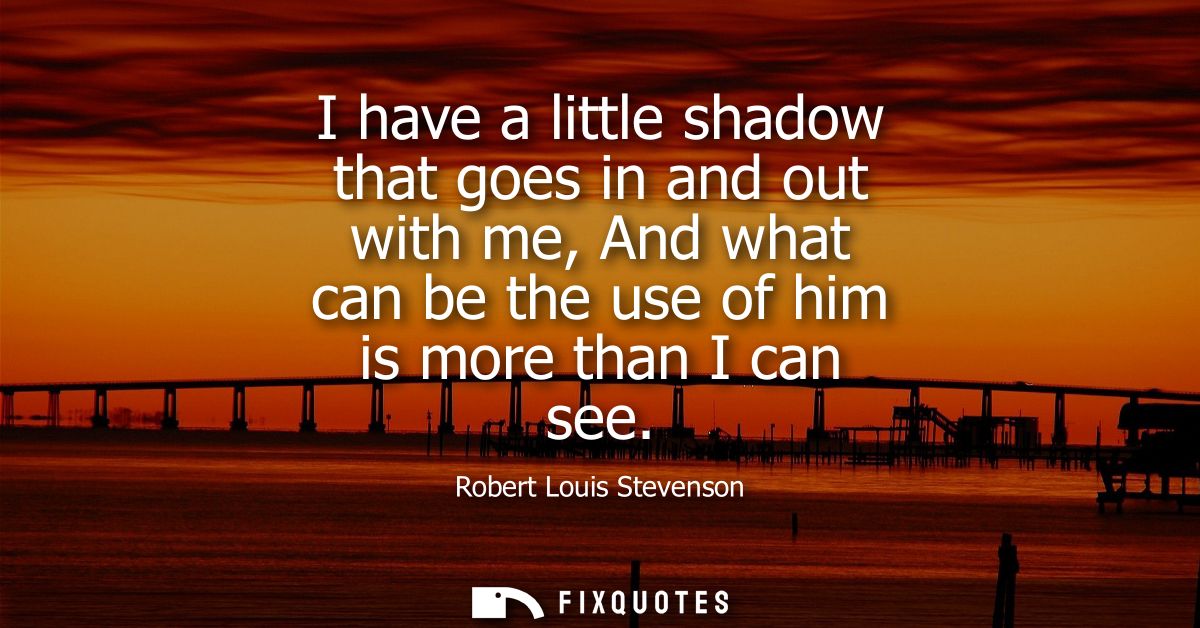
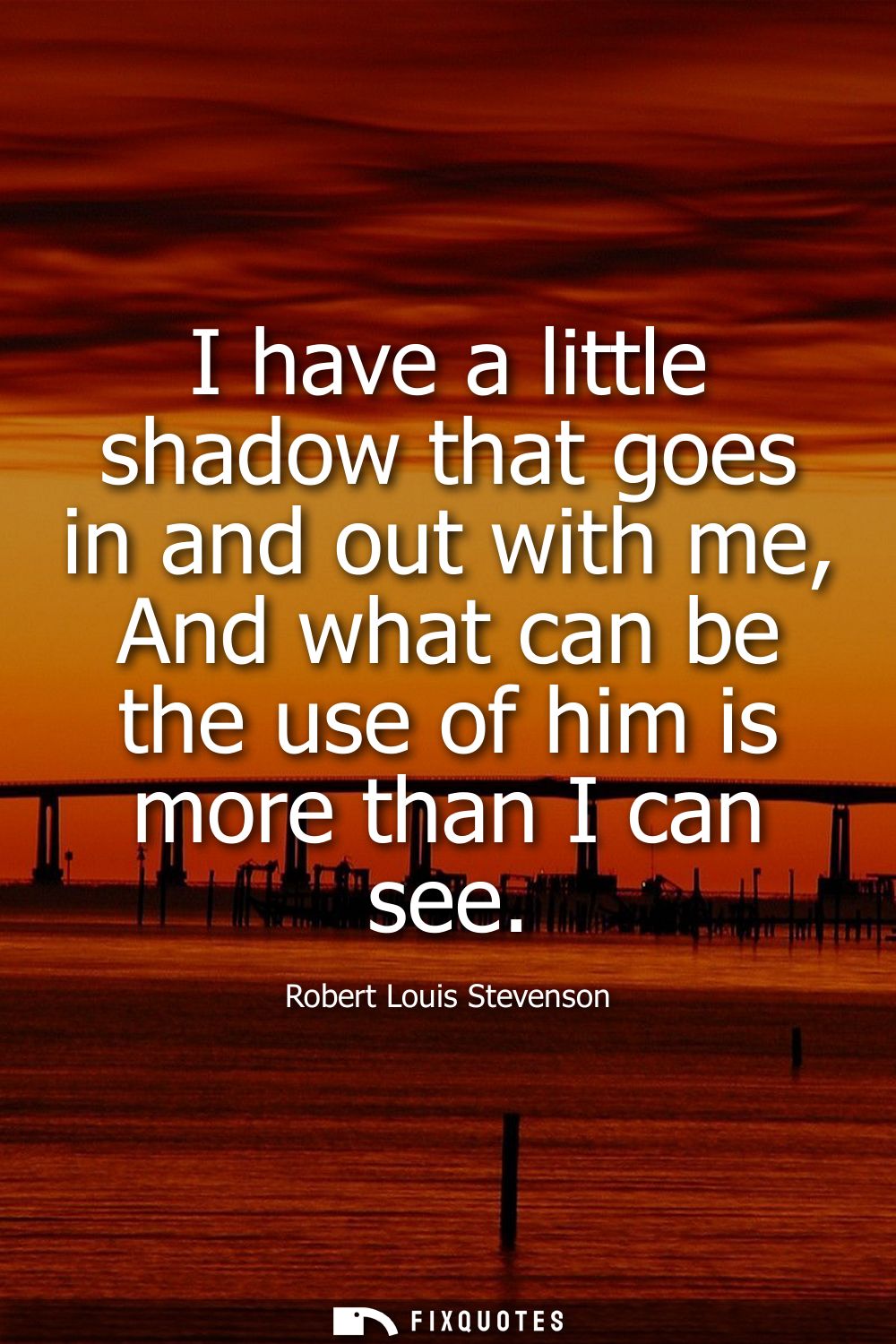
"I have a little shadow that goes in and out with me, And what can be the use of him is more than I can see"
About this Quote
Stevenson wrote “My Shadow” for A Child’s Garden of Verses, a book that famously refuses to patronize children. The poem’s voice is young, but the unease is adult. Notice how the shadow is gendered “him,” making it less a phenomenon than a companion - or a rival. It “goes in and out,” suggesting a threshold life: indoors/outdoors, safety/risk, daylight/darkness. The child can’t control it, can’t bargain with it, can only observe its strange loyalty.
In late-Victorian Britain, shadows carried extra freight: the era’s fascination with doubles and divided selves (think Jekyll and Hyde, Stevenson’s own later hit) and a moral culture obsessed with what follows you when no one is looking. Stevenson’s intent isn’t to sermonize; it’s to stage the first encounter with that haunting fact: you are never just one thing, even when you’re alone.
Quote Details
| Topic | Poetry |
|---|---|
| Source | "My Shadow" (poem), A Child's Garden of Verses, Robert Louis Stevenson, 1885 — first stanza (opening lines). |
| Cite |
Citation Formats
APA Style (7th ed.)
Stevenson, Robert Louis. (2026, January 18). I have a little shadow that goes in and out with me, And what can be the use of him is more than I can see. FixQuotes. https://fixquotes.com/quotes/i-have-a-little-shadow-that-goes-in-and-out-with-1528/
Chicago Style
Stevenson, Robert Louis. "I have a little shadow that goes in and out with me, And what can be the use of him is more than I can see." FixQuotes. January 18, 2026. https://fixquotes.com/quotes/i-have-a-little-shadow-that-goes-in-and-out-with-1528/.
MLA Style (9th ed.)
"I have a little shadow that goes in and out with me, And what can be the use of him is more than I can see." FixQuotes, 18 Jan. 2026, https://fixquotes.com/quotes/i-have-a-little-shadow-that-goes-in-and-out-with-1528/. Accessed 14 Mar. 2026.