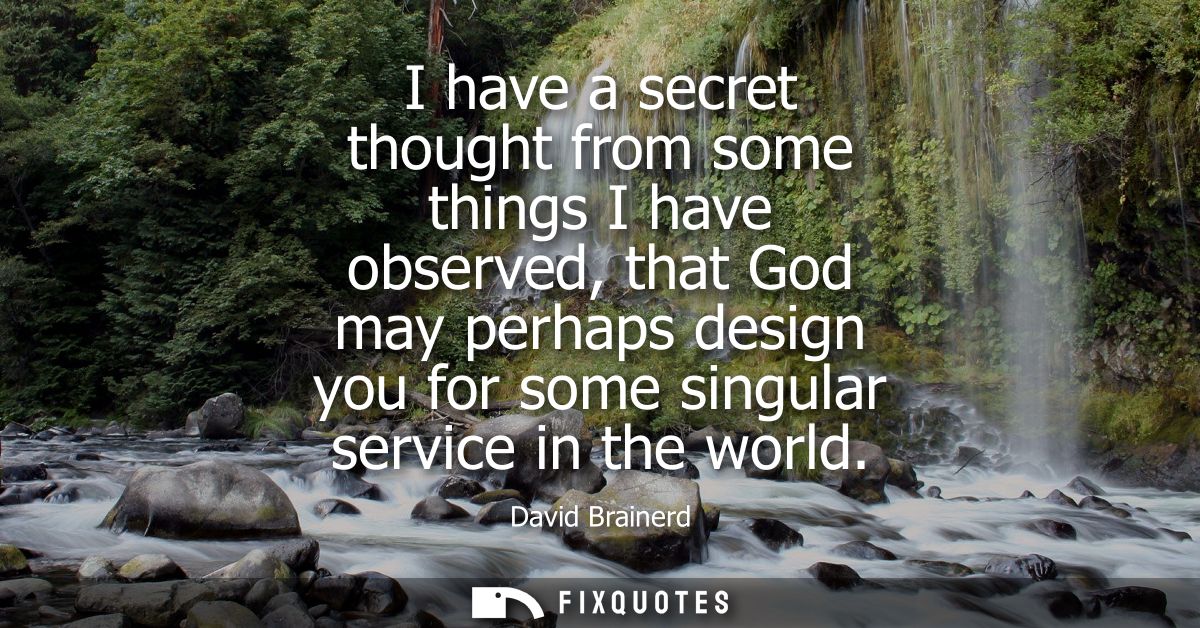
"I have a secret thought from some things I have observed, that God may perhaps design you for some singular service in the world"
About this Quote
A “secret thought” is a sly rhetorical move: Brainerd frames what’s really a charge as something almost too tender to say aloud. He isn’t merely complimenting someone’s potential; he’s recruiting them into a Puritan-adjacent worldview where a life only fully coheres when it’s read as providential assignment. The sentence offers intimacy (“from some things I have observed”) and humility (“may perhaps”) while still landing the desired blow: you are being watched, and the evidence points to calling.
Brainerd’s context matters. As an 18th-century missionary shaped by revivalist fervor and fragile health, he lived with urgency and a constant awareness of mortality. In that world, “singular service” isn’t self-actualization; it’s consecration under pressure. The word “design” does heavy lifting, implying that your talents and circumstances aren’t random, and that refusing the implied vocation is less a personal choice than a kind of misreading of reality.
The subtext is both pastoral and bracingly strategic. By claiming the thought is “secret,” Brainerd avoids the arrogance of declaring God’s will outright, yet still positions himself as a reliable interpreter of divine patterns. “Perhaps” softens the statement just enough to keep it from sounding like manipulation, even as it nudges the listener toward a single socially legible response: submission, seriousness, a life reorganized around mission.
It works because it marries affection to obligation. You’re singled out, but not for ego; for sacrifice. That’s the seduction and the discipline in one line.
Brainerd’s context matters. As an 18th-century missionary shaped by revivalist fervor and fragile health, he lived with urgency and a constant awareness of mortality. In that world, “singular service” isn’t self-actualization; it’s consecration under pressure. The word “design” does heavy lifting, implying that your talents and circumstances aren’t random, and that refusing the implied vocation is less a personal choice than a kind of misreading of reality.
The subtext is both pastoral and bracingly strategic. By claiming the thought is “secret,” Brainerd avoids the arrogance of declaring God’s will outright, yet still positions himself as a reliable interpreter of divine patterns. “Perhaps” softens the statement just enough to keep it from sounding like manipulation, even as it nudges the listener toward a single socially legible response: submission, seriousness, a life reorganized around mission.
It works because it marries affection to obligation. You’re singled out, but not for ego; for sacrifice. That’s the seduction and the discipline in one line.
Quote Details
| Topic | God |
|---|
More Quotes by David
Add to List