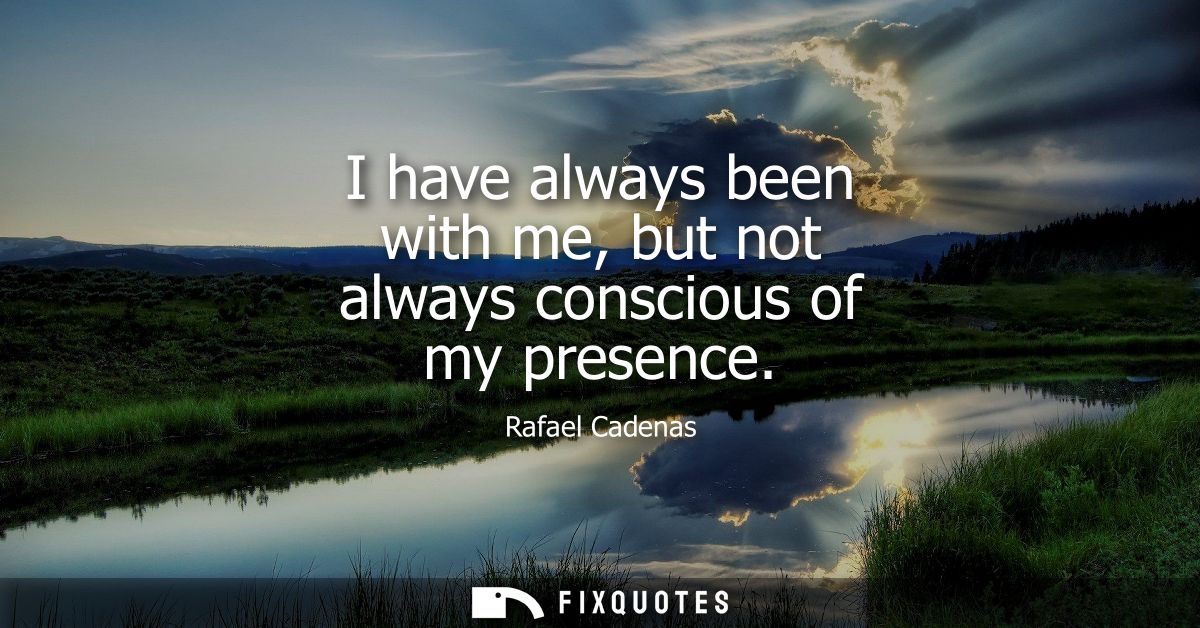
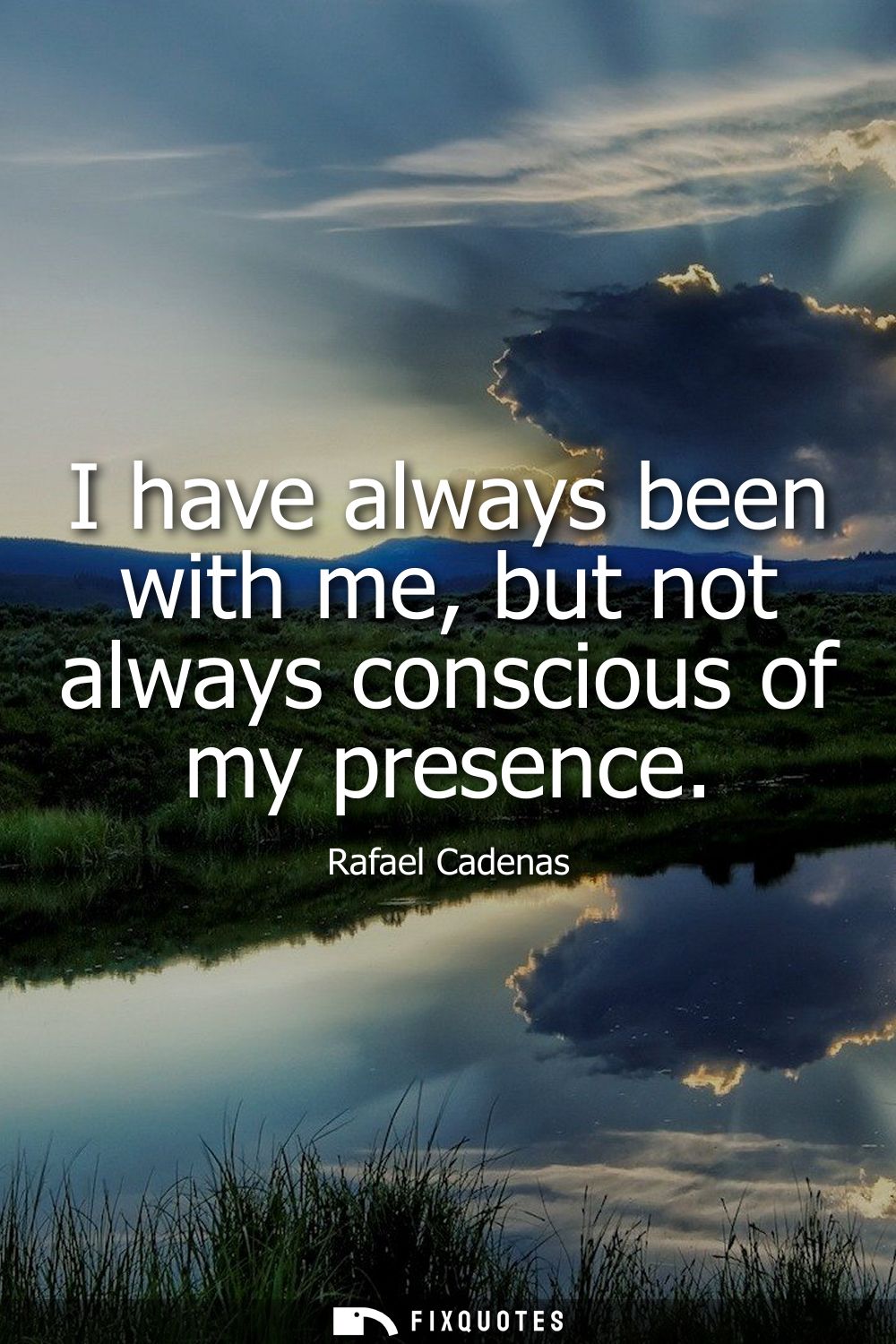
"I have always been with me, but not always conscious of my presence"
About this Quote
A poet’s quiet flex: the most intimate companion you’ll ever have is yourself, and even that relationship is often half-asleep. Cadenas frames identity not as a solid core but as a presence you can miss while living inside it. The line turns the self into both witness and stranger, collapsing the usual confidence of first-person speech. “I have always been with me” sounds like a truism until the second clause snaps it into something sharper: consciousness is intermittent, attention unreliable, intimacy with the self not guaranteed.
The intent feels less confessional than diagnostic. Cadenas isn’t staging a dramatic revelation; he’s pointing to the everyday anesthesia that keeps people moving through their lives on borrowed scripts: habit, politics, survival, ego. The subtext is a critique of modern distraction, but also of any ideology - including spiritual ones - that pretends self-knowledge is automatic or permanent. “Presence” suggests something almost meditative: a self that can be attended to like breath, not possessed like property.
Context matters: Cadenas is a Venezuelan poet shaped by political disillusionment and inner reckoning, writing in a Latin American tradition where the personal and civic frequently bleed together. In that light, “not always conscious” hints at what repression and turbulence do to interior life: they can make the self go dim, not through death but through noise. The line works because it makes alienation sound simple, then lets the simplicity sting. It leaves you with an unnerving possibility: you can survive for years and still fail to show up for your own existence.
The intent feels less confessional than diagnostic. Cadenas isn’t staging a dramatic revelation; he’s pointing to the everyday anesthesia that keeps people moving through their lives on borrowed scripts: habit, politics, survival, ego. The subtext is a critique of modern distraction, but also of any ideology - including spiritual ones - that pretends self-knowledge is automatic or permanent. “Presence” suggests something almost meditative: a self that can be attended to like breath, not possessed like property.
Context matters: Cadenas is a Venezuelan poet shaped by political disillusionment and inner reckoning, writing in a Latin American tradition where the personal and civic frequently bleed together. In that light, “not always conscious” hints at what repression and turbulence do to interior life: they can make the self go dim, not through death but through noise. The line works because it makes alienation sound simple, then lets the simplicity sting. It leaves you with an unnerving possibility: you can survive for years and still fail to show up for your own existence.
Quote Details
| Topic | Self-Love |
|---|---|
| Source | Help us find the source |
| Cite |
Citation Formats
APA Style (7th ed.)
Cadenas, Rafael. (2026, January 15). I have always been with me, but not always conscious of my presence. FixQuotes. https://fixquotes.com/quotes/i-have-always-been-with-me-but-not-always-172269/
Chicago Style
Cadenas, Rafael. "I have always been with me, but not always conscious of my presence." FixQuotes. January 15, 2026. https://fixquotes.com/quotes/i-have-always-been-with-me-but-not-always-172269/.
MLA Style (9th ed.)
"I have always been with me, but not always conscious of my presence." FixQuotes, 15 Jan. 2026, https://fixquotes.com/quotes/i-have-always-been-with-me-but-not-always-172269/. Accessed 30 Mar. 2026.
More Quotes by Rafael
Add to List