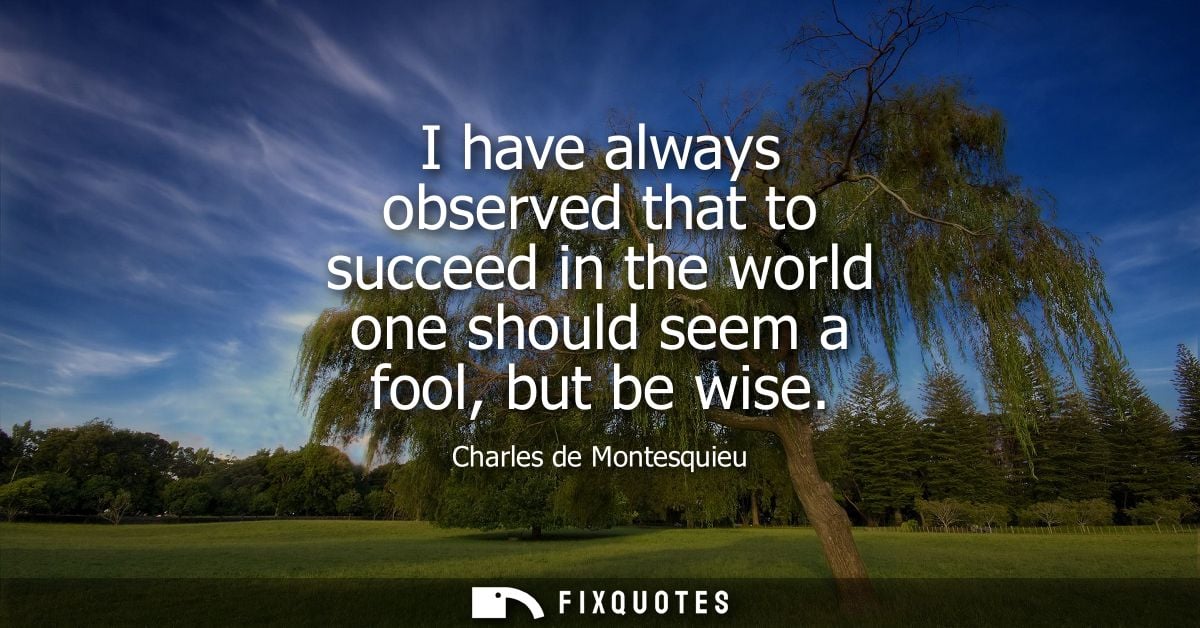
"I have always observed that to succeed in the world one should seem a fool, but be wise"
About this Quote
The subtext is that social life runs on misrecognition. People don’t simply assess what you are; they defend what your presence implies about them. If you appear too sharp, you become a mirror that flatters no one. If you appear unthreatening, you’re granted access, information, and latitude. Montesquieu is diagnosing a politics of perception: success belongs to the person who can manage others’ anxieties while keeping their own counsel.
Context matters. Montesquieu, an aristocratic jurist writing under an absolutist regime, built his critique through indirection, satire, and comparative distance (Persian Letters lets outsiders say what insiders can’t). This aphorism doubles as a survival tip and a moral indictment. It’s funny because it’s true, and unsettling because it implies a society where sincerity is for losers and wisdom must wear a costume. The irony bites: the “world” he describes is so poorly designed that it punishes the very clarity it claims to admire.
Quote Details
| Topic | Wisdom |
|---|---|
| Source | Unverified source: Pensées diverses (posthumous miscellany of pensées) (Charles de Montesquieu, 1899)
Evidence: J’ai toujours vu que, pour réussir dans le monde, il fallait avoir l’air fou, et être sage. (null). This is the closest verifiable PRIMARY-TEXT wording I can locate online in Montesquieu’s own writings: it appears in the French text of Montesquieu’s “Pensées diverses” as a standalone pensée. The ... Other candidates (1) Forbes (1979) compilation95.0% ... I have always observed that to succeed in the world one should seem a fool , but be wise . CHARLES DE MONTESQUIEU... |
| Cite |
Citation Formats
APA Style (7th ed.)
Montesquieu, Charles de. (2026, February 17). I have always observed that to succeed in the world one should seem a fool, but be wise. FixQuotes. https://fixquotes.com/quotes/i-have-always-observed-that-to-succeed-in-the-2804/
Chicago Style
Montesquieu, Charles de. "I have always observed that to succeed in the world one should seem a fool, but be wise." FixQuotes. February 17, 2026. https://fixquotes.com/quotes/i-have-always-observed-that-to-succeed-in-the-2804/.
MLA Style (9th ed.)
"I have always observed that to succeed in the world one should seem a fool, but be wise." FixQuotes, 17 Feb. 2026, https://fixquotes.com/quotes/i-have-always-observed-that-to-succeed-in-the-2804/. Accessed 24 Mar. 2026.