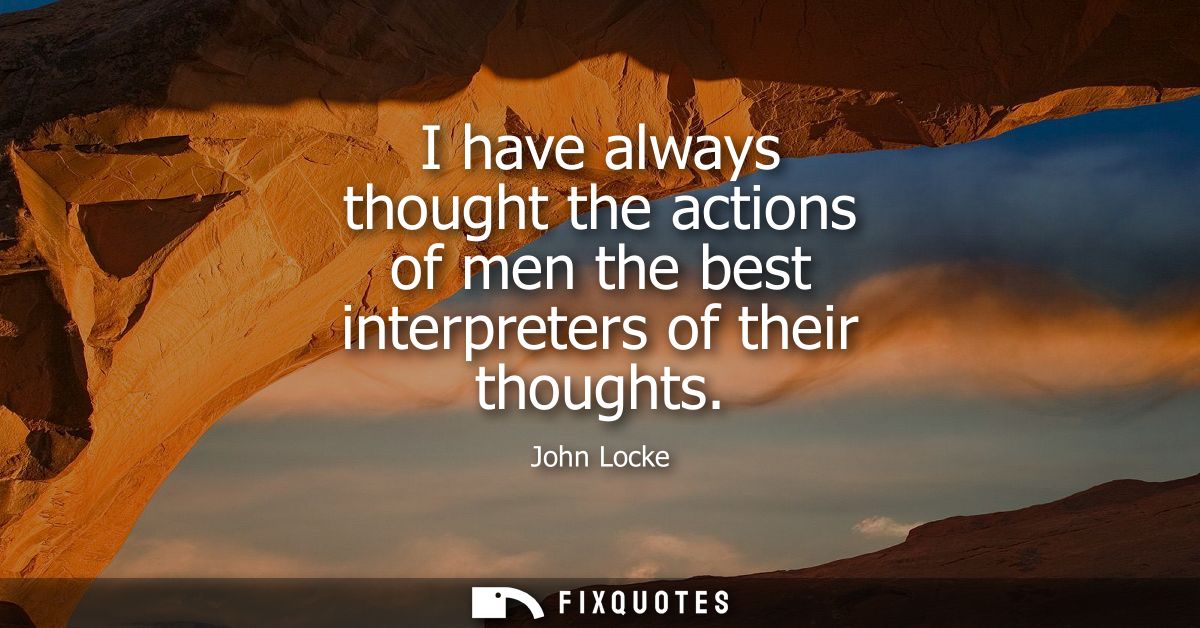
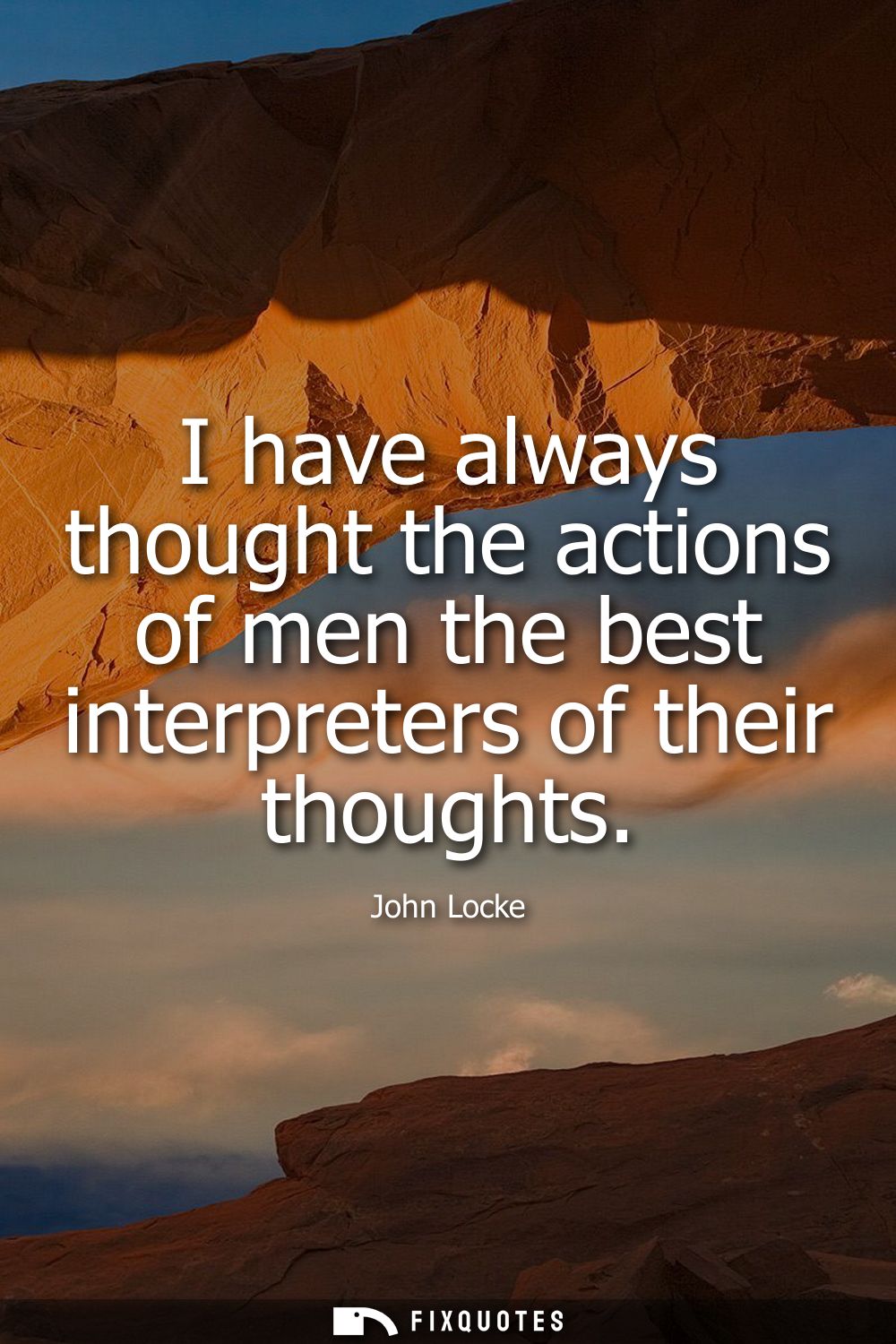
"I have always thought the actions of men the best interpreters of their thoughts"
About this Quote
The intent is also political. Writing in the wake of civil war, religious conflict, and the Stuart restoration, Locke’s liberal project depends on the possibility of judging citizens and rulers without pretending to read souls. A government can’t (and shouldn’t) police intentions; it can regulate acts. That’s one reason the sentence feels modern: it anticipates the liberal separation between belief and coercion, conscience and law.
Subtext: skepticism about self-knowledge and self-reporting. Locke’s empiricism treats the mind as something known through experience, not revelation. Even to oneself, “thoughts” are often post-hoc stories stitched to justify what desire or habit already chose. Action, by contrast, is where motives stop being theoretical and start taking shape in the world.
There’s an ethical sting here, too. Locke doesn’t let morality hide in interior purity. If your “principles” never materialize under inconvenience, they’re not principles; they’re décor. The line works because it’s both a method and a provocation: watch what people do when it matters, then you’ll know what they really believe.
Quote Details
| Topic | Wisdom |
|---|---|
| Source | Help us find the source |
| Cite | Cite this Quote |
Citation Formats
APA Style (7th ed.)
Locke, John. (n.d.). I have always thought the actions of men the best interpreters of their thoughts. FixQuotes. https://fixquotes.com/quotes/i-have-always-thought-the-actions-of-men-the-best-32133/
Chicago Style
Locke, John. "I have always thought the actions of men the best interpreters of their thoughts." FixQuotes. Accessed February 1, 2026. https://fixquotes.com/quotes/i-have-always-thought-the-actions-of-men-the-best-32133/.
MLA Style (9th ed.)
"I have always thought the actions of men the best interpreters of their thoughts." FixQuotes, https://fixquotes.com/quotes/i-have-always-thought-the-actions-of-men-the-best-32133/. Accessed 1 Feb. 2026.