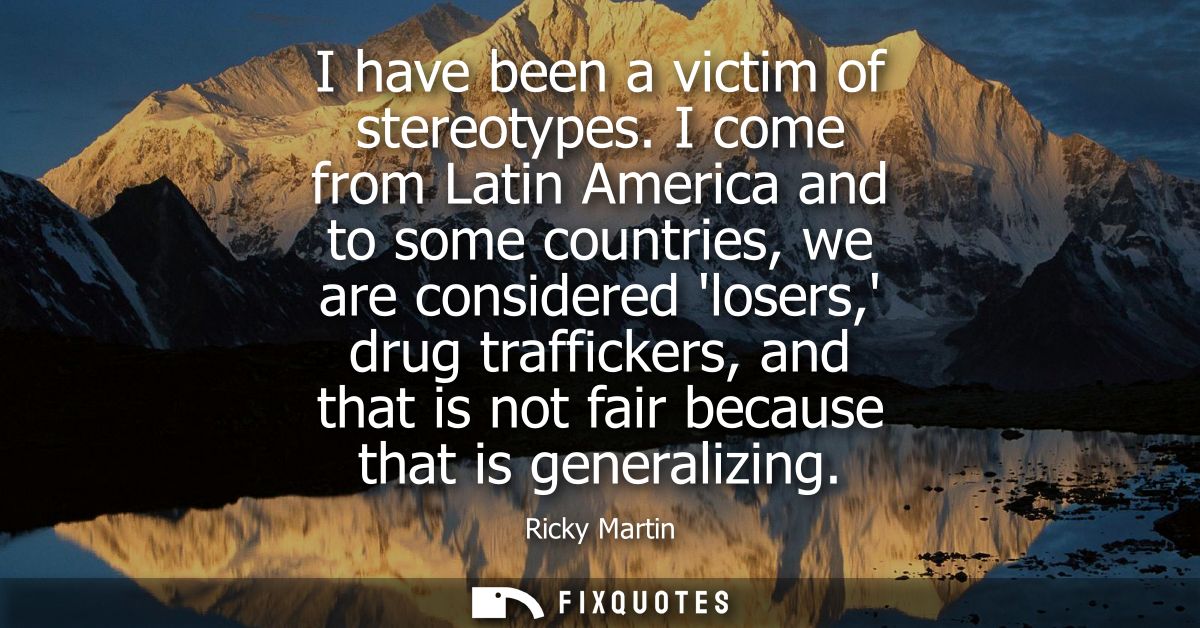
"I have been a victim of stereotypes. I come from Latin America, and to some countries, we are considered 'losers,' drug traffickers, and that is not fair because that is generalizing"
About this Quote
The key move is the pivot from “I” to “we.” He isn’t asking for individual sympathy; he’s widening the frame to collective harm, the way stigma operates at scale. “To some countries” is diplomatic but sharp: he’s pointing at power imbalances without turning the statement into a nationalist clapback. It implies a global gaze in which Latin America is perpetually on trial, evaluated by outsiders who feel entitled to reduce complexity to pathology.
Then he lands on “that is not fair because that is generalizing,” a phrase that sounds almost simple on purpose. It’s moral language anyone can understand, which matters coming from an artist whose reach is mainstream, cross-language, and commercially mediated. The subtext: Latin American identity is constantly translated for export, and stereotypes are the cheapest translation. Martin’s insistence on specificity is a demand to be seen as fully human - not as a “type” - and it doubles as a reminder that pop fame doesn’t insulate you from prejudice; it just gives you a microphone to name it.
Quote Details
| Topic | Equality |
|---|---|
| Source | Help us find the source |
| Cite |
Citation Formats
APA Style (7th ed.)
Martin, Ricky. (2026, February 16). I have been a victim of stereotypes. I come from Latin America, and to some countries, we are considered 'losers,' drug traffickers, and that is not fair because that is generalizing. FixQuotes. https://fixquotes.com/quotes/i-have-been-a-victim-of-stereotypes-i-come-from-152179/
Chicago Style
Martin, Ricky. "I have been a victim of stereotypes. I come from Latin America, and to some countries, we are considered 'losers,' drug traffickers, and that is not fair because that is generalizing." FixQuotes. February 16, 2026. https://fixquotes.com/quotes/i-have-been-a-victim-of-stereotypes-i-come-from-152179/.
MLA Style (9th ed.)
"I have been a victim of stereotypes. I come from Latin America, and to some countries, we are considered 'losers,' drug traffickers, and that is not fair because that is generalizing." FixQuotes, 16 Feb. 2026, https://fixquotes.com/quotes/i-have-been-a-victim-of-stereotypes-i-come-from-152179/. Accessed 18 Feb. 2026.