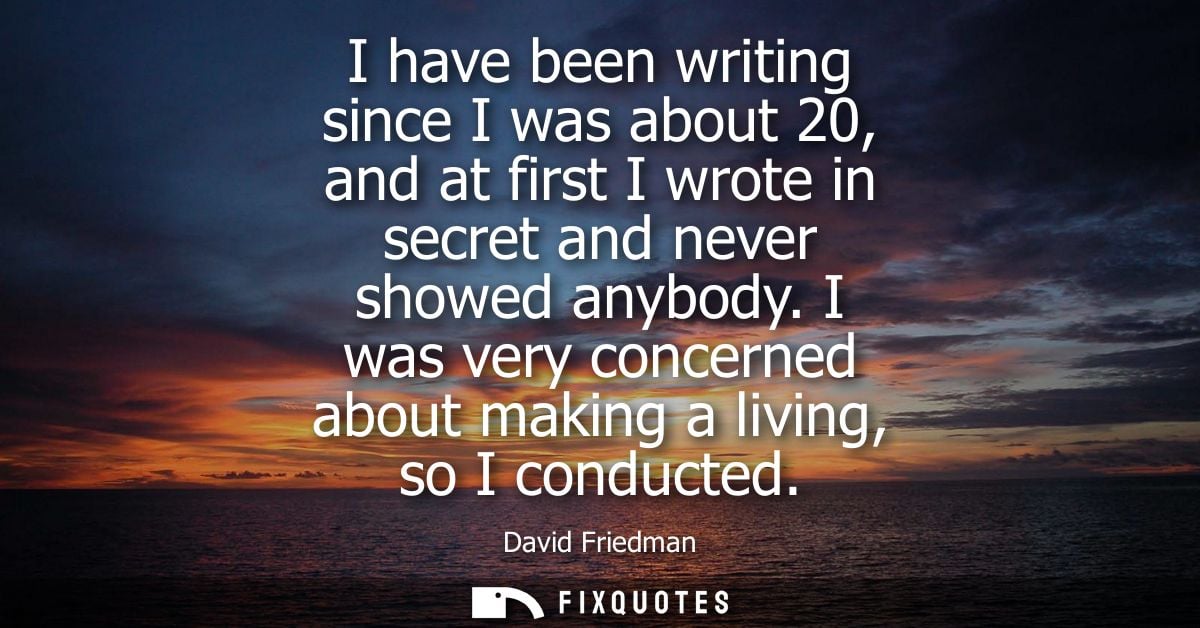
"I have been writing since I was about 20, and at first I wrote in secret and never showed anybody. I was very concerned about making a living, so I conducted"
About this Quote
The unfinished pivot - “I was very concerned about making a living, so I conducted” - is telling even in its truncation. Conducted what? A parallel life: day jobs, safer gigs, the respectable track. The grammar itself performs the split. One sentence holds the hidden art; the next begins to justify the compromise. That’s not hypocrisy; it’s the standard survival strategy in a culture that praises creativity while underwriting stability.
The intent reads as demystification. Friedman isn’t selling the myth of the fearless prodigy; he’s admitting to caution, even embarrassment, and then implying the long, incremental path from private practice to public work. The subtext is that artistry often arrives as a second language you teach yourself after hours, while your first language is security.
Context matters: a musician coming of age in the late 20th-century economy, where making art was admirable but not reliably employable. The quote works because it refuses the tidy arc. It catches the moment before the narrative turns inspirational - when writing is still a secret, and “making a living” is the loudest instrument in the room.
Quote Details
| Topic | Writing |
|---|---|
| Source | Help us find the source |
| Cite |
Citation Formats
APA Style (7th ed.)
Friedman, David. (2026, January 17). I have been writing since I was about 20, and at first I wrote in secret and never showed anybody. I was very concerned about making a living, so I conducted. FixQuotes. https://fixquotes.com/quotes/i-have-been-writing-since-i-was-about-20-and-at-47651/
Chicago Style
Friedman, David. "I have been writing since I was about 20, and at first I wrote in secret and never showed anybody. I was very concerned about making a living, so I conducted." FixQuotes. January 17, 2026. https://fixquotes.com/quotes/i-have-been-writing-since-i-was-about-20-and-at-47651/.
MLA Style (9th ed.)
"I have been writing since I was about 20, and at first I wrote in secret and never showed anybody. I was very concerned about making a living, so I conducted." FixQuotes, 17 Jan. 2026, https://fixquotes.com/quotes/i-have-been-writing-since-i-was-about-20-and-at-47651/. Accessed 12 Mar. 2026.