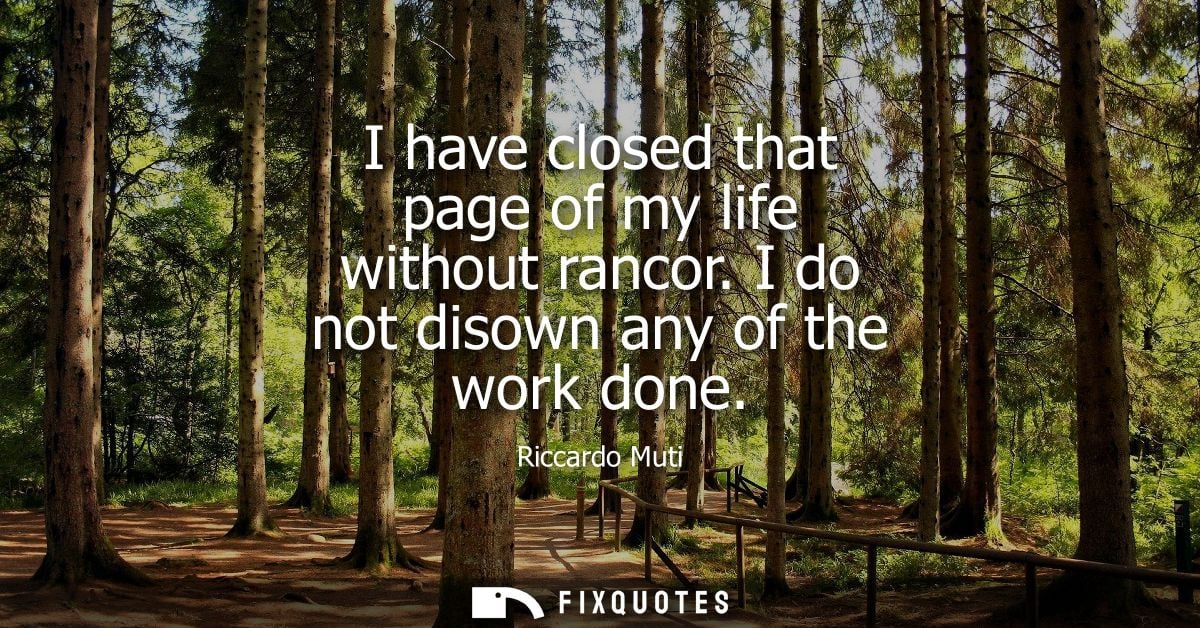
"I have closed that page of my life without rancor. I do not disown any of the work done"
About this Quote
The second sentence does the sharper work. “I do not disown any of the work done” turns what could be read as a break-up statement - with an institution, an orchestra, an era, a collaborator - into a claim of authorship. He won’t torch the archive to prove he’s moved on. That’s a subtle flex in a world where departures often come with revisionist history, where leaving is treated like a verdict on what came before. Muti rejects the tabloid logic that every ending must produce a villain.
The subtext: you can separate identity from affiliation. You can leave a chapter without declaring it a mistake. It’s also a way of protecting the people still inside that chapter; disowning the work would implicate colleagues, musicians, and audiences who built it with him. In classical music, legacy is a currency you can spend only once. Muti is cashing it carefully: no scorched earth, no apology tour, just a controlled cadence that keeps his authority intact while granting the past its due.
Quote Details
| Topic | Letting Go |
|---|---|
| Source | Help us find the source |
| Cite |
Citation Formats
APA Style (7th ed.)
Muti, Riccardo. (2026, January 15). I have closed that page of my life without rancor. I do not disown any of the work done. FixQuotes. https://fixquotes.com/quotes/i-have-closed-that-page-of-my-life-without-rancor-154037/
Chicago Style
Muti, Riccardo. "I have closed that page of my life without rancor. I do not disown any of the work done." FixQuotes. January 15, 2026. https://fixquotes.com/quotes/i-have-closed-that-page-of-my-life-without-rancor-154037/.
MLA Style (9th ed.)
"I have closed that page of my life without rancor. I do not disown any of the work done." FixQuotes, 15 Jan. 2026, https://fixquotes.com/quotes/i-have-closed-that-page-of-my-life-without-rancor-154037/. Accessed 10 Feb. 2026.