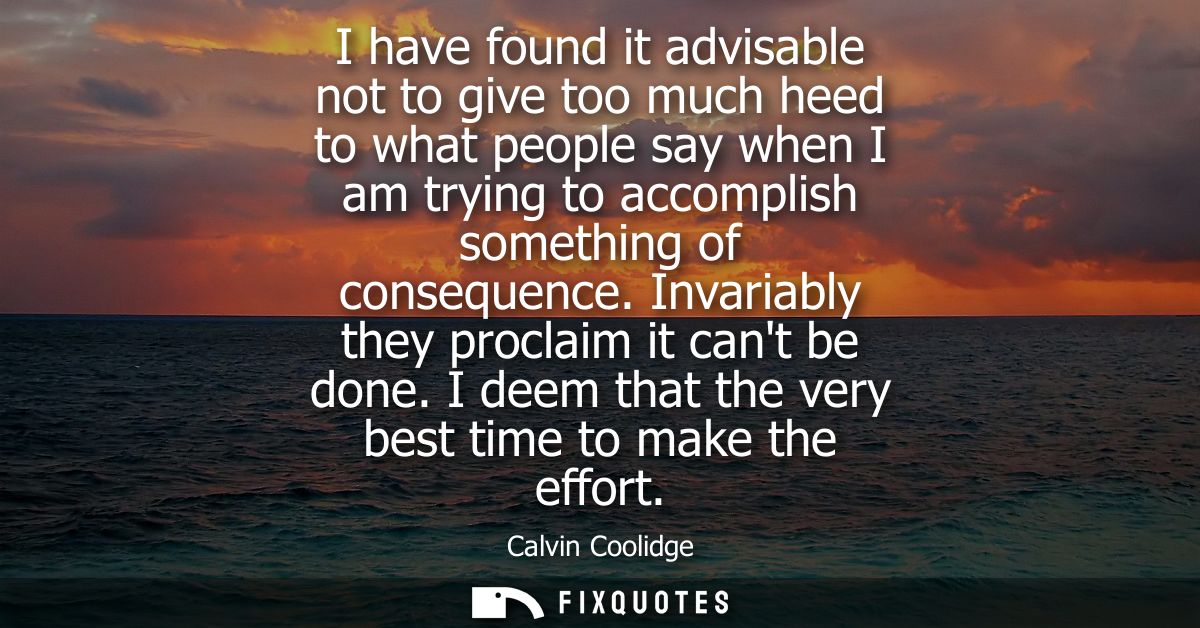
"I have found it advisable not to give too much heed to what people say when I am trying to accomplish something of consequence. Invariably they proclaim it can't be done. I deem that the very best time to make the effort"
About this Quote
The subtext is even sharper: consequential action rarely comes with a social permission slip. Coolidge isn’t claiming crowds are always mistaken on the merits; he’s arguing they’re reliable indicators of friction. When “people” say something can’t be done, he hears that it will be politically expensive, technically hard, or reputationally dangerous - which is precisely why it matters. The phrase “advisable not to give too much heed” reads like prudence, not bravado, letting him sound disciplined rather than defiant.
As a presidential voice from the 1920s, it also carries an insider’s awareness of how Washington and the press metabolize ambition: big projects invite instant vetoes from cynics, rivals, and the risk managers of the status quo. Coolidge’s rhetorical move is to treat that chorus as a timing mechanism. Skepticism becomes his signal to act, not because he’s addicted to contrarianism, but because consensus often arrives only after the breakthrough.
Quote Details
| Topic | Never Give Up |
|---|---|
| Source | Help us find the source |
| Cite |
Citation Formats
APA Style (7th ed.)
Coolidge, Calvin. (2026, January 17). I have found it advisable not to give too much heed to what people say when I am trying to accomplish something of consequence. Invariably they proclaim it can't be done. I deem that the very best time to make the effort. FixQuotes. https://fixquotes.com/quotes/i-have-found-it-advisable-not-to-give-too-much-30360/
Chicago Style
Coolidge, Calvin. "I have found it advisable not to give too much heed to what people say when I am trying to accomplish something of consequence. Invariably they proclaim it can't be done. I deem that the very best time to make the effort." FixQuotes. January 17, 2026. https://fixquotes.com/quotes/i-have-found-it-advisable-not-to-give-too-much-30360/.
MLA Style (9th ed.)
"I have found it advisable not to give too much heed to what people say when I am trying to accomplish something of consequence. Invariably they proclaim it can't be done. I deem that the very best time to make the effort." FixQuotes, 17 Jan. 2026, https://fixquotes.com/quotes/i-have-found-it-advisable-not-to-give-too-much-30360/. Accessed 12 Feb. 2026.