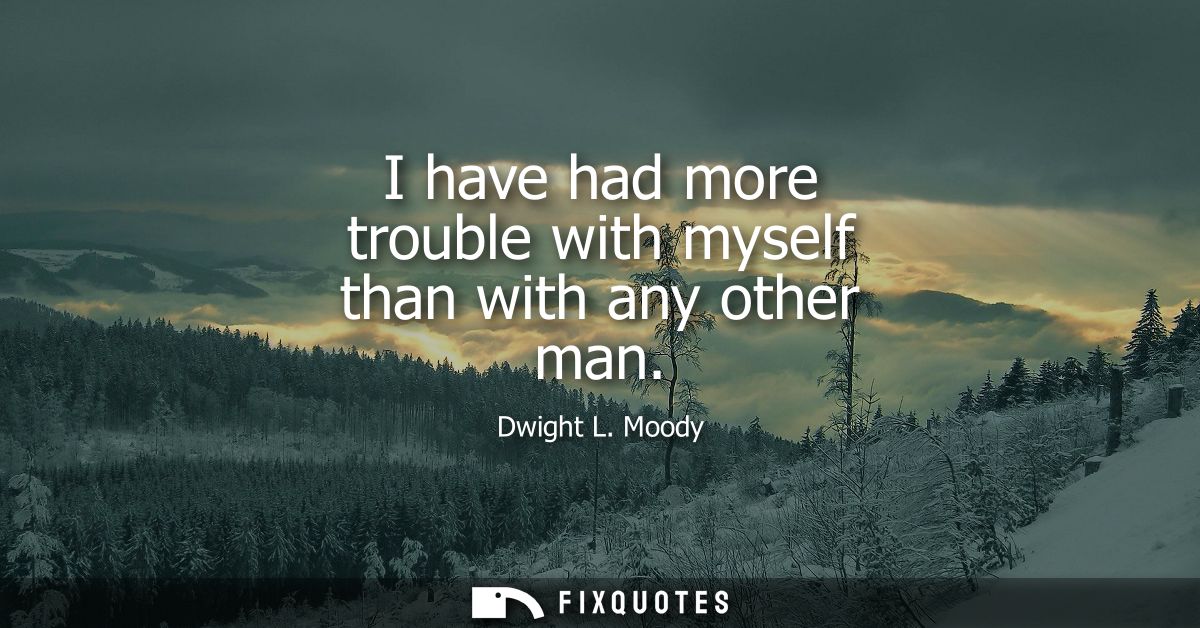
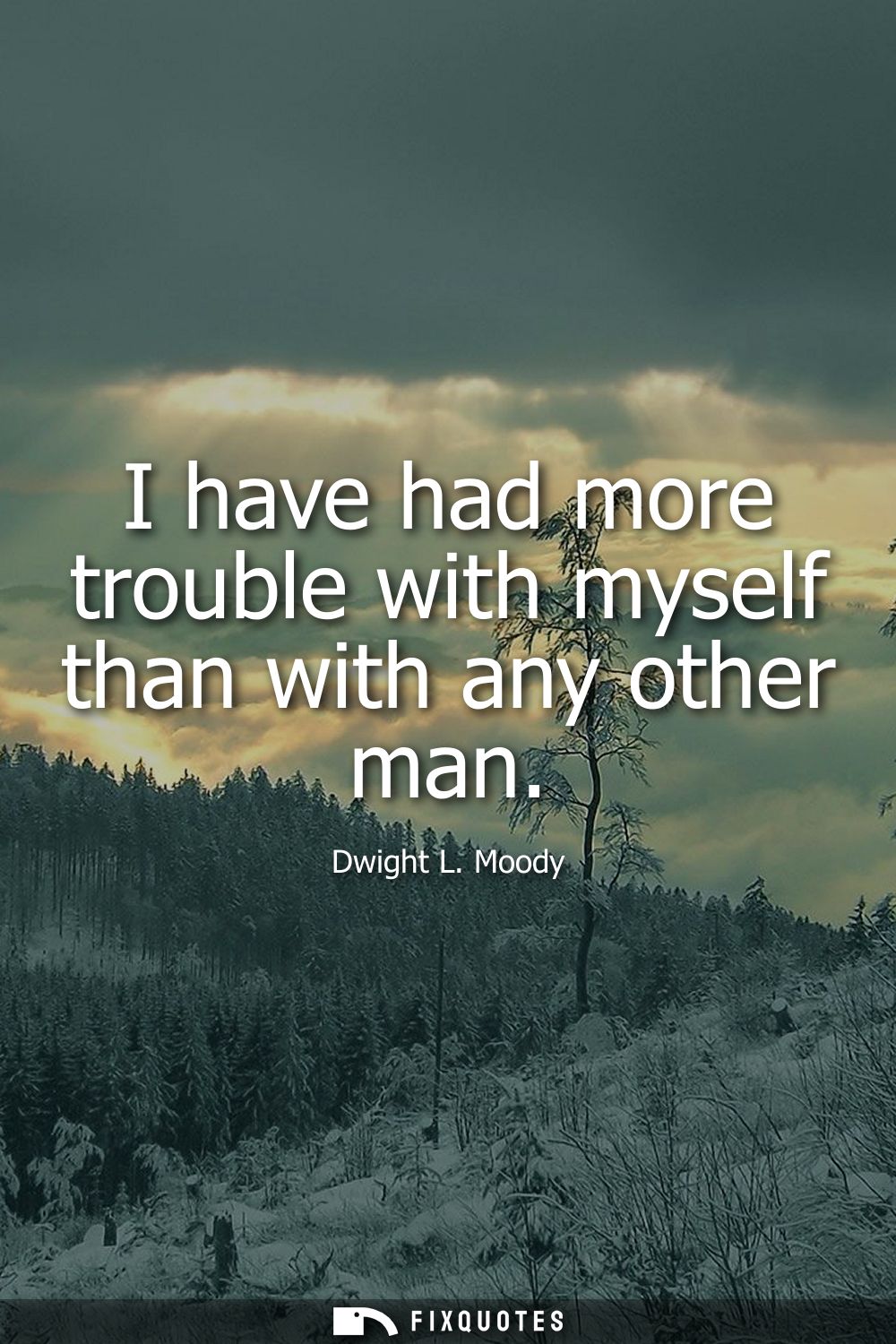
"I have had more trouble with myself than with any other man"
About this Quote
Self-conflict is Moody's stealth evangelism tactic: he makes the sinner in the room feel seen without ever naming them. "More trouble with myself than with any other man" is a plainspoken line that smuggles in a whole theology of human nature. The enemy isn't a cartoon villain or a corrupt society; it's the ordinary, intimate mess of impulse, pride, fear, and self-justification. Moody doesn't posture as a saint battling worldly foes. He frames sanctity as an unglamorous, daily labor of managing the person you can't escape.
The genius is the comparison. "Any other man" implies he's had plenty of dealings with others - conflict, disappointment, betrayal - yet the hardest opponent remains internal. That reverses the crowd's usual reflex to outsource blame. It's also a subtle democratizer: if even the famed revivalist can't conquer himself easily, your own struggle isn't disqualifying. It's the entry point.
Context matters. Moody rose in Gilded Age America, a period obsessed with self-making and moral certainty, when revival culture often rewarded public conviction and clear boundaries between the saved and the suspect. This line punctures that triumphalism. It's humility with teeth: a confession that pre-empts criticism ("You think I'm above you? I'm not") while reinforcing his message about sin as a condition, not a scandal.
The subtext is pastoral strategy. By centering inward "trouble", Moody turns religious life from performance to accountability. The battlefield is private; the stakes are eternal; the tone is disarmingly human.
The genius is the comparison. "Any other man" implies he's had plenty of dealings with others - conflict, disappointment, betrayal - yet the hardest opponent remains internal. That reverses the crowd's usual reflex to outsource blame. It's also a subtle democratizer: if even the famed revivalist can't conquer himself easily, your own struggle isn't disqualifying. It's the entry point.
Context matters. Moody rose in Gilded Age America, a period obsessed with self-making and moral certainty, when revival culture often rewarded public conviction and clear boundaries between the saved and the suspect. This line punctures that triumphalism. It's humility with teeth: a confession that pre-empts criticism ("You think I'm above you? I'm not") while reinforcing his message about sin as a condition, not a scandal.
The subtext is pastoral strategy. By centering inward "trouble", Moody turns religious life from performance to accountability. The battlefield is private; the stakes are eternal; the tone is disarmingly human.
Quote Details
| Topic | Self-Improvement |
|---|---|
| Source | Help us find the source |
| Cite |
Citation Formats
APA Style (7th ed.)
Moody, Dwight L. (2026, January 17). I have had more trouble with myself than with any other man. FixQuotes. https://fixquotes.com/quotes/i-have-had-more-trouble-with-myself-than-with-any-30942/
Chicago Style
Moody, Dwight L. "I have had more trouble with myself than with any other man." FixQuotes. January 17, 2026. https://fixquotes.com/quotes/i-have-had-more-trouble-with-myself-than-with-any-30942/.
MLA Style (9th ed.)
"I have had more trouble with myself than with any other man." FixQuotes, 17 Jan. 2026, https://fixquotes.com/quotes/i-have-had-more-trouble-with-myself-than-with-any-30942/. Accessed 7 Apr. 2026.
More Quotes by Dwight
Add to List