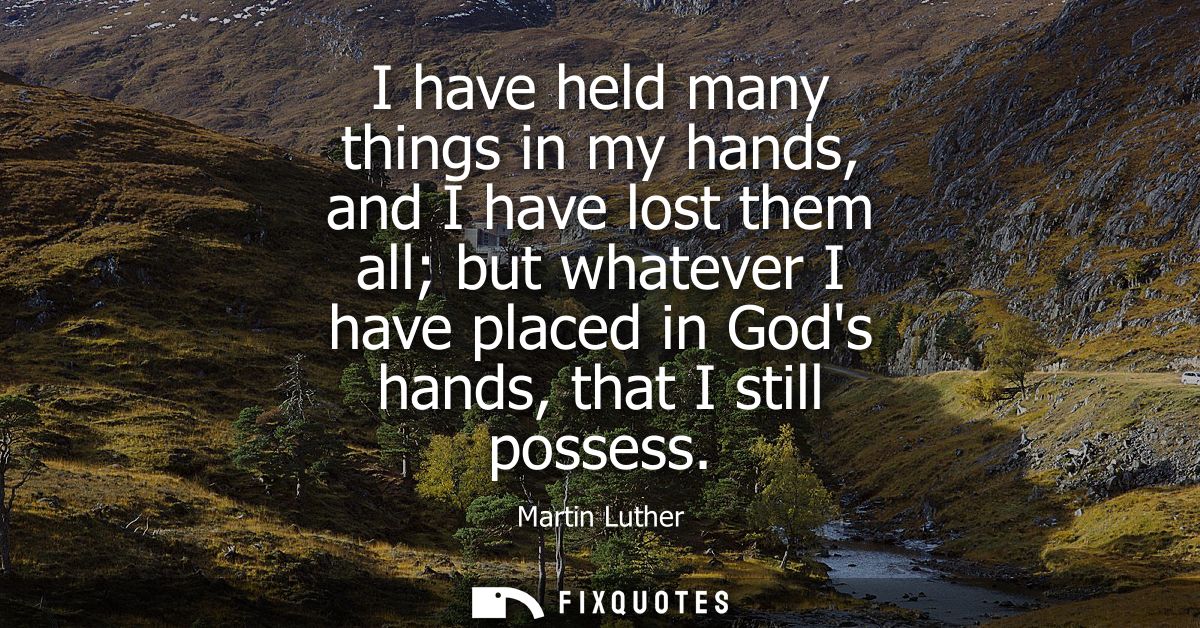
"I have held many things in my hands, and I have lost them all; but whatever I have placed in God's hands, that I still possess"
About this Quote
The intent is pastoral and polemical at once. Luther is selling an alternative economy, one that undercuts the anxious accumulation of late medieval piety and status. In a culture where salvation could feel like a ledger - penance, indulgences, relics, merits - he offers a different security: not control, but custody. "God's hands" does a lot of work. It's intimate (hands, not throne), but also absolute: the safest vault is the one you can't break into yourself.
The subtext is biography. Luther knew how quickly the tangible can evaporate: reputation, safety, career, even the stability of the church he was raised in. The Reformation made him both famous and hunted, and it forced a daily reckoning with loss as the price of conscience. Casting God as the only reliable holder also distances him from intermediaries. No saint, priest, or papal treasury here - just a direct deposit into divine care.
Rhetorically, the quote comforts by sounding like hard-won realism. It doesn't romanticize detachment; it admits loss, then turns that admission into a strategy for endurance.
Quote Details
| Topic | Faith |
|---|---|
| Source | Help us find the source |
| Cite |
Citation Formats
APA Style (7th ed.)
Luther, Martin. (2026, January 14). I have held many things in my hands, and I have lost them all; but whatever I have placed in God's hands, that I still possess. FixQuotes. https://fixquotes.com/quotes/i-have-held-many-things-in-my-hands-and-i-have-14061/
Chicago Style
Luther, Martin. "I have held many things in my hands, and I have lost them all; but whatever I have placed in God's hands, that I still possess." FixQuotes. January 14, 2026. https://fixquotes.com/quotes/i-have-held-many-things-in-my-hands-and-i-have-14061/.
MLA Style (9th ed.)
"I have held many things in my hands, and I have lost them all; but whatever I have placed in God's hands, that I still possess." FixQuotes, 14 Jan. 2026, https://fixquotes.com/quotes/i-have-held-many-things-in-my-hands-and-i-have-14061/. Accessed 13 Feb. 2026.