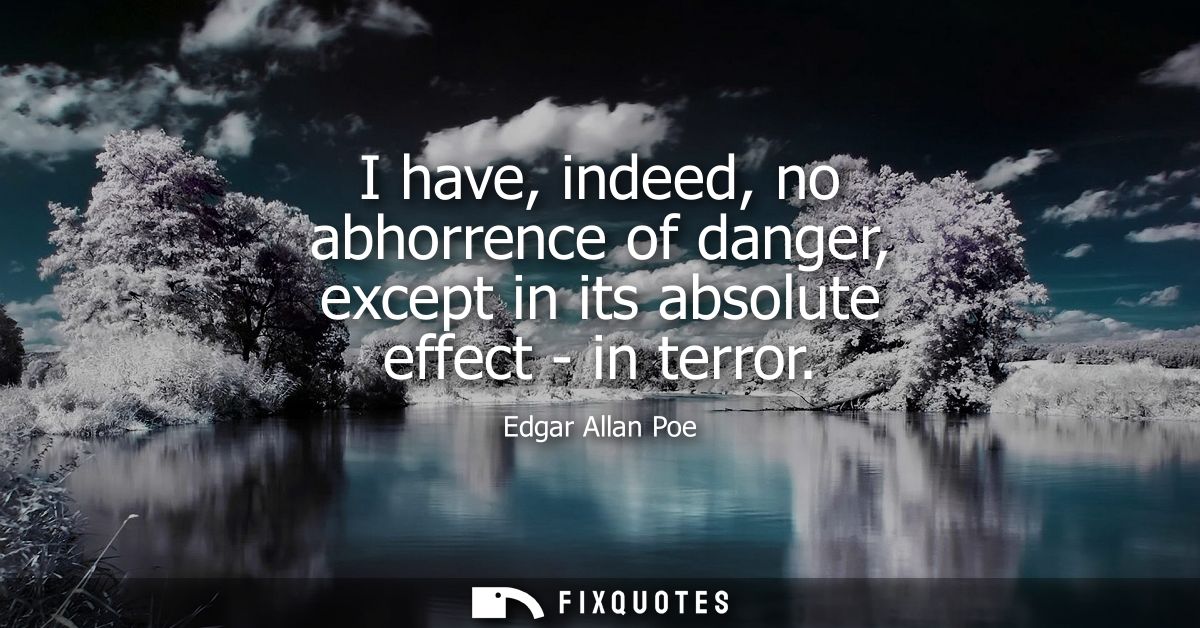
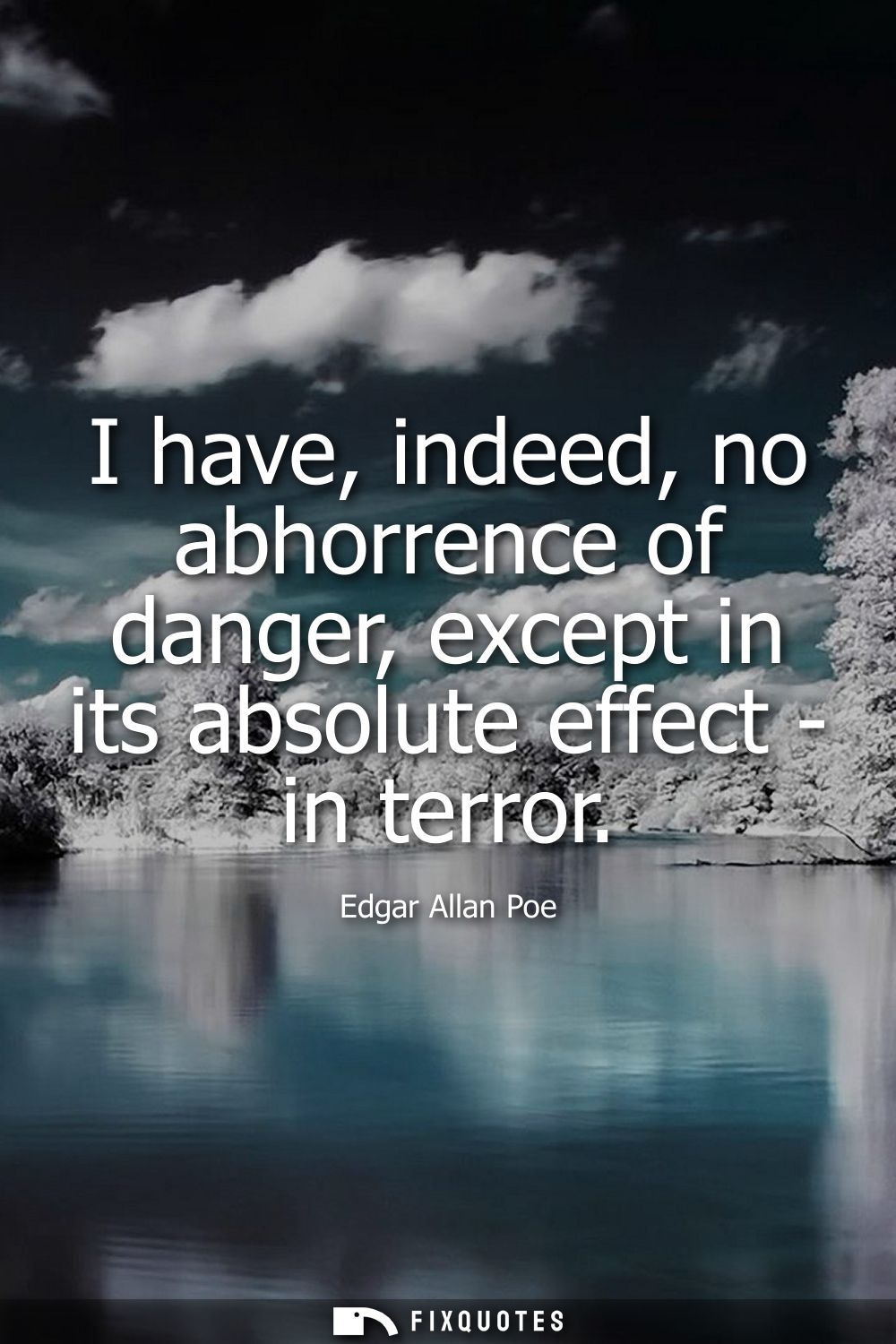
"I have, indeed, no abhorrence of danger, except in its absolute effect - in terror"
About this Quote
That’s the subtext Poe returns to across his fiction and poetry: the external world isn’t the real horror. The real horror is the psyche under stress, when perception buckles and the self becomes an unreliable witness. In that sense, “danger” is manageable, even thrilling; “terror” is the irreversible state change, the moment suspense curdles into panic and the body becomes its own antagonist.
Context matters because Poe wrote in an America fascinated by scientific reason and mesmerism, policing emotion even as it consumed sensational literature. He weaponizes that tension. The speaker sounds like an empiricist explaining his thresholds, but the rhetoric betrays obsession: “absolute effect” implies terror is measurable, inevitable, almost chemical. It’s a refusal of heroic stoicism and a blueprint for modern psychological horror, where the scariest room is the one inside your skull.
Quote Details
| Topic | Fear |
|---|---|
| Source | Help us find the source |
| Cite |
Citation Formats
APA Style (7th ed.)
Poe, Edgar Allan. (2026, January 15). I have, indeed, no abhorrence of danger, except in its absolute effect - in terror. FixQuotes. https://fixquotes.com/quotes/i-have-indeed-no-abhorrence-of-danger-except-in-13914/
Chicago Style
Poe, Edgar Allan. "I have, indeed, no abhorrence of danger, except in its absolute effect - in terror." FixQuotes. January 15, 2026. https://fixquotes.com/quotes/i-have-indeed-no-abhorrence-of-danger-except-in-13914/.
MLA Style (9th ed.)
"I have, indeed, no abhorrence of danger, except in its absolute effect - in terror." FixQuotes, 15 Jan. 2026, https://fixquotes.com/quotes/i-have-indeed-no-abhorrence-of-danger-except-in-13914/. Accessed 1 Mar. 2026.