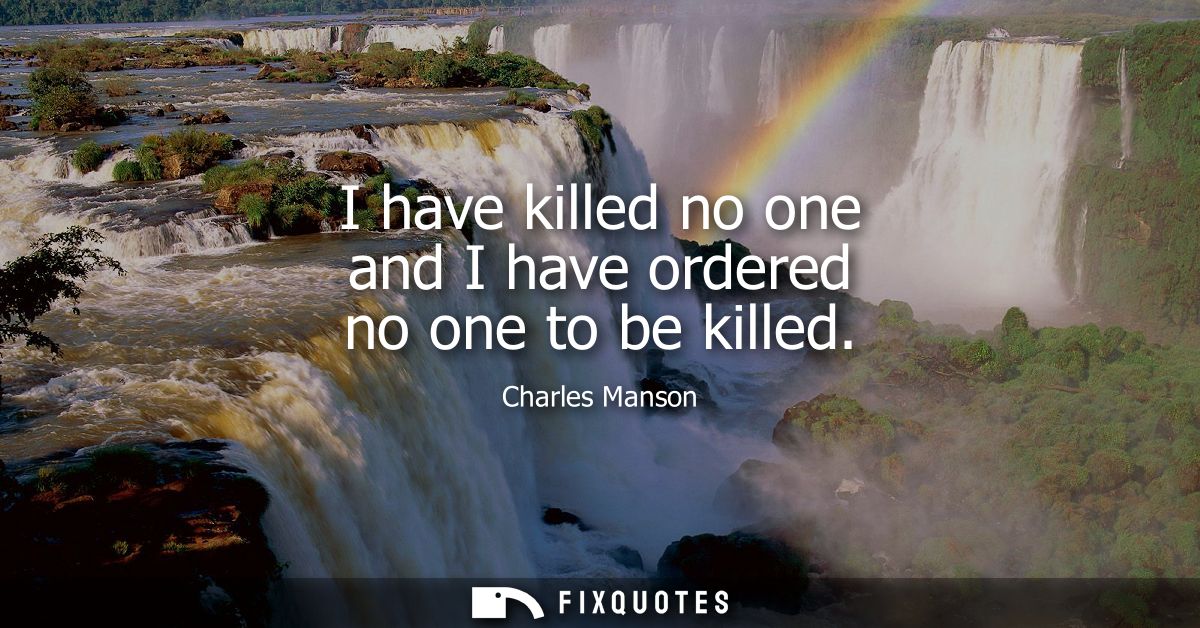
"I have killed no one and I have ordered no one to be killed"
About this Quote
A sentence like this is built to sound like a clean exit ramp: crisp, technical, and morally evacuated. Manson isn’t arguing innocence in any human sense; he’s arguing a narrow category error. By separating “killed” from “ordered,” he tries to relocate guilt from action to interpretation, from blood to bureaucracy. It’s the grammar of evasion: two clauses, two denials, a tidy symmetry that performs reasonableness while refusing responsibility.
The specific intent is strategic. In court and in the public imagination, murder is the undeniable thing. Conspiracy and incitement are murkier, easier to cast as narrative, misunderstanding, or media hysteria. Manson aims for that fog. He frames himself as adjacent to violence rather than causative, as if influence were a passive condition rather than a deliberate instrument.
The subtext is a power play disguised as defensiveness. Even in denial, he is reminding you of the central fact of his mythology: people killed for him, around him, in his name. The claim tries to preserve the cult-leader posture (I’m not a thug; I’m a thinker) while dodging the legal logic that made him culpable: directing, manipulating, and scripting the actions of followers.
Context does the rest. The Tate-LaBianca murders weren’t just crimes; they were a cultural wound, televised as a collapse of ’60s idealism into spectacle and terror. This line weaponizes that spectacle, betting that Americans raised on lone-gunman stories will struggle with a more modern villain: the man who doesn’t pull the trigger, but makes the trigger feel inevitable.
The specific intent is strategic. In court and in the public imagination, murder is the undeniable thing. Conspiracy and incitement are murkier, easier to cast as narrative, misunderstanding, or media hysteria. Manson aims for that fog. He frames himself as adjacent to violence rather than causative, as if influence were a passive condition rather than a deliberate instrument.
The subtext is a power play disguised as defensiveness. Even in denial, he is reminding you of the central fact of his mythology: people killed for him, around him, in his name. The claim tries to preserve the cult-leader posture (I’m not a thug; I’m a thinker) while dodging the legal logic that made him culpable: directing, manipulating, and scripting the actions of followers.
Context does the rest. The Tate-LaBianca murders weren’t just crimes; they were a cultural wound, televised as a collapse of ’60s idealism into spectacle and terror. This line weaponizes that spectacle, betting that Americans raised on lone-gunman stories will struggle with a more modern villain: the man who doesn’t pull the trigger, but makes the trigger feel inevitable.
Quote Details
| Topic | Justice |
|---|---|
| Source | Help us find the source |
| Cite |
Citation Formats
APA Style (7th ed.)
Manson, Charles. (2026, January 17). I have killed no one and I have ordered no one to be killed. FixQuotes. https://fixquotes.com/quotes/i-have-killed-no-one-and-i-have-ordered-no-one-to-52004/
Chicago Style
Manson, Charles. "I have killed no one and I have ordered no one to be killed." FixQuotes. January 17, 2026. https://fixquotes.com/quotes/i-have-killed-no-one-and-i-have-ordered-no-one-to-52004/.
MLA Style (9th ed.)
"I have killed no one and I have ordered no one to be killed." FixQuotes, 17 Jan. 2026, https://fixquotes.com/quotes/i-have-killed-no-one-and-i-have-ordered-no-one-to-52004/. Accessed 1 Apr. 2026.
More Quotes by Charles
Add to List