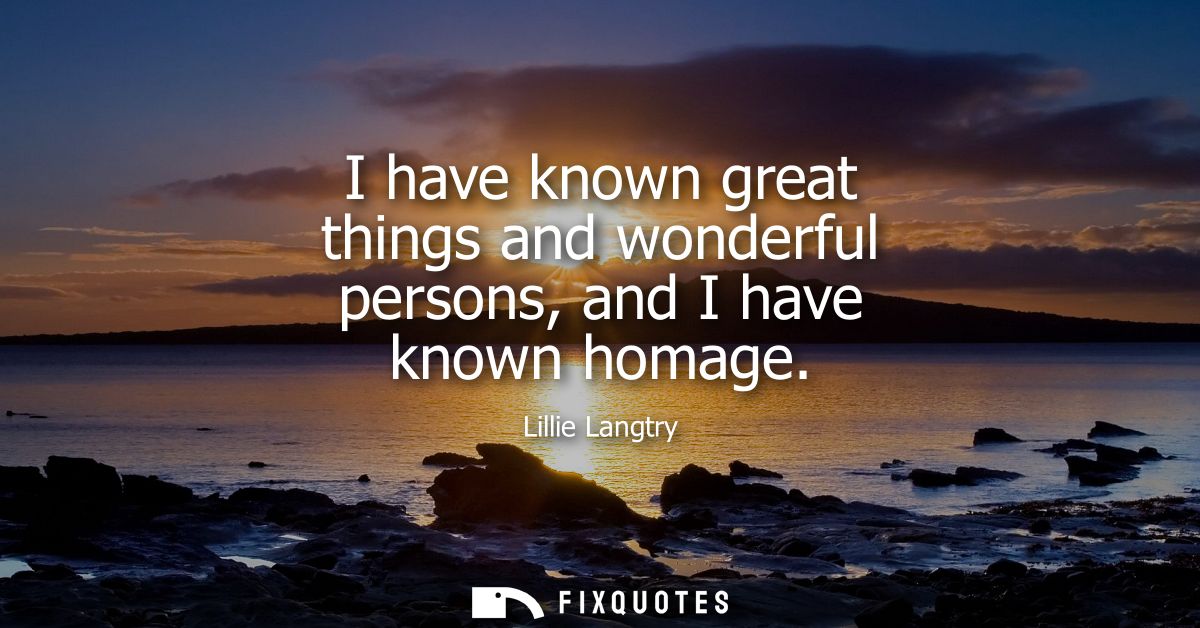
"I have known great things and wonderful persons, and I have known homage"
About this Quote
For a woman whose public identity was built in the late Victorian celebrity machine - photographed, gossiped about, appraised like an artwork - “homage” doubles as brag and critique. She’s not just claiming she met the important people; she’s saying she has been treated as important. Yet the phrasing keeps it oddly detached, as if she’s cataloging experiences the way society cataloged her: seen, acclaimed, consumed.
The subtext is a knowing admission about power and its price. Homage is flattering, but it’s also a transaction: the audience offers devotion, the icon offers access (or the illusion of it). Langtry’s intent feels less like self-mythologizing than self-accounting - a performer noting that her life included not only remarkable encounters but also the strange, sometimes lonely phenomenon of being elevated into a symbol.
It works because it compresses an entire cultural moment into one sharp word: homage as the Victorian prototype of modern celebrity worship, with all its glamour and its faint aftertaste of emptiness.
Quote Details
| Topic | Life |
|---|---|
| Source | Help us find the source |
| Cite |
Citation Formats
APA Style (7th ed.)
Langtry, Lillie. (2026, January 16). I have known great things and wonderful persons, and I have known homage. FixQuotes. https://fixquotes.com/quotes/i-have-known-great-things-and-wonderful-persons-120432/
Chicago Style
Langtry, Lillie. "I have known great things and wonderful persons, and I have known homage." FixQuotes. January 16, 2026. https://fixquotes.com/quotes/i-have-known-great-things-and-wonderful-persons-120432/.
MLA Style (9th ed.)
"I have known great things and wonderful persons, and I have known homage." FixQuotes, 16 Jan. 2026, https://fixquotes.com/quotes/i-have-known-great-things-and-wonderful-persons-120432/. Accessed 9 Feb. 2026.